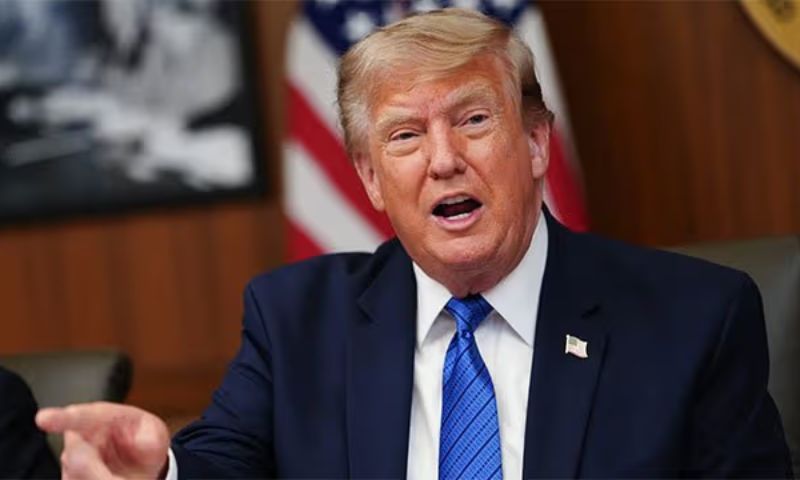
WASHINGTON: US President Donald Trump said Monday he would seek conflict compensation from Iran as part of any future peace negotiations, citing attacks and “atrocities” stretching back decades allegedly backed or perpetrated by Iran.
In a post on his Truth Social platform, Trump said Iranian representatives had raised the issue of compensation for damage caused during the conflict, despite it not having been discussed in previous negotiations or meetings.
Iran is “asking for compensation for the damage done to them during the last five months Military Conflict… I am likewise demanding compensation from Iran, for all of the people that they have killed and gravely wounded with their roadside bombs and many conflicts,” Trump posted.
Trump said he viewed the Iranian demand as an “interesting idea” and would respond by seeking compensation from Iran for people he said had been killed or seriously wounded in attacks and conflicts involving the country.
— Rapid Response 47 (@RapidResponse47) August 10, 2026
Trump said he was also seeking compensation for the families of Iranian protesters whom he said had been killed over the past five decades. He further cited what he described as 52,000 people killed in Iran during the past five months.
“I have instructed my representatives to put this firmly into any, and all, future negotiations,” Trump said.
The demand comes as Iran pushes to reopen the Strait of Hormuz, conditioning any off-ramp on compensation and other concessions.
Trump’s ultimatum follows reports that Iranian representatives are seeking damages from the five-month regional war the US and Israel began on February 28.
US-Iran negotiations
Trump last week threatened to hit Iran “very hard”, potentially with attacks against civilian infrastructure, only to pull back, hinting a peace deal was near.
His latest comments on Truth Social came a day after Trump said he was “low-keying” his approach to the conflict, suggesting that he was prepared to let economic pressure mount in place of further military strikes.
Digital media outlet Axios said that the US President did not express any frustration with Iran’s delaying an agreement to open the Strait of Hormuz in their interview with him published Sunday.
Tehran has demanded that the US first end its blockade of Iranian ports and lift sanctions on its oil industry.
As negotiations have stalled, the strait’s blockage by Iran has sent fuel prices soaring and rattled the world economy, putting pressure on Trump ahead of midterm elections in November.
US, Iran continue exchanging messages
On Monday, Iranian Foreign Ministry spokesman Esmaeil Baqaei said that the US and Iran are exchanging messages through intermediaries as efforts intensify to revive negotiations.
Baqaei said messages were being exchanged on current issues through mediators but stressed that this did not amount to negotiations between Tehran and Washington.
“Of course, it is natural to exchange messages through mediators on current issues, but what the next step will be depends on the circumstances,” Baqaei said, according to Iran’s state news agency IRNA.
“Currently, we are focused on negotiations with Oman to determine the shipping route,” he added.
Also Read: US, Iran Continue Exchanging Messages Through Mediators: Tehran
Iranian Foreign Minister Abbas Araghchi had made a similar distinction on Sunday, saying the two sides were not negotiating but were exchanging messages through intermediaries.
“This is not called ‘negotiation’, it’s an ‘exchange of messages’,” Araghchi said.
Pakistan and Qatar are mediating between Tehran and Washington in efforts to revive talks under the Islamabad Memorandum of Understanding (MoU) framework to permanently end the conflict through diplomacy and dialogue.
Talks on Hormuz shipping arrangements
Currently, Iran and Oman are holding talks on arrangements for shipping through the Strait of Hormuz.
Baqaei said the discussions were proceeding in a “very smooth and constructive manner”, according to IRNA.
He said an understanding had already been reached on a traffic map, while technical issues related to a joint statement were still being discussed.
Baqaei said the talks were not currently focused on how any transit fee would be divided between Iran and Oman.
“What is clear is that mechanisms will be created that, in addition to monitoring the safe passage of shipping through the Strait of Hormuz, will provide cooperation on environmental issues, provide maritime services, and combat crime,” he said.
He added that maritime services would normally require compensation.
Baqaei also stressed that the discussions with Oman over a safe shipping route were separate from the broader question of reopening the Strait of Hormuz.
He said the waterway remained insecure because of what Tehran describes as violations by the United States, including an ongoing naval blockade.
Tehran sets conditions for reopening
Iranian officials have said that a safe and lasting reopening of the strategic waterway would require the United States to address what Tehran considers violations of the Islamabad MoU.
Baqaei said the current negotiations with Oman were focused on establishing a safe shipping route and were separate from the issue of reopening the strait.
“The Strait of Hormuz is insecure for other reasons,” he said, adding that resolving the situation would require addressing US actions, including the naval blockade of Iranian ports.
Araghchi said on Sunday that an agreement between Iran and Oman on the strait was in its “final stages”, but warned that it would not immediately reopen the waterway to shipping.
According to Mehr news agency, Araghchi said the agreement would establish new shipping lanes to be used once the United States fulfilled other conditions and the strait was reopened.
Iran has also demanded compensation for war damage, the lifting of the US naval blockade, an end to sanctions and the release of frozen Iranian assets, according to Tasnim news agency.
Oil markets watch Hormuz developments
Oil prices were little changed on Monday after earlier gains faded as Iran’s conditions for reopening the Strait of Hormuz tempered expectations of a swift agreement, Reuters reported.
Brent crude futures stood at $83.54 a barrel, down 1%, by 11:43 a.m. PKT. US West Texas Intermediate crude was down 15 cents, or 0.2%, at $78.03 a barrel.
Both benchmarks had fallen more than 7% the previous week on hopes that Iran and Oman were close to reaching an agreement that could lead to the reopening of the waterway.
The Strait of Hormuz is a critical global energy route. It carried about a fifth of the world’s oil before the conflict.
The diplomatic efforts have continued amid repeated incidents involving commercial shipping in the strait.
Pakistan and Qatar intensify mediation
Pakistan and Qatar have intensified diplomatic efforts to create conditions for the resumption of formal negotiations between Washington and Tehran.
Iran said on Monday that Pakistan is playing a central role in mediation between Washington and Tehran.
Baqaei said invitations extended by Pakistan to Iranian Parliament Speaker Mohammad Bagher Ghalibaf and Foreign Minister Abbas Araghchi to visit Islamabad would be taken up when the time was right.
“The relationship between Iran and Pakistan is a very important one,” he said, describing such visits as a natural part of the close relationship between the two neighbours.
Pakistan has been the principal mediator between Iran and the United States after helping secure a ceasefire on April 8 and hosting high-level talks between the two sides in Islamabad on April 12 and 13.
Under the Islamabad MoU, Iran and the United States committed to halt military operations, reopen the Strait of Hormuz to commercial shipping and negotiate a comprehensive agreement covering Iran’s nuclear programme, US sanctions and a permanent ceasefire within 60 days.
Pakistan and Qatar later co-mediated the first round of high-level talks in Lucerne, Switzerland, on June 21. The meeting was attended by Vance and Ghalibaf.
Following the talks, Pakistan and Qatar said significant progress had been made in diplomatic efforts between Washington and Tehran.