
Key points
- Retail investors bought $22.7 million of SpaceX shares
- Stock fell 12.9 per cent after earnings
- Heavy AI spending remains a key investor concern
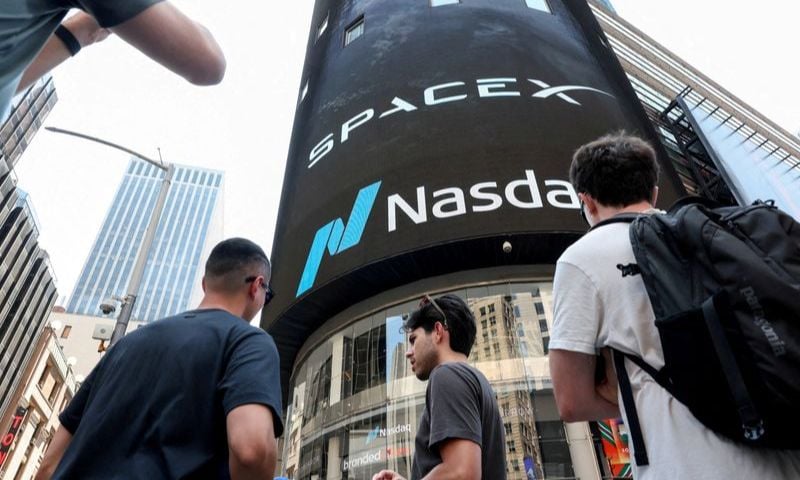
ISLAMABAD: Retail investors have stepped up purchases of SpaceX shares after the Elon Musk-led company suffered a sharp post-earnings sell-off, betting that the decline offers an opportunity to buy into one of the world’s most closely watched technology companies at a lower price.
Individual investors bought a net $22.7 million of SpaceX shares during the first hour of trading on Friday, according to Vanda Research data cited by Reuters. That marked the third-highest first-hour retail purchase total since the company’s initial public offering (IPO) in June.
The buying came after SpaceX shares fell 12.9 per cent following the company’s first earnings report as a publicly traded business. The fall indicated investor concerns over its rapidly rising spending on artificial intelligence (AI) and infrastructure.
Retail investors have remained persistent buyers since SpaceX went public. According to Vanda Research, retail investors recorded net purchases of the stock on every trading day since the IPO.
The latest buying could potentially become the second-largest day of net retail purchases since SpaceX’s market debut.
SpaceX’s earnings themselves were not uniformly weak. The company reported a net loss of $541 million, or 9 cents a share, for the quarter ended in June. However, the loss was substantially smaller than analysts had expected. Revenue surged 90 per cent from a year earlier to $7.8 billion.
ALSO READ: SpaceX Rocket Stage Believed to Have Crashed Into Moon
Its connectivity business, led by Starlink, remained a major source of growth. Starlink’s subscriber base doubled to 12 million during the period, helping connectivity revenue rise 66 per cent year-on-year.
The main concern for investors was the scale of SpaceX’s spending. Research and development and infrastructure expenditure increased to about $18 billion from less than $3 billion a year earlier.
SpaceX executives have indicated that elevated spending is likely to continue. They added to concerns across the technology sector that companies are committing enormous sums to AI before the financial returns from those investments have fully materialised.
SpaceX defends spending
The spending has nevertheless been defended by Musk, who has argued that investment in AI and infrastructure will accelerate the company’s growth and help hit an annual revenue of $1 trillion by 2030.
The stock declined against the backdrop of a major change in its shareholder structure. More than 900 million shares became eligible for trading on Thursday as the first lock-up period following the IPO expired.
The release more than doubled the amount of stock previously available for trade, creating concerns that employees and early investors could increase selling pressure.
Those concerns initially contributed to a nearly 14 per cent fall in shares on Thursday. Yet the stock rebounded 6.1 per cent on Friday to close at $114.92, indicating that investors were prepared to absorb the additional supply.
The rebound also reinforced the view among some analysts that the sell-off had created an attractive entry point.
Morgan Stanley analyst Adam Jonas described the lock-up expiry as an opportunity to buy the shares at a discount and projected that SpaceX could reach $300 by mid-2027.
The shares have experienced extreme volatility since its June IPO, which was the largest public offering in history.
The stock initially surged from its $135 offering price to more than $225 before subsequently losing much of those gains.
The latest retail buying suggests that the company’s individual investor base remains willing to look beyond short-term volatility and focus on its longer-term prospects in satellite communications, launch services and AI.
However, the competing forces of strong revenue growth, massive capital expenditure and newly available insider shares are likely to keep it volatile as investors assess whether Musk’s ambitious plans can generate returns commensurate with the company’s valuation.