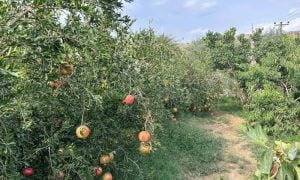



HYDERABAD, Pakistan: For Syed Nadeem Shah — a seasoned mango grower in his late 60s — it was a day well spent. He took out time with his friends to drop by the mango orchard of fellow grower Imdad Nizamani in Tando Soomro, a town 47 kilometres east of Hyderabad in lower Sindh.
Tando Soomro falls in Tando Allahyar district — a region known for its highly fertile land where the commercial value of agricultural acreage is quite high.
“Commercial value of land is usually measured by its location in addition to its soil fertility. Tando Allahyar is indeed known for fertile land, but that doesn’t mean that land across Tando Allahyar district will fetch a heavy per-acre price,” says Mahmood Nawaz Shah, president of Sindh Abadgar Board (SAB), who accompanied Nadeem to Nizamani’s farm.
“Usually, such a piece of land involves a price of Rs5 million to Rs6 million an acre,” Shah says.
Tando Allahyar is part of the core belt famed for Sindhri — the undisputed identity of Sindh for its juicy pulp — which leads the region’s vast mango portfolio.
A bitter harvest
This year’s mango season is at its fag end, and the mood among the growers remains sombre.
Nizamani is a leading grower in Sindh’s agriculture landscape. He not only manages his orchard personally but also handles direct marketing through modern farm management. He adopted advanced techniques originally learned under the Pakistan-Australia Agricultural Cooperation project in 2006.
“This season proved to be disastrous for many mango growers. Almost every grower I spoke to complained of malformation and pests that severely affected crops,” he remarks.
Nadeem readily admits that he and his peers gained valuable input from Nizamani despite being experienced orchard owners themselves. “It was a great learning experience and knowledge-sharing opportunity insofar as farm practices are concerned,” Nadeem observes.
“We want to ward off the threat of fungus and disease afflicting our mangoes. Pests coupled with disease have been severely damaging for mangoes”
Pakistan’s mango heartland
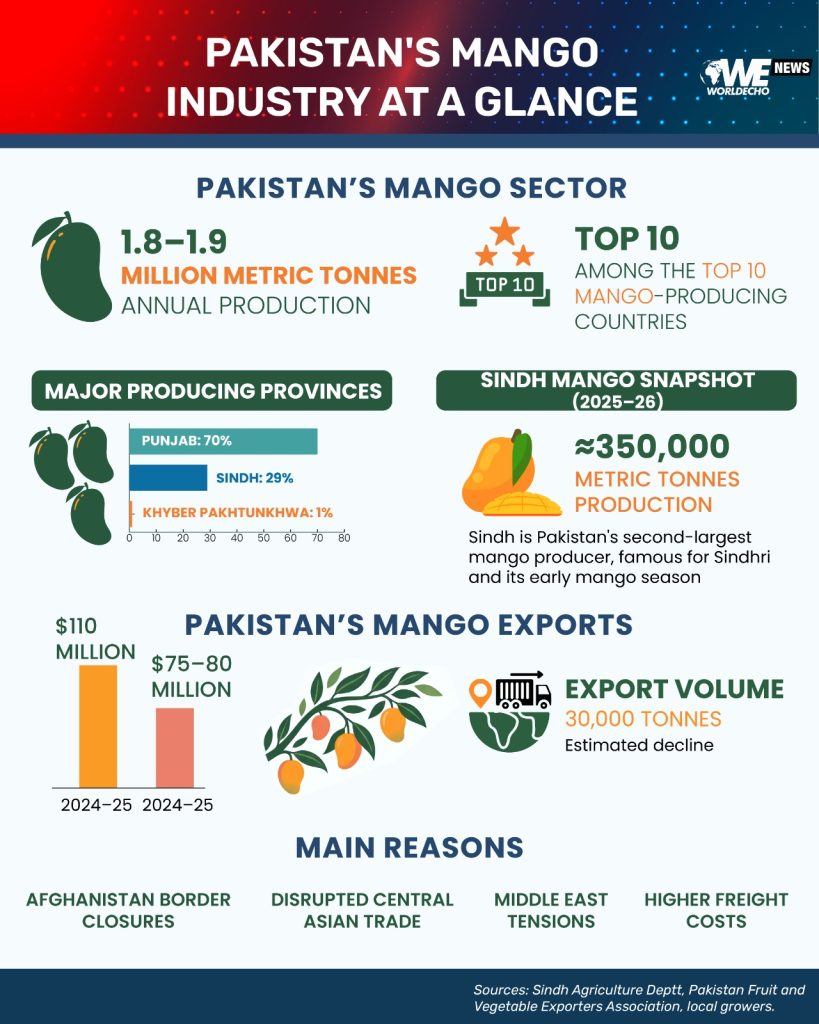
Pakistan’s annual mango production invariably stands between 1.8 million and 1.9 million metric tonnes, placing the country consistently among the world’s top ten mango producers.
Punjab leads national output with approximately a 70 per cent share, while Sindh contributes 29 per cent and Khyber Pakhtunkhwa accounts for around 1 per cent.
In terms of regional volume, the Sindh Agriculture Department recorded production figures of around 350,000 metric tonnes for the 2025–26 season.
Sindh makes the second-largest contribution to both national production and exports. Almost all major commercial varieties are cultivated across the province, but Sindhri tops overall yields.
Because of favourable Southern weather, Pakistan’s mango season begins in lower Sindh — a timing advantage mirrored by major field crops like cotton and wheat. A mango tree passes through distinct growth stages: early flowering appears on stems by late winter, followed by fruit setting around February. The developing fruit becomes kairi (unripe mangoes) by March, before the fruit is ready for picking by early May.
June, however, remains the recommended window for harvesting Sindhri, as the fruit reaches full maturity, taste, colour, and size by then. Farmers often pick earlier to capitalise on premium early-market prices, according to Nadeem Shah.
Trade routes choked
The 2025–26 season proved particularly rough for producers. Batoor — the local term for mango malformation — took a heavy economic toll despite back-to-back fungicide and pesticide sprays.
International trade disruptions made farmers’ losses even worse.
According to Abdul Waheed, patron-in-chief of the Pakistan Fruit and Vegetable Exporters Association, mango export earnings reached $110 million in 2024–25, but projected earnings for 2025–26 dropped sharply to between $75 million and $80 million, representing an estimated export contraction of 30,000 tonnes.
The closure of overland trade routes into Afghanistan — a primary gateway to Central Asian markets — and broader geopolitical volatility in the Middle East disrupted logistics and pushed up freight costs. Middle Eastern countries represent the largest regular export destination for Pakistani mangoes, but shipments failed to reach target markets at standard volumes.
Managing mango survival
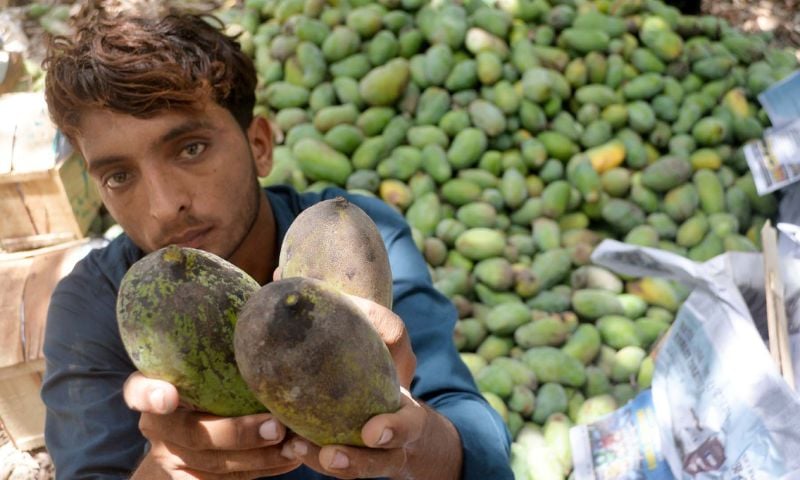
The disease known as batoor involves a defaced, ugly bunch formation of small flowers at the node of a branch. Plant pathologists emphasise that these affected clusters must be manually dissected right at the node and buried; otherwise, the fungal spores continue infecting adjacent flowering shoots across the canopy.
Nizamani stresses that farm orchard management lies at the heart of the crisis. “To me, it is all about orchard management practices because disease and fungus issues are directly related to upkeep,” he pleads. “We should manage orchards ourselves, move away from the traditional contractual system, and only then will we achieve quality produce without these severe losses.”
Nizamani advises growers to retain complete control during the critical pre-harvest management phase. “Do we want our orchards to turn into unmanaged Miani forests or ensure proper structural upkeep?” he asks.
“The trend of large, towering canopies is common in local orchards, but excessive height blocks sunlight and air circulation. Under changing climatic and temperature conditions, controlling tree height through regular pruning is essential so sunlight reaches the internal stems and soil,” Nizamani notes.
He adds that growers must understand soil dynamics: continuous farming depletes key nutrients that must be replenished, while proper drainage is essential to avoid waterlogging during extreme weather events. “I fail to understand why farmers remain obsessed with flood irrigation,” he says.
Mahmood Nawaz Shah echoes these operational concerns.
“It was unusual that market prices plummeted in a year when total production was also down,” Shah reflects. “We need evidence-based solutions to understand why fungal attacks and malformation have grown so frequent over recent years. Contractors quit mid-season, pest impacts were severe, and rates collapsed.”
Broken orchard contracts
Sindh’s mango sector has historically relied on a contractual system, where orchard owners sign seasonal agreements handing over harvest rights and market operations to third-party contractors in exchange for lump-sum payments.
Because orchard management is labour-intensive, many landowners prefer receiving an advance payout while leaving harvesting and logistics to contractors.
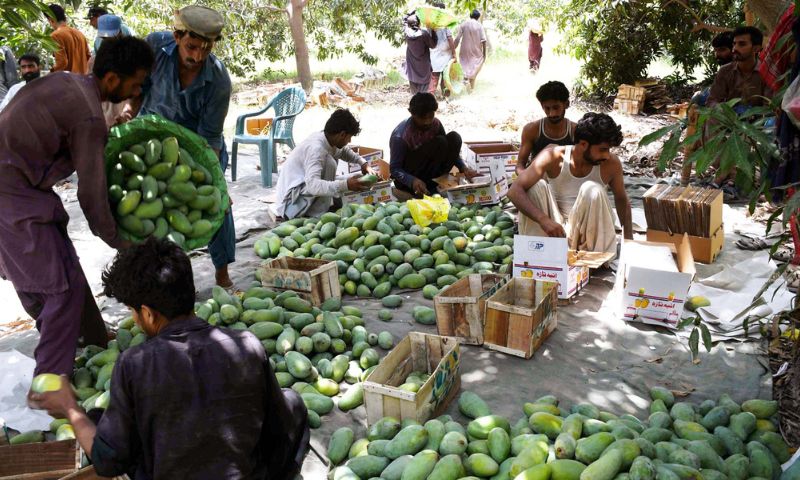
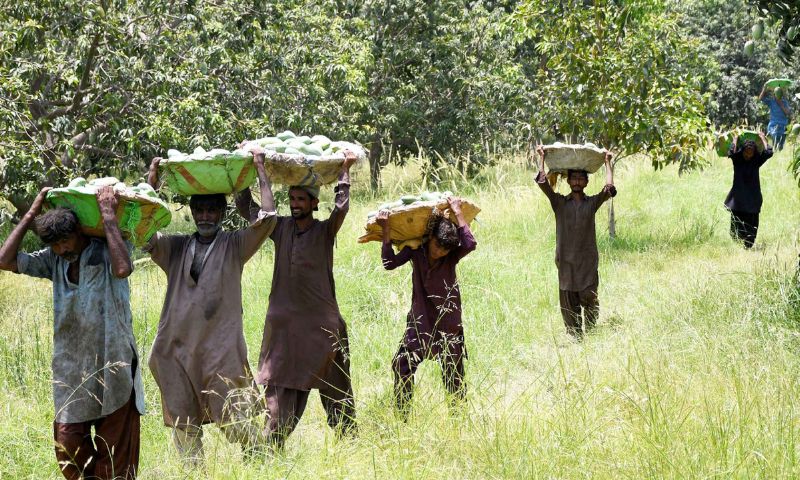
Contractors traditionally rely on skilled, migratory labour teams — predominantly from Punjab — who possess specialised skills in picking, sorting, sizing, and packing delicate mangoes, skills that local agricultural labourers often lack.
Typically, contractors pay a portion of the agreed contract value up front and pay the balance in instalments as harvesting progresses.
“Our contractor paid Rs30 million out of a Rs100 million contract this year and simply walked away,” says Dr Zulfikar Yousfani, secretary-general of the Sindh Abadgar Board, whose family owns several hundred acres of orchards.
“When we eventually harvested and marketed the remaining crop ourselves, rates were too low to recover costs. It has been a terrible year economically.”
Contractors faced similar setbacks. “Afghanistan takes a large volume of Pakistani mangoes for transit into wider regional markets, but border closures halted shipments,” explains Jam Siraj, a veteran contractor from southern Punjab working at Mir Shah Mohammad Talpur’s orchard. “We couldn’t even recover basic harvesting expenses, and malformation losses in the fields were massive.”
Mir Shah Mohammad Talpur agrees that fundamental management practices must shift.
“I recently controlled the height of my trees through pruning, and that step alone delivered better output this year despite the wider regional downturn,” he notes.
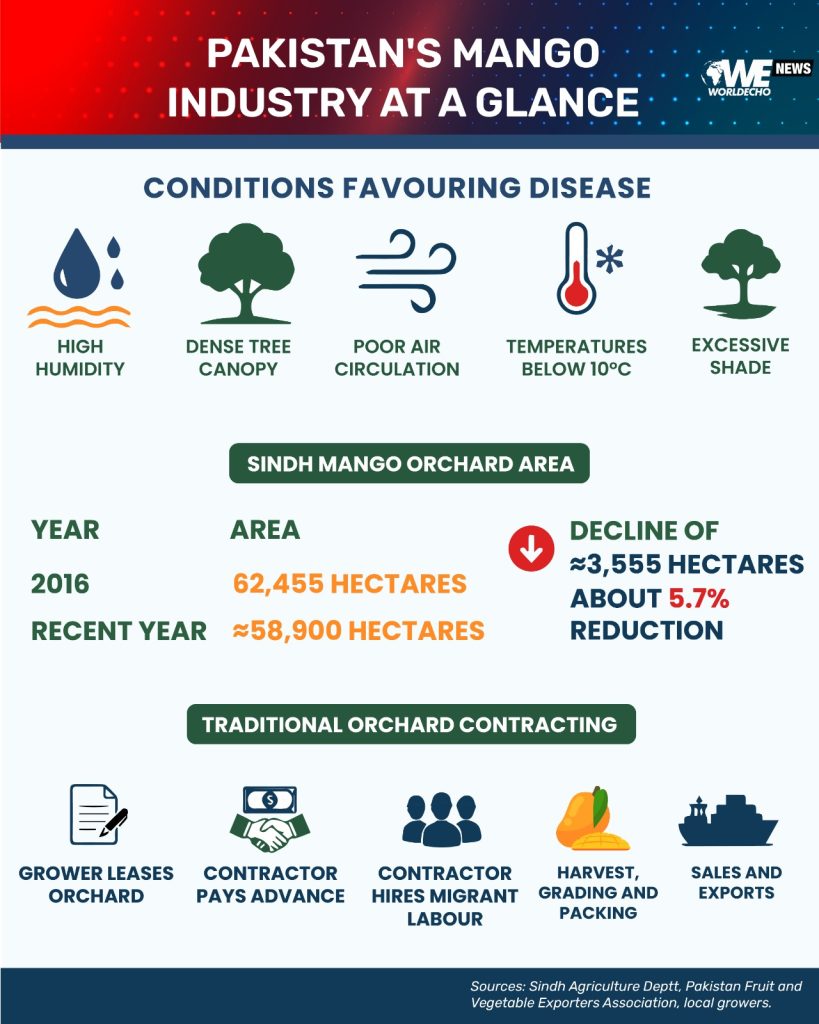
Data from the Sindh Agriculture Department reveals that mango orchard acreage in the province has contracted over the past decade — dropping from 62,455 hectares in 2016 down to around 58,900 hectares in recent years.
According to Khalid Iqbal Rajput, Director of Plant Disease at Agriculture Research Centre in Tandojam, seasonal field surveys conducted by research teams confirmed widespread yield drops across lower Sindh.
Mango malformation, caused by the fungus Fusarium mangiferae, reduced yields by 20 to 50 per cent, while mango hopper (Idioscopus clypealis) inflicted losses of 30 to 55 per cent. Thrips (Scirtothrips dorsalis) accounted for a further 20 to 40 per cent reduction in production, whereas anthracnose, caused by Colletotrichum gloeosporioides, was found to be widespread, particularly in unpruned orchards.
Rajput explains that unfavourable weather patterns, excessive shade, high humidity, temperatures dipping below 10°C, and neglected undergrowth create ideal conditions for disease vectors to thrive.
He stresses that preventive action is crucial: “Fungicides must be applied during the first week of October, followed by micronutrient sprays in late October when early vegetative growth begins. Malformed parts must be dissected, removed from the field, and buried, followed immediately by copper-based sprays.”