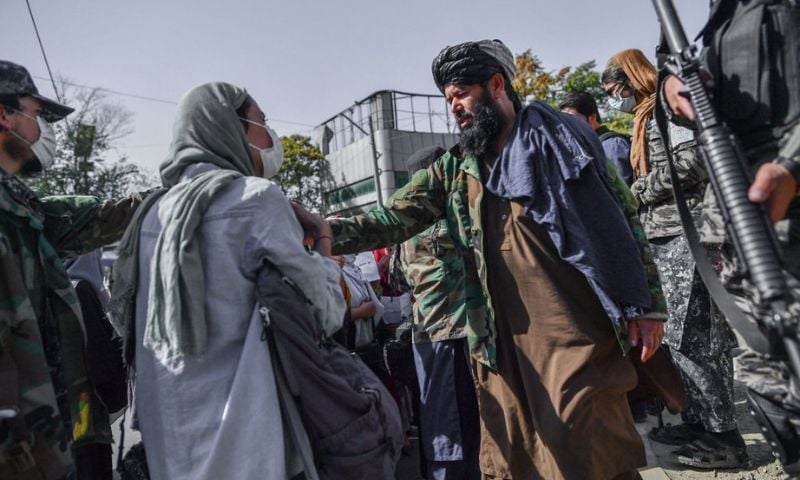
KABUL, Afghanistan: Five years after the Taliban returned to power in Afghanistan, Human Rights Watch (HRW) on Monday said the country was facing one of the world’s gravest human rights and humanitarian crises, urging governments to take action to hold the Taliban regime accountable and protect vulnerable Afghans.
In a report marking the fifth anniversary of the Taliban’s return to power on August 15, 2021, the rights organisation said the Taliban regime had systematically violated fundamental rights through sweeping restrictions, particularly those targeting women and girls.
HRW stated that Afghanistan remained the only country in the world where girls were barred from education beyond the sixth grade, while women continued to face severe restrictions on employment, freedom of movement, freedom of expression and participation in public life.
Severe restrictions and crackdown
HRW said the Taliban regime had expanded severe restrictions affecting nearly every aspect of public life and intensified measures to suppress dissent.
According to the organisation, journalists, women’s rights defenders, civil society activists, academics, artists and other critics had been subjected to threats, arbitrary detention, torture and other forms of ill-treatment.
The report said hundreds of former Afghan government security personnel had also been targeted in revenge attacks and extrajudicial killings in recent years.
HRW further said recently enacted Taliban regime legislation had reinforced the country’s repressive legal framework. The organisation said the law could be used to suppress opposition and institutionalise religious discrimination.
According to HRW, changes to the criminal procedure code had also weakened legal protections for women by narrowing the definition of domestic violence, while a decree governing the legal separation of spouses removed the minimum legal age for girls’ marriage, increasing the risk of child marriage.
Humanitarian situation
The organisation said Afghanistan’s humanitarian situation had continued to deteriorate following major reductions in international assistance.
It estimated that more than 17 million people, or around 40 percent of the population, were projected to face acute food insecurity, while more than 3.7 million children were suffering from acute malnutrition.
The report added that the country’s health system was struggling with severe shortages of resources.
HRW attributed the worsening humanitarian situation in part to cuts in foreign assistance and restrictions imposed by the Taliban regime on female humanitarian workers, saying the measures had reduced access to essential services and humanitarian aid.
HRW calls for accountability of Taliban regime
Referring to arrest warrants issued for Taliban regime leaders by the International Criminal Court and the establishment of an independent United Nations accountability mechanism for Afghanistan in 2025, HRW described both developments as important steps towards ending impunity for human rights violations.
It urged governments to ensure the UN mechanism was adequately funded while supporting investigations by the ICC and national prosecutions under the principle of universal jurisdiction.
Fereshta Abbasi, Afghanistan researcher at Human Rights Watch, said the anniversary should serve as a reminder of the consequences of continued impunity.
“The fifth anniversary of the Taliban’s takeover is a stark reminder of the devastating cost of impunity,” Abbasi told Kabul Now.
“Governments must move beyond statements of concern and demand justice for the grave crimes committed in Afghanistan, including the crime against humanity of gender-based persecution.”