


KABUL, Afghanistan: Taliban regime’s morality police have arrested 10 Afghan women in the southern province of Helmand for failing to follow the regime’s dress code, Amu TV reported, in the latest reported enforcement of restrictions on women under Taliban rule.
The Afghan women were detained on Monday in Lashkar Gah, the capital of Helmand province, following a verbal confrontation with officials from the Taliban regime’s Ministry for the Propagation of Virtue and the Prevention of Vice, four local sources, including two journalists, told the Afghanistan-based broadcaster.
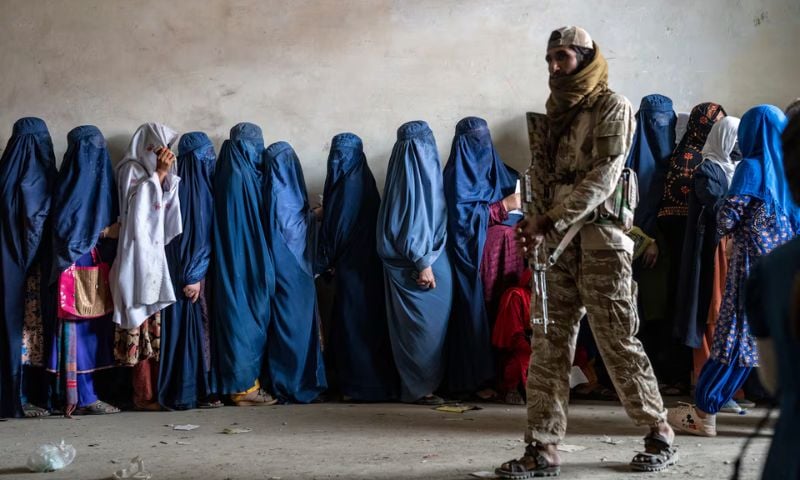
The women had travelled to the city for shopping and were wearing black Islamic dress but not the all-covering burqa, also known as the chadari, according to the sources.
“In Helmand, women are expected to wear the burqa,” one witness told Amu TV. “These women had hijab but not a burqa. The regime’s morality police arrested them, and we still do not know whether they have been released.”
Afghan women detentions in Herat
The reported arrests come days after residents in the western province of Herat told Amu TV that the Taliban regime’s morality police had detained nine women over a two-day period in the city’s 64-Meter, Marble Market and Bakrabad neighbourhoods.
Witnesses said those women were also wearing Islamic dress when they were taken into custody.
Residents in Herat also told the broadcaster that two female students were detained while travelling to a private educational centre. Their whereabouts were also unknown, according to the residents, cited by Amu TV.
Former detainees told Amu TV that women arrested by the Taliban regime’s morality police are often held without access to legal representation or family members and subjected to psychological pressure.
“When I was detained, I experienced systematic physical and psychological abuse,” Roqia Saiee, a women’s rights activist and former Taliban regime detainee, told the broadcaster. “There is no accountability inside Taliban prisons.”
Taliban regime’s restrictions on Afghan women
Since returning to power in August 2021, the Taliban have imposed increasingly strict restrictions on women and girls, regulating their dress, movement, education and employment.
Human rights organisations and the United Nations have repeatedly condemned the measures, describing them as systematic violations of women’s rights.
Women have been barred from working in most sectors, while girls have been prohibited from attending secondary schools and universities, making Afghanistan the only country where girls are officially banned from education beyond the sixth grade.
HRW warns of worsening human rights crisis
Meanwhile, Human Rights Watch (HRW) said Afghanistan has endured five years of sweeping repression and deteriorating human rights since the Taliban returned to power, with women and girls bearing the brunt of increasingly restrictive policies.
In an assessment released ahead of the fifth anniversary of the Taliban’s return to power on August 15, the rights organisation said Afghanistan had become one of the world’s gravest human rights crises as the Taliban regime continued to dismantle civil liberties, suppress dissent and institutionalise discrimination against women.
Also Read: Five Years of Taliban Rule: Afghanistan’s Human Rights Collapse
HRW said Taliban regime policies had systematically stripped women and girls of their rights to education, employment, freedom of expression and participation in public life.
The organisation also said independent journalism had come under sustained pressure, with Taliban regime detaining, beating and intimidating journalists while imposing sweeping restrictions on media organisations.
According to HRW, hundreds of media outlets have closed since 2021, forcing many journalists into exile or out of the profession. Women journalists have been disproportionately affected.
The report also documented arbitrary arrests, torture and intimidation of human rights defenders, civil society activists and people perceived as critics of the Taliban regime.
HRW further said it had documented revenge killings and enforced disappearances of former members of Afghanistan’s security forces despite the Taliban’s announcement of a general amnesty after taking power.
The organisation also highlighted the crackdown on women-led protests that emerged after the Taliban takeover.
Demonstrators demanding equal rights under the slogan “Bread, Work, Freedom” were met with violence, arbitrary detention and threats, while several activists were allegedly held incommunicado and pressured into making forced confessions.