KABUL: Five years after the Taliban regained power, Afghanistan remains trapped in one of the world’s worst humanitarian crises, with millions struggling to survive amid widespread hunger, a collapsing healthcare system and deepening poverty, according to a new Human Rights Watch (HRW) assessment.
Ahead of the fifth anniversary of the Taliban’s return to power on August 15, Human Rights Watch said Afghanistan’s humanitarian emergency has been driven by economic collapse following the takeover, the suspension of much international assistance, and Taliban restrictions that have complicated aid delivery, particularly to women and girls.
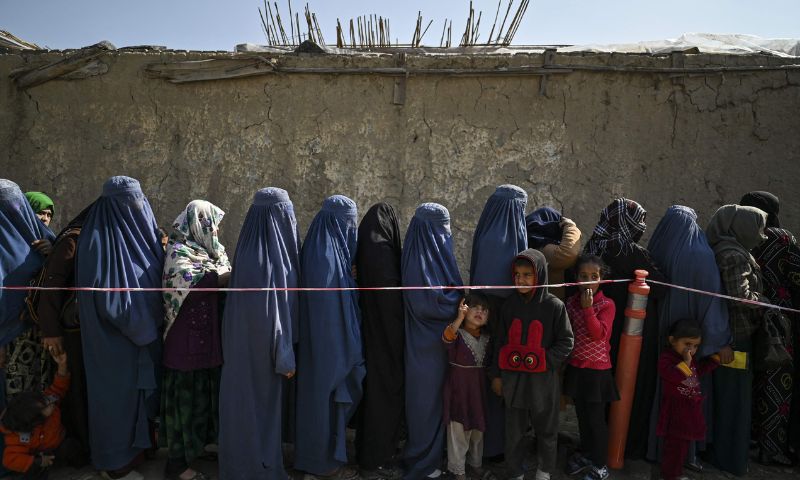
According to HRW, around half of Afghanistan’s population has required humanitarian assistance over the past five years, while more than 3.7 million children are suffering from acute malnutrition.
The withdrawal of international financial support after the Taliban’s return to power severely weakened Afghanistan’s economy, leaving countless families without stable incomes. As businesses closed and public services deteriorated, millions of Afghans were pushed deeper into poverty, with many households forced to skip meals and sell assets simply to survive.
Humanitarian organizations have also struggled to reach vulnerable communities because of Taliban restrictions on female aid workers.
Since many Afghan women can only receive assistance from female humanitarian staff, the restrictions have significantly reduced access to essential food, healthcare and social services in several parts of the country.
Healthcare has emerged as one of the sectors hardest hit by the crisis. HRW said hospitals and clinics across Afghanistan continue to face severe shortages of medicines, medical equipment and trained personnel following years of declining international funding.
Women and girls have encountered additional barriers to obtaining healthcare under Taliban rule. In many provinces, women must be accompanied by a male guardian, or mahram, when travelling for medical treatment and can only be examined by female healthcare professionals.
At the same time, the Taliban’s decision to prohibit women from attending institutions offering medical education threatens to worsen the country’s shortage of female doctors, nurses and midwives, raising concerns about future access to healthcare for Afghan women.
READ ALSO: Afghan People Suffering for Five Years under Taliban Rule: Human Rights Watch
Afghanistan’s humanitarian burden has also been compounded by the return of millions of Afghan refugees from neighbouring countries.
HRW said nearly five million Afghans have been deported or asked to return from Pakistan and Iran, while Turkey has also deported Afghan nationals and prevented others from seeking asylum at its borders.
Most returnees have arrived in Afghanistan with few resources and little prospect of employment, housing or access to basic services, placing additional strain on already overstretched humanitarian operations.
The report notes that renewed border clashes with Pakistan and sporadic attacks by the Islamic State group have further contributed to civilian suffering and insecurity, adding another layer of hardship for communities already struggling to recover from years of conflict.
Human Rights Watch warned that without sustained international humanitarian funding and the removal of restrictions affecting aid delivery, Afghanistan’s humanitarian crisis is likely to deepen further, leaving millions of people dependent on emergency assistance for the foreseeable future.