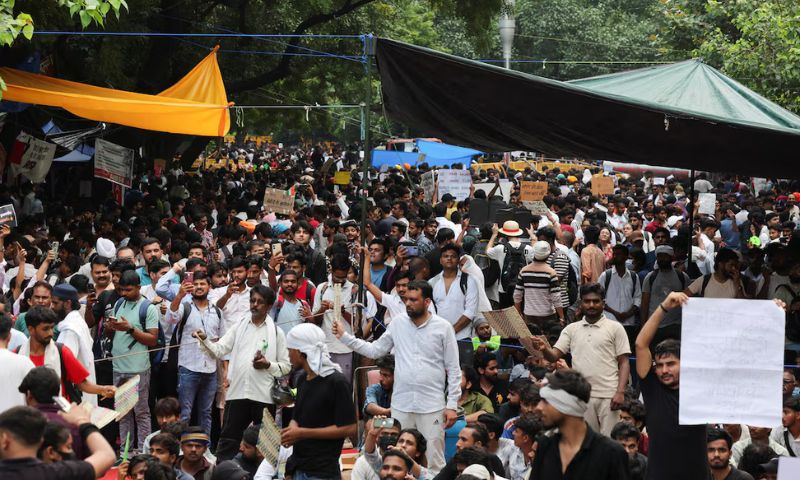



NEW DELHI: India’s recent student protests over examination paper leaks have exposed a deeper crisis confronting the country’s younger generation, with economists warning that unemployment and limited career opportunities are driving growing public frustration.
The demonstrations were triggered after a leaked National Eligibility cum Entrance Test (NEET) paper forced authorities to hold a retest for more than two million medical aspirants.
However, analysts say the protests quickly evolved into a broader expression of dissatisfaction over the country’s employment landscape.
India has the world’s largest Generation Z population, yet graduate unemployment among people aged 15 to 25 is estimated at nearly 40 per cent, according to the State of Working India 2026 report.
The political battleground has officially shifted from the streets of New Delhi straight into the halls of Parliament. Following the massive “Sansad Chalo” (March to Parliament) rally on 20 July 2026, the youth-led anti-paper leak agitation has evolved into a nationwide campaign… pic.twitter.com/cb1AR817eq
— Kumar R Talukdar🇮🇳 (@Kumarjyoti49291) August 3, 2026
Graduates accounted for almost two-thirds of the country’s unemployed in 2023.
As competition for secure employment intensifies, millions of students are increasingly relying on highly competitive entrance examinations such as NEET, the Joint Entrance Examination (JEE), the Common University Entrance Test (CUET) and the Union Public Service Commission (UPSC) civil services examination as pathways to stable careers.
Economists say the protests reflect wider concerns over slow job creation despite the rapid expansion of higher education. While India has produced millions of university graduates annually over the past two decades, employment growth has struggled to keep pace.
Research firms have also highlighted structural challenges within the economy, noting that manufacturing has expanded more slowly than expected, while a large share of the workforce remains dependent on agriculture.
ALSO READ: India’s Civic Space Crumbles as Modi’s Third Term Put on Global Rights Watchlist
Analysts have further warned that advances in artificial intelligence could reshape India’s information technology and business process outsourcing sectors, traditionally viewed as major sources of graduate employment.
The protests have increased pressure on Prime Minister Narendra Modi’s government, which has responded by appointing a new education minister, announcing a task force to reform the education system and introducing tougher penalties for examination paper leaks.
Economists, however, argue that restoring confidence among India’s youth will require not only reforms to examination systems but also sustained job creation and broader economic opportunities.