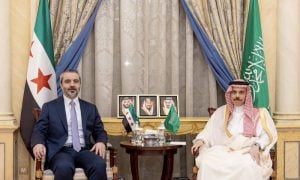
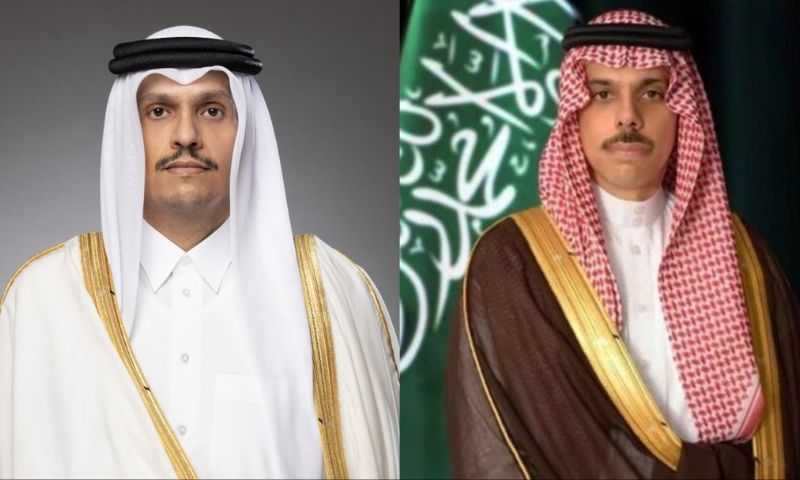
DOHA, Qatar: Saudi Foreign Minister Prince Faisal bin Farhan bin Abdullah Al Saud and Qatari Prime Minister and Foreign Minister Sheikh Mohammed bin Abdulrahman Al Thani discussed regional developments and diplomatic efforts to de-escalate the US and Iran tensions during a telephone conversation on Sunday.
According to Qatar’s Ministry of Foreign Affairs, the two ministers reviewed bilateral relations and explored ways to further strengthen cooperation between Doha and Riyadh.
The Saudi and Qatari Foreign Ministers also discussed the latest regional developments, particularly the diplomatic efforts and joint coordination to de-escalate and strengthen security and stability in the region.
The Saudi Foreign Minister also held a separate phone call with Jordanian Foreign Minister Ayman Safadi.
سمو وزير الخارجية الأمير #فيصل_بن_فرحان @FaisalbinFarhan يتلقى اتصالين هاتفيين منفصلين من معالي الشيخ محمد بن عبدالرحمن بن جاسم آل ثاني رئيس مجلس الوزراء وزير خارجية دولة قطر، ومن معالي نائب رئيس الوزراء وزير الخارجية وشؤون المغتربين في المملكة الأردنية الهاشمية السيد أيمن… pic.twitter.com/segkMG0Tlv
— وزارة الخارجية 🇸🇦 (@KSAMOFA) August 2, 2026
The Qatari Prime Minister stressed the need for all parties to commit to dialogue and diplomacy, and to implement the understanding between the US and Iran, including ensuring freedom of navigation in the Strait of Hormuz, in order to maintain security in the region, preserve the progress achieved, and promote regional stability.
Sheikh Mohammed reiterated Qatar’s unwavering support for all efforts aimed at reducing tensions and reaching a comprehensive agreement that secures sustainable peace in the region.
Prime Minister and Minister of Foreign Affairs, Saudi Minister of Foreign Affairs Hold Phone Call
Doha | August 02, 2026
HE Prime Minister and Minister of Foreign Affairs Sheikh @MBA_AlThani_ and HH Minister of Foreign Affairs of the Kingdom of Saudi Arabia Prince Faisal bin… pic.twitter.com/w84fMvjBbB
— Ministry of Foreign Affairs – Qatar (@MofaQatar_EN) August 2, 2026
Qatar stresses implementation of Islamabad MoU
Meanwhile, Sheikh Mohammed held similar telephone conversations on Sunday with Jordan’s Foreign Minister, Ayman Safadi, and Kuwaiti Foreign Minister Sheikh Jarrah Jaber Al-Ahmad Al-Sabah.
During the phone call, the Qatari and Jordanian Foreign Ministers discussed the latest regional developments, particularly the diplomatic efforts and joint coordination to de-escalate and strengthen security and stability in the region, according to the Qatari Foreign Ministry.
Sheikh Mohammed stressed the need for all parties to commit to dialogue and diplomacy, and to implement the Islamabad MoU between the US and Iran, including ensuring freedom of navigation in the Strait of Hormuz, in order to maintain security in the region, preserve the progress achieved, and promote regional stability.
Prime Minister and Minister of Foreign Affairs, Jordanian Deputy Prime Minister and Foreign Minister Hold Phone Call
Doha | August 02, 2026
HE Prime Minister and Minister of Foreign Affairs Sheikh @MBA_AlThani_ and HE Deputy Prime Minister and Minister of Foreign Affairs and… pic.twitter.com/rrUAUtcLK6
— Ministry of Foreign Affairs – Qatar (@MofaQatar_EN) August 2, 2026
The Qatari Foreign Minister also held a telephone conversation with his Kuwaiti counterpart Sheikh Jarrah Jaber Al-Ahmad Al-Sabah.
During the call, the two sides discussed the latest regional developments, particularly ongoing diplomatic efforts and joint coordination aimed at de-escalating tensions and reinforcing regional security and stability.
Prime Minister and Minister of Foreign Affairs Holds Phone Call with Kuwaiti Foreign Minister
Doha | August 02, 2026
HE Prime Minister and Minister of Foreign Affairs Sheikh @MBA_AlThani_ held a telephone conversation on Sunday with HE Minister of Foreign Affairs of the State… pic.twitter.com/niwvU94pOh
— Ministry of Foreign Affairs – Qatar (@MofaQatar_EN) August 2, 2026
Mediators seek to revive Islamabad MoU
Meanwhile, an Iranian lawmaker said on Sunday that mediators are making fresh efforts to revive the Pakistan-brokered Islamabad MoU that halted the war between the US and Iran in June.
Hassan Ghashghavi, spokesman for the Iranian parliament’s National Security Commission, said mediators were continuing efforts to revive the agreement, which was brokered by Pakistan and Qatar and signed following talks held in Islamabad.
“There is an effort underway to revive the 14-point Islamabad agreement, particularly by the mediators,” Ghashghavi said in a video interview.
“They know that the main issue and, in fact, the key to the matter right now is the issue of the Strait of Hormuz, so yes, there is an exchange of views,” he added.
The Iranian lawmaker also said there was a “constant exchange of views and discussion over proposals” but did not elaborate further.
Trump pauses US strikes on Iran
The remarks came a day after US President Donald Trump announced that the United States and Israel had agreed to postpone any planned military action against Iran, provided an agreement to end months of conflict could be reached quickly.
In a post on his Truth Social platform on Saturday, Trump said Washington remained fully prepared to launch military operations if diplomacy failed.
Also Read: Mediators Seek to Revive Pakistan-Brokered Islamabad MoU Between US and Iran
“The USA is locked and loaded and ready to go against the Islamic Republic of Iran, at levels of military strength and power not seen since the Second World War,” the US President wrote.
Trump said he had nevertheless agreed to suspend any immediate military action after receiving requests from Iran and several countries in the Middle East to refrain from launching attacks.
“Based on this request, I have agreed, for the future benefit of the world and the survival of a successful and prosperous Iran, to cancel the attack, subject to being able to rapidly make a deal,” he said.
According to Trump, any future agreement must include the immediate reopening of the Strait of Hormuz to commercial shipping and firm guarantees regarding Iran’s nuclear programme.
“The U.S.A. is locked and loaded and ready to go against the Islamic Republic of Iran, at levels of Military Terror, Strength, and Power not seen since World War II. Despite this, we have just been asked by Iran, and other Middle Eastern Countries, to hold off any attack in that… pic.twitter.com/Ylmlm06j3E
— The White House (@WhiteHouse) August 2, 2026
He added that Israel supported the US position, saying: “The Country of Israel joins me in this commitment. Get to work, everybody, and get it done.”
Iran rejects Trump’s claim
Iran rejected Trump’s claim that Tehran had requested Washington to refrain from launching fresh military strikes.
Iran’s Mehr news agency, quoting military officials, described the claim as “another falsehood” and said Iran’s armed forces remained on high alert and fully prepared to respond to any potential threat.
Meanwhile, US Secretary of State Marco Rubio said recent American military strikes had increased Iran’s willingness to negotiate.
Speaking to Fox News, Rubio claimed the attacks had significantly weakened Iran’s conventional military capabilities while acknowledging that Tehran still possessed missiles and drones capable of carrying out attacks.
He said the discussions now included both Iran’s nuclear programme and the future of the Strait of Hormuz.
Islamabad MoU framework
The Islamabad MoU was brokered by Pakistan and Qatar following negotiations in Islamabad after months of military confrontation between Washington and Tehran.
Under the Islamabad MoU, the US and Iran committed to halt military operations, reopen the Strait of Hormuz to commercial shipping and negotiate a comprehensive agreement covering Iran’s nuclear programme, US sanctions and a permanent ceasefire within 60 days.
Pakistan and Qatar subsequently co-mediated the first round of high-level negotiations in Lucerne, Switzerland, on June 21.
The talks were attended by US Vice President JD Vance and Iranian Parliament Speaker Mohammad Bagher Ghalibaf.
Saudi Arabia calls for dialogue
Separately, Saudi Crown Prince and Prime Minister Prince Mohammed bin Salman stressed the need for diplomacy during a telephone conversation with President Trump, according to the Saudi Press Agency.
During the telephone conversation with Trump, the Saudi Crown Prince stressed the “necessity of prioritising dialogue to de-escalate tensions” in the Middle East, SPA reported.
Crown Prince Mohammed bin Salman stressed the importance of paving the way for “diplomatic solutions that yield positive results to preserve the security and stability of the region, and prevent being drawn into a broader conflict whose repercussions affect regional and international security and stability”.
🇸🇦📞🇺🇸| HRH Crown Prince Mohammed bin Salman held a phone call with U.S. President Donald J. Trump. pic.twitter.com/SQQdpAjakf
— Foreign Ministry 🇸🇦 (@KSAmofaEN) August 2, 2026
Pakistan’s mediation efforts
Pakistan has played a central mediating role between the United States and Iran since brokering a ceasefire on 8 April and hosting high-level talks between the two sides in Islamabad on 12 and 13 April.
Pakistan has repeatedly urged both countries to honour the Islamabad MoU and continue diplomatic engagement.
The first round of Pakistan- and Qatar-mediated negotiations under the agreement was later held in Lucerne, Switzerland, on 21 June.
The talks were attended by US Vice President JD Vance and Iranian Parliament Speaker Mohammad Bagher Ghalibaf.
Following the negotiations, Pakistan and Qatar announced significant progress in diplomatic efforts, while Washington eased certain sanctions on Tehran.
The latest diplomatic activity comes amid months of heightened tensions between Washington and Tehran.