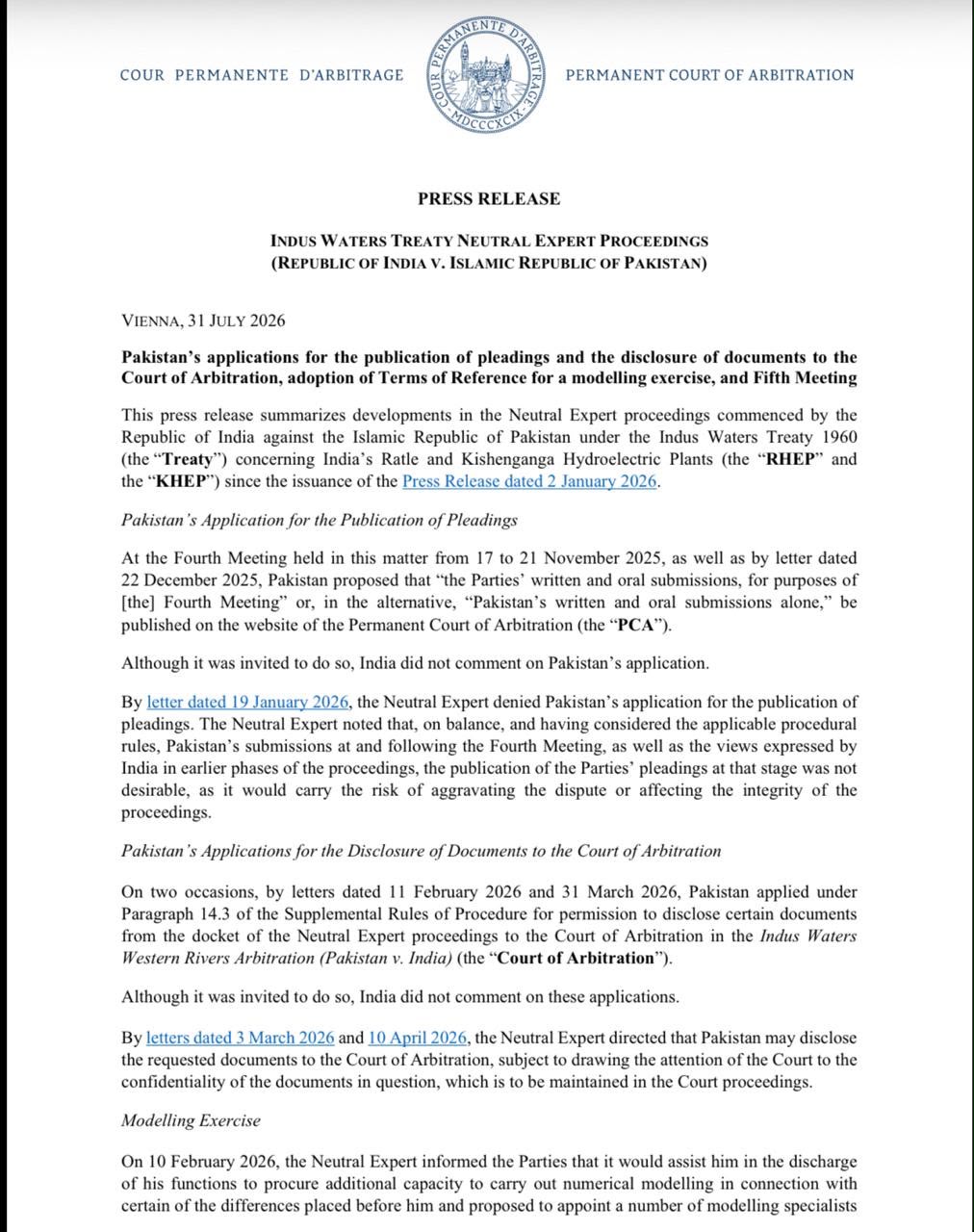
ISLAMABAD: The Permanent Court of Arbitration’s latest press release issued on 31st July has confirmed that the Neutral Expert proceedings under the Indus Water Treaty are continuing despite India’s unilateral withdrawal and non-participation.
Pakistan remains actively engaged in the legal and technical process, while the Neutral Expert has maintained the proceedings, initiated independent technical modelling, and set a timeline leading to a final decision in 2027.
The Indus Waters Treaty, brokered by the World Bank in 1960, is regarded as one of the world’s most durable water-sharing agreements.
It allocates the eastern rivers — Ravi, Beas and Sutlej — primarily to India, while granting Pakistan rights over the western rivers — Indus, Jhelum and Chenab.
Neutral Expert proceedings continue unabated
India’s strategy to derail the treaty dispute resolution process has suffered another major setback as the Neutral Expert proceedings continue unabated despite Indian withdrawal.
Pakistan’s principled commitment to international law has prevailed, while India’s policy of boycott has failed to halt the Treaty mechanism.
Neutral Expert has effectively rejected India’s attempt to freeze the proceedings, reaffirming the continuing authority of the IWT framework.
India walked away from proceedings
India walked away from the proceedings, but the proceedings did not walk away from India. The Treaty mechanism continues to function with full momentum.
India’s non-participation has neither weakened the proceedings nor diminished international scrutiny of the disputed hydroelectric projects.
Independent international experts are now scientifically examining Pakistan’s objections, reinforcing the credibility of Pakistan’s legal and technical position.
Neutral Expert’s latest roadmap confirms that India’s unilateral actions cannot override the dispute resolution provisions of IWT.
Final decision scheduled for 2027
Neutral Expert’s revised work programme reflects institutional confidence in the ongoing process, with a final decision scheduled for 2027.
India unilaterally announced to place the treaty in abeyance in April 2025, following an attack on tourists in Indian Illegally Occupied Jammu and Kashmir’s Pahalgam that killed 26 people.
New Delhi blamed Pakistan for the incident without presenting evidence, while Islamabad firmly rejected the allegation and warned that any attempt to suspend Pakistan’s water share would be treated as an act of war.
India has no authority to unilaterally place the treaty in abeyance
In a significant development supporting Pakistan’s stance, the Permanent Court of Arbitration had ruled in June that India has no authority to unilaterally place the treaty in abeyance.
Islamabad has repeatedly maintained that any attempt to alter the natural flow of Transboundary Rivers or impede Pakistan’s share of water under the treaty would be regarded as an “act of war.”
The Permanent Court of Arbitration (PCA) — an organisation that provides a framework for international disputes — last year issued a Supplemental Award of Competence, stating that India could not unilaterally hold the treaty in abeyance.
Pakistan urges UN Security Council to take notice of India’s violations
Earlier in May, Pakistan called on the United Nations Security Council to take urgent notice of India’s violations of the Indus Waters Treaty (IWT), warning that unilateral actions affecting transboundary water resources undermine the international agreement and threaten regional stability.
Pakistan’s Deputy Prime Minister and Foreign Minister Ishaq Dar, in a letter to the President of the Security Council, Leonor Zalabata Torres, said that at least 17 projects by India on waterways part of the Indus River System would give New Delhi the “tools for hydro-hegemony”.
“Such an inter-basin diversion of water of the Chenab into the Beas system constitutes a grave violation of not just the IWT but also of the laws of treaty, particularly the Vienna Convention on the Law of Treaties, as well as the broader framework of international water law, including the principles reflected in the 1977 UN convention on watercourses,” he said.
It argued that these projects reflect India’s intention to unilaterally alter the treaty-governed utilisation and flow of the Western Rivers, effectively weaponising water resources.
Islamabad says India’s disregard for the treaty has affected established mechanisms of coordination and raised concerns over downstream flows, and has sown another seed of instability in the region.