MUSCAT, Oman: Hidden for millennia along Oman’s rugged southern coastline, a stepped pyramid dating back nearly 5,800 years has emerged from the sands of time, and it may force archaeologists to completely rethink how ancient civilizations across the Arabian Peninsula connected, traded, and worshipped long before the rise of the great empires.
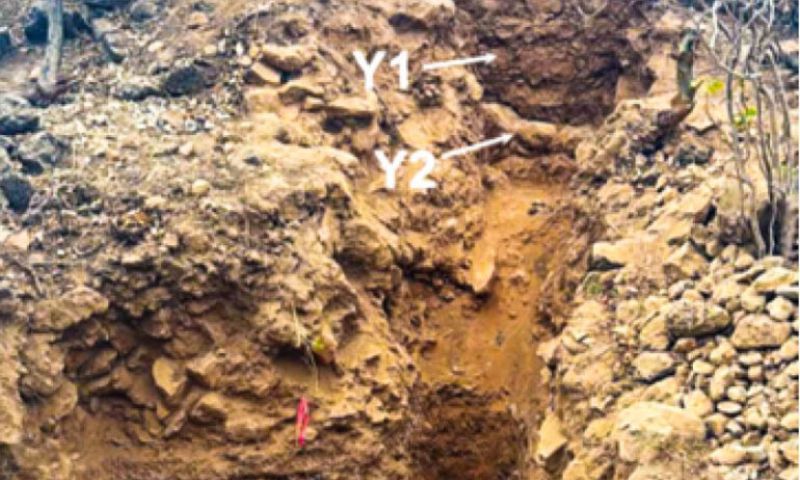
The remarkable structure, standing at Khawr Kharfut, a remote site overlooking the Arabian Sea in Oman’s Dhofar region, has been the focus of excavations since 2014 under the direction of the Archaeological Research Institute in Indiana. But it was during the 2023 and 2024 excavation seasons that researchers unearthed something truly extraordinary: a carefully built northern wall featuring stepped masonry, the hallmark of pyramid construction that had never before been documented from this period in the region.
Archaeologists have uncovered a remarkable six-thousand-year-old Neolithic stepped pyramid on the southern coast of Dhofar, a landmark find that fundamentally reshapes our understanding of South Arabia’s prehistoric era.
Read More: https://t.co/Th1dvEhQ0f— Muscat Daily (@muscat_daily) July 30, 2026
Though the ravages of time have weathered the structure, its elevated mound remains a striking landmark above the coastline, a silent sentinel that once commanded views of both the sea and the incense-rich highlands of Dhofar. Its commanding position has led researchers to suggest it may have served ceremonial, administrative, or other important communal purposes that brought together communities from across the ancient world.
Mesopotamian connections point to vast trade network
The significance of the discovery lies not just in the structure itself, but in what it reveals about the reach of early civilisations.
Among the most stunning finds are stone vessels that closely resemble examples associated with the Anu ziggurat in Mesopotamia during the Warka period, dated between roughly 3800 and 3400 BCE, a link that suggests direct contact between Oman’s ancient inhabitants and one of the world’s earliest urban civilisations.
Read Also: Remains of Rare Sun Temple Discovered in Egypt: Ministry
A fragment of a stone vessel found on the pyramid’s northern slope may provide the most important clue in linking the monument to that same era. Pottery collected during the excavation includes plain red and brown wares, vessels decorated with fingernail impressions, and occasional fragments of imported glazed ceramics, evidence of a community that combined local craftsmanship with participation in wider exchange networks stretching across the Arabian Sea and into Mesopotamia.
Decorative patterns found on several pieces also show striking similarities with pottery traditions from southern Mesopotamia and inland regions of South Arabia, further cementing the site’s role as a crossroads of ancient cultures.
Read Also: Discover the Pyramids of Spain, Mexico, Italy and Egypt
A ceremonial centre at the crossroads of civilisations
Based on the evidence uncovered so far, archaeologists believe Khawr Kharfut may have functioned as both a ceremonial centre and a strategic meeting point for inland and maritime communities.
The settlement appears to have connected the incense-producing highlands of Dhofar, renowned in antiquity for their precious frankincense, with trading routes extending across the Arabian Sea and into the heart of Mesopotamia.
“The discovery points to a long-term, organised, symbolically charged settlement utilising far-reaching trade networks into Mesopotamia and probably elsewhere,” the researchers wrote in their study, published in Athar, the bulletin of archaeological research in Oman.
Nature’s gift: Why this site thrived
The surrounding landscape would have offered clear advantages to ancient inhabitants. Sheltered waters, freshwater springs, nearby lagoons, and plentiful woodland created one of the most favourable natural environments along this stretch of the Arabian Sea coast.
These resources likely supported repeated seasonal visits, maritime activity, and sustained human occupation over many centuries, making Khawr Kharfut a hub of activity long before the rise of the great trading empires.
Read Also: Scientists Discover Hidden Corridor in Giza’s Pyramid
What comes next
The discovery raises as many questions as it answers. Further work is now planned to establish a more precise timeline for the site, with researchers intending to carry out radiocarbon dating and compare additional ceramic material from neighbouring regions. These efforts, they hope, will clarify the settlement’s place in the broader story of Neolithic societies in South Arabia and the ancient Near East.
For now, the stepped pyramid of Khawr Kharfut stands as a testament to a forgotten era, a time when the shores of Oman were not isolated outposts but vibrant nodes in a web of trade, culture, and ceremony that spanned half the known world. And if the researchers are right, this is just the beginning of what could be one of the most significant archaeological discoveries in the region in decades.