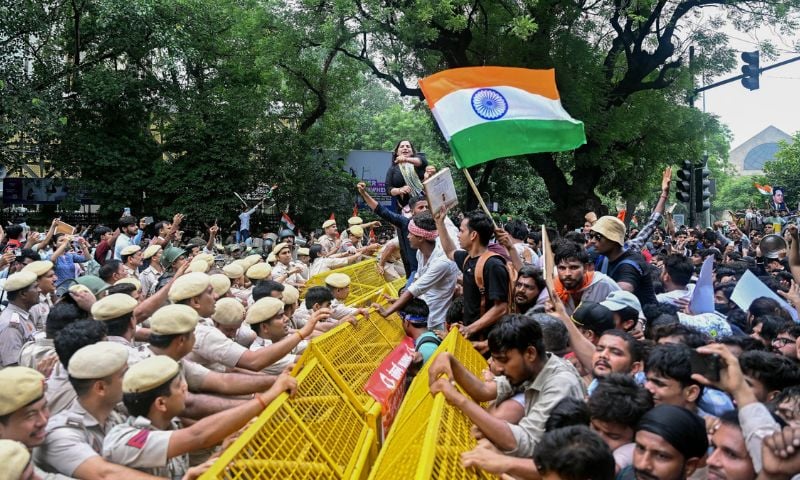
NEW DELHI: India’s youth-led “Cockroach” movement has threatened to resume nationwide protests, accusing Prime Minister Narendra Modi’s government of reneging on its promise not to take action against student demonstrators following last week’s mass protests that forced the resignation of the education minister.
The Cockroach Janta Party (CJP), which spearheaded demonstrations over alleged examination paper leaks and irregularities, said police had detained or harassed hundreds of students despite assurances that no punitive action would be taken against protesters.
“If the government does not honour the agreement and release everyone detained or arrested, we will be compelled to resume the protest,” CJP spokesperson Ashutosh Ranka told reporters.
Protesters Face Arrests
The movement said at least 100 people had been arrested, many under non-bailable charges, with police cases registered in Delhi, Assam, West Bengal and Bihar.
The CJP agreed to suspend demonstrations on Saturday after Education Minister Dharmendra Pradhan resigned, fulfilling one of the protesters’ key demands, and senior government ministers reportedly pledged that participants would not face reprisals.
However, movement leaders now allege the government has failed to honour that commitment.
Legal Challenge
The group has launched a legal fund to support protesters facing criminal charges.
Neha Bora, president of the All India Students Association and a prominent figure in the movement, travelled to Bihar to press authorities to withdraw cases against demonstrators.
In Bihar, a police officer was suspended after allegedly using an assault rifle to disperse protesters.
Meanwhile, opposition politicians have demanded accountability over last week’s police crackdown, while India’s Chief Justice called for an independent investigation after a petition alleged excessive use of force against protesters in New Delhi.
“The right to peaceful, lawful protest is absolutely guaranteed” under India’s Constitution, the Chief Justice said.
Social Media Fuels Movement
The movement, founded in May by public relations graduate Abhijeet Dipke, has rapidly gained millions of followers on social media, with Instagram emerging as its primary platform for mobilisation.
Last week’s demonstrations drew hundreds of thousands of students across India, marking one of the biggest public challenges to Modi’s government in more than a decade.
The protests forced the resignation of Dharmendra Pradhan—the first senior minister in Modi’s administration to step down following sustained public pressure.
Government Announces Reforms
The government has pledged to overhaul India’s examination system and introduced legislation in parliament seeking tougher penalties for exam paper leaks.
The protests have also highlighted the growing political influence of India’s Generation Z, with social media platforms playing a central role in organising demonstrations and amplifying demands for accountability.