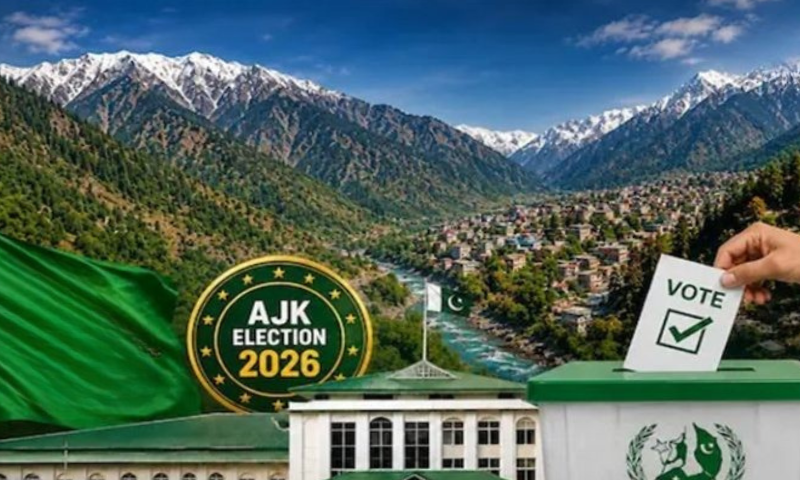



ISLAMABAD: The electoral process for the 2026 Azad Jammu and Kashmir Legislative Assembly formally began on Monday with polling in Mirpur Division, the first of three phases that will determine the composition of the territory’s 53-member legislature.
The first phase covers Mirpur Division, while polling in Muzaffarabad Division and the refugee constituencies is scheduled for August 2. The third and final phase will be held in Poonch Division on August 10.
The phased schedule was adopted by the Election Commission to facilitate security arrangements and ensure the smooth conduct of polling.
Composition of the Assembly
The Azad Jammu and Kashmir Legislative Assembly comprises 53 members.
Of these, 45 members are directly elected through universal adult franchise. The elected seats include 33 territorial constituencies in Azad Jammu and Kashmir and 12 constituencies reserved for refugees from Jammu and Kashmir residing in different parts of Pakistan.
The remaining eight members are elected indirectly after the general elections. They comprise five seats reserved for women, one seat for technocrats, one for religious scholars (Ulema and Mashaikh), and one for overseas Kashmiris.
A political party or coalition requires the support of 27 members in the Assembly to form the government.
Why the Elections Are Being Held in Phases
Unlike previous elections, the 2026 polls are being conducted in three phases.
According to the Election Commission, the staggered schedule has been designed to enhance security, improve logistical arrangements and ensure the safety of election staff and voters.
Thousands of police personnel, law enforcement officials and Pakistan Army troops have been deployed to safeguard polling stations across the three divisions.
Who Can Vote?
Registered voters cast ballots for candidates contesting their respective constituencies.
The Election Commission has established polling stations across the territory and refugee constituencies, with security arrangements varying according to the sensitivity of each polling station.
Formation of the Government
Once voting in all three phases is completed and the results are officially announced, the newly elected Assembly will meet to elect the Prime Minister of Azad Jammu and Kashmir.
Following the election of the Speaker and Deputy Speaker, members will also elect representatives to the reserved seats, completing the 53-member Assembly.
The government is formed by the party or coalition that secures the support of at least 27 members in the House.
Parliamentary System Overview
Azad Jammu and Kashmir has operated under a parliamentary democratic system since the adoption of the Interim Constitution Act, 1974. Under the system, the Prime Minister serves as the head of government, while the President is the constitutional head of the state.
The territory’s first democratic elections based on universal adult franchise were held in 1970 under a presidential system, allowing residents of Azad Jammu and Kashmir and refugees from Jammu and Kashmir residing in Pakistan to elect their representatives.
The parliamentary system replaced the presidential model in 1974, establishing the framework under which the Legislative Assembly functions today.