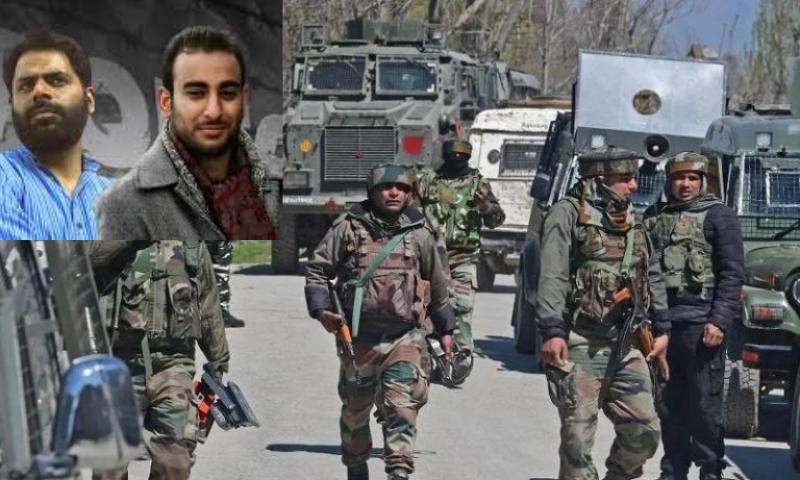
NEW DELHI: Indian authorities have released prominent Kashmiri human rights activist Khurram Parvez and journalist Irfan Mehraj on bail after they spent years in prison, in a case that has drawn sustained criticism from international human rights organisations and the United Nations.
Parvez, programme coordinator for the Jammu Kashmir Coalition of Civil Society (JKCCS), was arrested by India’s National Investigation Agency (NIA) from his home in Srinagar in 2021.
Mehraj, a freelance journalist associated with the same rights group, was arrested in 2023.
Both men face charges under India’s anti-terror laws, which rights groups say allow authorities to detain suspects for prolonged periods without trial.
The two were released from a New Delhi prison late on Wednesday, their relatives told AFP, requesting anonymity.
Strict Bail Conditions
Although granted bail, Parvez and Mehraj remain under strict court-imposed restrictions.
They must stay in New Delhi while their trial continues and are barred from travelling to Indian illegally occupied Jammu and Kashmir, according to court documents seen by AFP.
The National Investigation Agency challenged the bail order, but a higher court upheld the decision.
Rights Groups Condemn Arrests
The JKCCS has spent decades documenting human rights violations in Indian illegally occupied Jammu and Kashmir, including torture, unlawful killings and alleged enforced disappearances.
The organisation has also highlighted thousands of unmarked graves in border areas that it says may contain the remains of victims of enforced disappearances.
International human rights organisations have repeatedly called for Parvez’s release. In 2023, the UN Working Group on Arbitrary Detention said his detention was “an act of reprisal for his human rights work” and an attempt to silence him and Kashmiri civil society.
Scrutiny Over Crackdown in Kashmir
Journalists and rights advocates say pressure on civil society has intensified since Prime Minister Narendra Modi’s government revoked the semi-autonomous status of Indian illegally occupied Jammu and Kashmir in 2019.
According to Indian government figures, more than 3,600 people were arrested under anti-terror laws in the region between 2019 and 2023, with more than half still in custody.
Jammu and Kashmir Dispute
The Jammu and Kashmir dispute is one of the longest pending disputes on the agenda of the United Nations Security Council (UNSC).
Several UN Security Council resolutions, inter alia, affirm the right of Kashmiris to self-determination and the manner in which the Jammu and Kashmir dispute would be resolved.
They categorically state that the final disposition of the state of Jammu and Kashmir will be made in accordance with the will of the Kashmiri people expressed through the democratic method of a free and impartial plebiscite conducted under the auspices of the United Nations.
India has been taking different steps to strengthen its occupation of Jammu and Kashmir since 27 October 1947, when it forcibly took over control of the erstwhile princely state of Jammu and Kashmir.
However, in a major development, on 5 August 2019, India scrapped the special status of the Indian Illegally Occupied Jammu and Kashmir (IIOJK) and bifurcated it into two ‘Union Territories’ to alter its internationally-recognised disputed status and undermine the right to self-determination of the Kashmiri people.
These measures were in blatant violation of the UN Security Council resolutions and international law, including the 4th Geneva Convention.
India has since started a process to change the demographic structure and political landscape of IIOJK. The ultimate aim is to transform the Kashmiri people into a disempowered minority in their own land.