India’s youth are increasingly challenging Prime Minister Narendra Modi’s government—not through elections or political parties, but through protests, sit-ins and a movement that began with an insult.
What started as a satirical response to a judge’s controversial remark has rapidly transformed into one of the most consequential youth-led movements in India, posing the most dangerous threat to the Modi era.
The Cockroach Janta Party (CJP), once dismissed as an internet fad, has become a vehicle for a generation frustrated by examination scandals, unemployment and diminishing faith in institutions.
The movement’s origins are almost surreal. A judicial remark likening fake degree holders and backdoor job-seeking unemployed youth to “cockroaches” was intended as a put-down.
Instead, it provided India’s young people with a symbol of defiance. Within days, social media users embraced the label, creating memes, sharing personal stories and organising under a common banner.
Modern political movements often emerge from moments of symbolism. Occupy Wall Street had the “99 per cent”. Hong Kong had umbrellas. India’s youth have cockroaches.
What makes this movement significant is not its unusual name but the speed with which it has moved from screens to streets.
For months, India’s youth have been grappling with allegations of examination paper leaks, particularly surrounding the National Eligibility-cum-Entrance Test (NEET), one of the country’s most competitive examinations.
ALSO READ: India’s Youth Movement Vows to Continue Nationwide Protests Despite Police Violence
For millions of Indian families, education is viewed as the surest path to economic advancement. When that system appears compromised, frustration quickly turns into outrage. That outrage is visible across India.
Protesting cockroaches spread across India
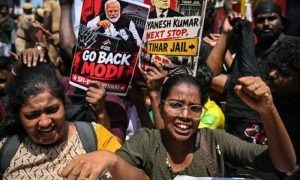
In New Delhi, students and activists have staged sit-ins at Jantar Mantar and attempted marches towards Parliament under the banner of the “Sansad (Parliament) Chalo” campaign.
Police have responded with barricades, tear gas and detentions. Similar demonstrations have been reported in Mumbai, Bengaluru, Pune, Goa, Lucknow and several university towns, underscoring the movement’s growing national footprint.
‘Cockroaches’ attract political figures
The protests have also attracted prominent figures. Opposition leaders Rahul Gandhi and Priyanka Gandhi Vadra have expressed solidarity with demonstrators. Even before them, activist Sonam Wangchuk’s hunger strike has added moral weight to the movement. The result is a coalition that extends beyond students to encompass a broader cross-section of civil society.The
Modi government responds cautiously
Education Minister Dharmendra Pradhan has promised reforms and discussions on examination irregularities. Senior officials have sought to project confidence, emphasising that institutions remain robust and that corrective measures are underway.
Yet governments often struggle to understand youth movements because they focus on immediate demands rather than underlying grievances.
The demand for the education minister’s resignation is not the movement’s central issue. It is merely its most visible demand.
The deeper concerns are structural: a shortage of quality jobs, repeated examination controversies and a widening gap between expectations and reality.
Headlines versus reality
India’s economic story remains impressive on paper. It is among the world’s fastest-growing major economies, home to a thriving technology sector and an increasingly influential global presence.
However, economic growth statistics offer limited comfort to graduates competing with millions of others for a shrinking pool of secure employment opportunities.
Disconnect lies at the heart of the movement.
India is producing more educated young people than ever before, but many feel that the institutions designed to reward merit are no longer functioning as they should.
When examination results are questioned, and recruitment processes are delayed or challenged, trust begins to erode.
Political movements become consequential when they outgrow their founding grievance.
The anti-corruption movement of the early 2010s reshaped Indian politics. Farmers’ protests forced the government to repeal contentious agricultural laws. The anti-citizenship protests demonstrated the power of sustained public mobilisation. The Cockroach movement appears to be following a similar trajectory.
Language of Gen Z
Unlike previous protest movements, however, this one speaks the language of Generation Z. Its organisers communicate through memes, livestreams and short videos. It has no singular leader, no central office and no rigid ideology. It is decentralised, adaptive and remarkably difficult to contain.
That presents a challenge for any government.
Prime Minister Modi remains India’s dominant political figure, and his government retains considerable institutional and political advantages. Yet political strength does not make governments immune to changing public sentiment.
Venting generations’ anxiety
The Cockroach movement has tapped into something larger than dissatisfaction with a single examination or minister.
It reflects the anxieties of a generation that believes it has upheld its end of the bargain—studied hard, pursued higher education and embraced the promise of a modern India—only to find opportunity increasingly elusive.
Cockroach: symbol of resilience
Ironically, the movement’s chosen symbol may explain its resilience.
Cockroaches are difficult to eliminate because they adapt, survive and multiply. By embracing an insult, India’s youth have transformed it into a statement of persistence.
Every attempt to dismiss the movement appears only to strengthen its appeal.
It is too early to predict whether the protests will lead to lasting political change. Youth movements are often powerful in the moment but struggle to sustain momentum over time.
Much will depend on whether organisers can translate anger into a coherent agenda and whether the government can address the concerns that brought people onto the streets.
One thing, however, is already clear
The Cockroach movement is no longer merely a social media phenomenon. It has become a reflection of a generation’s frustrations and aspirations.
And for a government in its second decade and third term in power, that may prove to be one of the defining political stories of contemporary India.