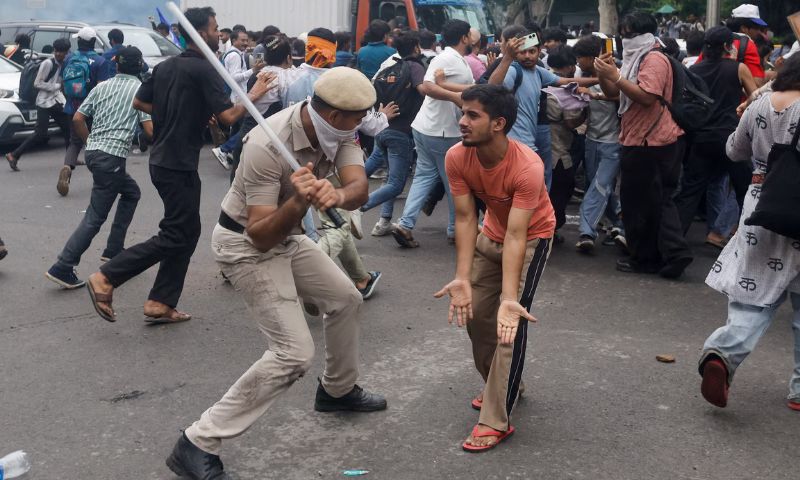
NEW DELHI: India’s youth-led Cockroach Janta Party (CJP) movement vowed on Tuesday to continue nationwide protests until Education Minister Dharmendra Pradhan resigns, a day after violent clashes with police in New Delhi left nearly 180 people injured and triggered fresh criticism of the government’s handling of dissent.
Thousands of protesters remained camped at Delhi’s Jantar Mantar protest site under heavy police presence, insisting they would not leave until their demands were met.
जंतर मंतर पर युवाओं का हुजूम उमड़ा है,
आप भी आए और सपोर्ट करें। pic.twitter.com/fWUDgmZhHO
— Cockroach Janta Party (@CJP_for_India) July 21, 2026
The movement, which began as an online campaign in May, has rapidly grown into one of the most significant public challenges to Prime Minister Narendra Modi’s government since it returned to power for a third term in 2024.
🇮🇳 | Nearly 200 people were injured during ongoing protests of India’s “Cockroach Movement.”
Police cracked down on protesters trying to reach the Parliament building in New Delhi.
Students, in particular, are swarming the streets to express their anger at the BJP-led… pic.twitter.com/66uu01ZKrX
— The Specter (@specter_affairs) July 21, 2026
Protesters refuse to back down
“We won’t stop. Pradhan has to be sacked,” CJP spokesperson Ashutosh Ranka said in a social media post, reaffirming the movement’s central demand following Monday’s confrontation.
Sonam Wangchuk is on 24th day of his hunger strike.
He is still fighting for us.
We won't stop. Pradhan has to be sacked.
— Ashutosh Ranka (@AshutoshRanka) July 21, 2026
Protest organisers also called for broader reforms to India’s education system, saying recent examination scandals had undermined public confidence in the country’s testing process.
CJP founder Abhijeet Dipke said the movement would continue its campaign and accused New Delhi police of using “brutal” force against demonstrators.
आरएसएस मुख्यालय के बाहर प्रदर्शन में बड़ी संख्या में छात्र, युवा, महिलाएं और वरिष्ठ नागरिक शामिल हुए।
युवाओं को न्याय दो। pic.twitter.com/tl9u6dh5rL
— Cockroach Janta Party (@CJP_for_India) July 21, 2026
“The police will hurt the youth again,” Dipke told reporters, adding that the group would maintain its sit-in protest until the government acted on its demands.
Delhi police and RAF fired tear gas shells on cockroach protest pic.twitter.com/fWBbg1GAwN
— p. (@_Real_PR) July 20, 2026
He said around 150 protesters were injured when police fired tear gas and used batons to disperse Monday’s march towards Parliament.
“एक एक छात्र का बैग चेक करके उसे जंतर मंतर पर एंट्री दी जा रही थी,
फिर पत्थर भरे ट्रक कहां से आए?
दिल्ली पुलिस जवाब दे”: अभिजीत दीपके pic.twitter.com/JXDQHQdLqz
— Cockroach Janta Party (@CJP_for_India) July 21, 2026
Police violence against protesters
Thousands of protesters had gathered in central New Delhi on Monday to demand Pradhan’s resignation before police blocked their march to Parliament with tear gas and baton charges.
Delhi Police said nearly 180 people were injured in the clashes, including 118 police personnel and about 60 protesters.
AAP Chief @arvindkejriwal visited the injured youth protesters who have returned to Jantar Mantar today in spite of their injuries to show their resolve against this cruel government.
Thank you for supporting the youth in these difficult times. pic.twitter.com/bj0fhGzNyX
— Cockroach is Back (@Cockroachisback) July 21, 2026
Protest organisers said that hundreds of peaceful protesters had been injured during a “brutal” use of force.
Videos circulating on social media showed police beating protesters and dragging them away, fuelling public outrage and prompting more people to join the demonstrations on Tuesday.
Amnesty International said the police response showed “how peaceful dissent is being suppressed in India”.
Tear gas and batons. Suspended metro services and mobile internet. Reported unnecessary and excessive use of force against peaceful protesters. Demonstrators in India were marching towards parliament to demand the resignation of a Union education minister following alleged… pic.twitter.com/TzAp5Xe9MS
— Amnesty International (@amnesty) July 21, 2026
Twenty-year-old student Sona Bisht said the confrontation had strengthened the protesters’ resolve.
“If the government thinks that doing this with Gen Z, they can stop us, then that won’t happen,” she said. “Till the time our demands are not met, we will not move from here.”
Opposition joins protests
The protests escalated politically after opposition leader Rahul Gandhi and dozens of lawmakers from the Congress party staged a sit-in outside Prime Minister Narendra Modi’s residence on Tuesday.
Videos shared by the party appeared to show Gandhi being detained by security personnel after he accused the government of refusing to take responsibility for the police action against students.
मोदी की तानाशाही देखिए।
देश के नेता विपक्ष के साथ ऐसा सुलूक किया जा रहा है।
शर्मनाक! pic.twitter.com/mPvojsUnbA
— Congress (@INCIndia) July 21, 2026
“What happened yesterday is our Constitution got trampled upon,” senior Congress leader Sandeep Dixit said.
Rahul Gandhi demanded Modi resign for “destroying the future of India’s youth”. Parliament was later adjourned after opposition lawmakers sought a debate on the alleged police brutality.
मोदी जी, हर ज़ोर आज़मा लो, सारी ताकत लगा लो – छात्रों के इंसाफ की ये लड़ाई अब रोके न रुकेगी। pic.twitter.com/suXh8LkWzh
— Rahul Gandhi (@RahulGandhi) July 21, 2026
Examination scandals fuel unrest
The demonstrations were sparked by a series of examination scandals that have shaken confidence in India’s education system.
उत्तराखंड में छात्रों का विरोध प्रदर्शन,
मांग: उत्तराखंड व देश के शिक्षा मंत्री का इस्तीफा। pic.twitter.com/2YGDJB1llj
— Cockroach Janta Party (@CJP_for_India) July 21, 2026
Last month, about 2.2 million aspiring medical students were forced to retake an entrance examination after a question paper leak invalidated the original test.
The controversy followed another scandal involving the online marking of examinations taken by nearly two million high school students.
The CJP has also demanded compensation of 10 million rupees for the families of students who died by suicide following the examination leak and has accused the government of failing to ensure accountability.
The movement gained further momentum after veteran activist Sonam Wangchuk, who had been on a three-week hunger strike in solidarity with the protesters, was taken to hospital by police against his will.
On Tuesday, the Delhi High Court ruled that he could be transferred from a government hospital to a private medical facility following a petition by his wife.
Despite government outreach through talks with senior ministers, movement leaders said they would continue their campaign until concrete action was taken, insisting that assurances alone would not end the protests.