Key Points
- Finance Minister meets US development finance officials
- Focus on energy, IT, minerals and agriculture
- US agency invited to identify viable projects
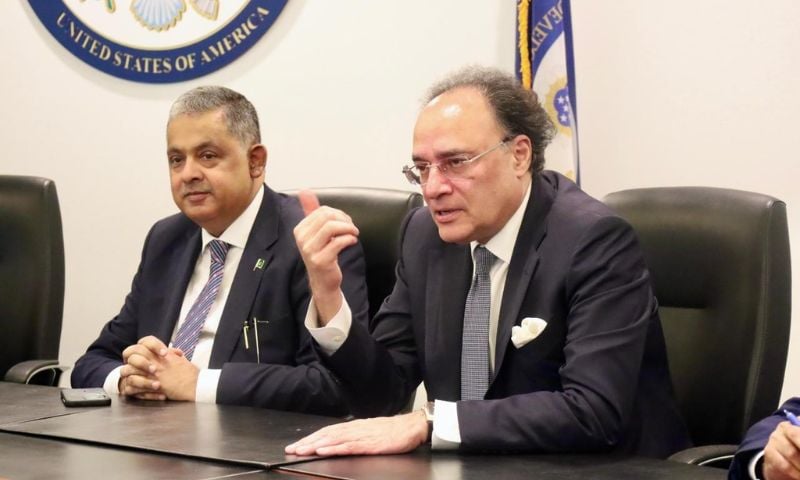
ISLAMABAD: Pakistan has stepped up efforts to attract US investment across key sectors of its economy as Finance Minister Senator Muhammad Aurangzeb invited the US International Development Finance Corporation (DFC) to explore opportunities.
The Minister urged the DFC to expand investment in energy, infrastructure, information technology, minerals, food, and agriculture.
The invitation was extended during a meeting with representatives of the US development finance agency in Washington.
Both sides discussed ways to expand cooperation and mobilise private capital into sectors identified by Islamabad as critical to long-term economic growth.
According to a statement issued by the Finance Division, Aurangzeb said Pakistan was seeking robust support from the DFC in priority sectors.
He encouraged the agency’s team to visit the country to identify commercially viable projects and develop business plans in consultation with relevant stakeholders.
He welcomed the DFC’s focus on ports, telecommunications, information technology, energy, mining, pharmaceuticals, manufacturing, and supply chain development. According to the Finance Minister, the agency’s priorities were closely aligned with those of the Pakistani government.
“The DFC’s emphasis on these sectors is in line with the Government of Pakistan’s development priorities,” the minister said.
Aurangzeb also invited the DFC delegation to engage with the public and private sector partners during a prospective visit to Pakistan to assess investment opportunities on the ground.
The meeting also aligns with Pakistan’s endeavour to build on recent macroeconomic gains and increasing foreign direct investment as part of its broader economic reform agenda.
The government has repeatedly identified infrastructure, digital transformation, energy security, and mineral development as pillars of sustainable growth.
The US International Development Finance Corporation is the United States’ development finance institution, providing loans, guarantees, political risk insurance, and technical assistance to support private sector projects in emerging markets.
Pakistan seeks strong economic ties with the US
Pakistan has sought to strengthen economic ties with the United States and international financial institutions in recent years. The country considers private-sector participation essential to narrowing its financing gap and creating jobs in a country of more than 240 million people.
ALSO READ: Pakistan, US Discuss Expanding Economic Cooperation in Key Sectors
The Finance Minister is on a three-day official visit to the US, primarily to continue tariff negotiations. His schedule includes meetings with officials from the Office of the United States Trade Representative (USTR), the US Export-Import Bank, the US International Development Finance Corporation (DFC), and the International Monetary Fund (IMF), according to the Finance Minister.
The focus of the ongoing visit is on the framework for a potential bilateral trade agreement, expanding trade and investment between the two countries.
The talks are expected to cover tariffs, market access, investment opportunities and broader economic cooperation.
Meetings with the Exim Bank and the DFC are also expected to explore avenues for financing infrastructure, energy and private-sector investment projects in Pakistan.
Aurangzeb’s visit comes as Pakistani and US officials continue negotiations over the global tariff regime announced by US President Donald Trump on April 2, 2025, under the International Emergency Economic Powers Act (IEEPA), which initially imposed a 29 per cent tariff on Pakistani exports.
A Pakistani delegation that visited Washington in July 2025 succeeded in persuading US officials to reduce the proposed tariff from 29 per cent to 19 per cent.
The tariff landscape has since changed following a US Supreme Court ruling earlier this year that invalidated the IEEPA-based tariffs.
In response, the Trump administration invoked Section 122 of the Trade Act to impose a temporary global tariff of 10pc, which is due to expire on July 24 after the statutory 150-day period.
Pakistan is also among nearly 60 countries facing USTR investigations under Section 301 over alleged forced labour and related trade practices.
Islamabad has submitted detailed responses to the USTR, including an additional submission this week ahead of the latest negotiations.