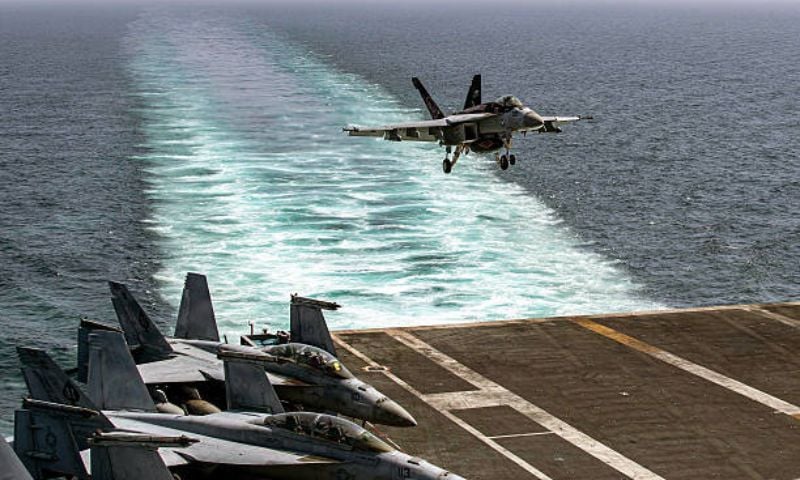



WASHINGTON/TEHRAN: The United States and Iran exchanged fresh military strikes late on Monday and into Tuesday, marking another significant escalation in the confrontation that has heightened security concerns across the Gulf region and around the Strait of Hormuz.
The US Central Command (CENTCOM) announced that American forces had completed a new round of military strikes against Iran at 9 p.m. Eastern Time on Monday.
— U.S. Central Command (@CENTCOM) July 21, 2026
According to the command, the operation targeted Iranian military command centres, maritime capabilities, missile and drone launch sites, and air defence systems.
CENTCOM said the strikes were intended to weaken Iran’s ability to launch attacks against commercial shipping transiting the Strait of Hormuz, one of the world’s most strategically important maritime corridors.
Washington confirms latest military strikes on Iran
Earlier, the US military confirmed that the latest operation had commenced at 4 p.m. ET under the direction of the US Commander-in-Chief. It was the tenth consecutive day of US strikes on Iran.
Today at 4 p.m. ET, U.S. forces began a new round of strikes against Iran at the Commander in Chief’s direction. The strikes are designed to further degrade Iranian military capabilities used to attack commercial shipping in the Strait of Hormuz.
— U.S. Central Command (@CENTCOM) July 20, 2026
The strikes, it said, were specifically designed to further degrade Iranian military capabilities used in attacks on commercial vessels in the region.
The US military also noted that commercial shipping through the Strait of Hormuz had continued despite the heightened tensions.
Since early May, CENTCOM forces have facilitated the safe passage of approximately 900 commercial vessels transporting an estimated 450 million barrels of crude oil through the waterway.
The command warned that American forces remained fully prepared to respond to what it described as any further “unwarranted aggression” by Iran against civilian maritime traffic.
Tehran launches retaliatory strikes on US military assets in the Gulf
Iran, meanwhile, announced a series of retaliatory military operations against US military assets in the Gulf. In separate statements, Iran’s Islamic Revolutionary Guard Corps (IRGC) claimed it had targeted American military systems in Bahrain, including a radar installation and an air defence system in Muharraq.
The Guards also said a Patriot air defence system in Riffa had been struck during a coordinated missile and drone attack. Iran further claimed that its military had launched ground-to-ground missiles at Camp Arifjan in Kuwait, saying it had targeted US HIMARS missile systems stationed at the base.
READ ALSO: Trump Threatens More Strikes on Iran as Mediators Push for De-escalation
Iranian state broadcaster IRIB reported that the attack formed part of the 18th phase of Tehran’s ongoing “Thunder” military operation, describing it as retaliation for the latest US strikes.
Kuwait’s military activated its air defence systems in response to what it described as hostile Iranian missile and drone attacks, according to reports carried by Al Jazeera.
Separately, Iran’s Revolutionary Guards reported that two oil tankers caught fire after explosions while attempting to navigate the southern route of the Strait of Hormuz.
The IRGC also reiterated that the strategic waterway would remain closed for as long as US military operations in the region continued.
Multiple explosions reported across southern Iran
Meanwhile, multiple explosions were reported across southern Iran. According to Iranian media reports cited by Al Jazeera, loud explosions were heard in the central city of Isfahan, while further blasts were reported in Bandar Abbas, Chabahar and on Qeshm Island.
Iran’s Mehr news agency also reported that air defence systems were activated near the Bushehr nuclear power plant following the explosions, although there was no immediate confirmation of damage to the facility.
The latest exchange of strikes represents one of the most serious military escalations between Washington and Tehran in recent months, raising fresh concerns over regional stability, global energy supplies and the security of international shipping through the Gulf.