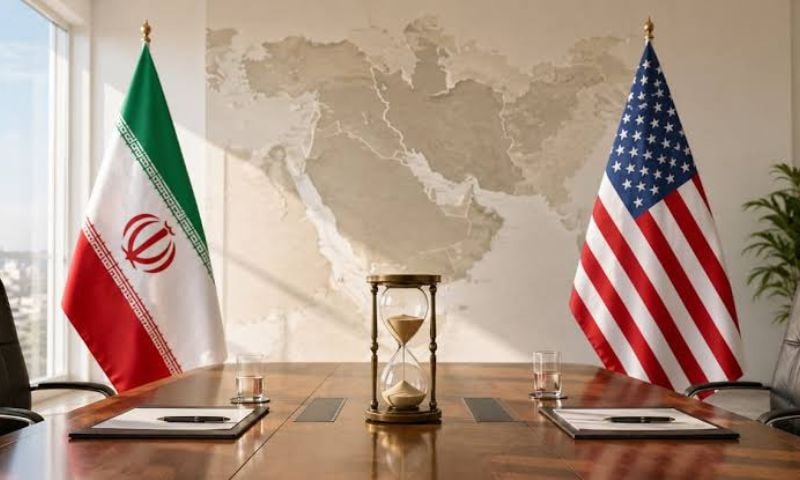



WASHINGTON/TEHRAN: The United States and Iran signalled on Monday that they remain open to diplomacy despite escalating military confrontation, raising hopes of renewed negotiations under the Islamabad Memorandum of Understanding (MoU) framework as mediators sought to de-escalate the conflict and revive dialogue between Washington and Tehran.
The Islamabad MoU, brokered by Pakistan, was signed in June to end hostilities between the two countries and pave the way for a lasting peace agreement to permanently end the conflict.
The Islamabad MoU was signed on June 18 by US President Donald Trump, Iranian President Masoud Pezeshkian, and Pakistan’s Prime Minister Shehbaz Sharif, following Islamabad brokered a ceasefire between Washington and Tehran.
Under the Islamabad MoU, the US and Iran committed to halt military operations, reopen the Strait of Hormuz to commercial shipping, and negotiate a comprehensive agreement covering Iran’s nuclear programme, US sanctions, and a permanent ceasefire within 60 days.
The diplomatic signals came as oil prices retreated from more than one-month highs after investors reacted to indications that diplomatic efforts to revive talks between Washington and Tehran were continuing.
A senior Iranian official, cited by Reuters, said mediators had conveyed a proposal for a 10-day ceasefire aimed at de-escalating the conflict and reviving an interim agreement reached last month between Tehran and Washington.
مسؤول إيراني يقول لوكالة رويترز إن "الوسطاء اقترحوا هدنة لمدة 10 أيام" بين إيران والولايات المتحدة بهدف العودة إلى طاولة المفاوضات pic.twitter.com/WBTiYv1fM0
— التلفزيون العربي (@AlarabyTV) July 20, 2026
At a weekly press conference in Tehran, Iranian Foreign Ministry spokesman Esmaeil Baghaei said intermediaries had delivered fresh proposals to Iran in recent days and that negotiations with the United States could continue if they served Iran’s national interests, AFP reported.
Asked whether the door to talks with Washington had closed, Baghaei rejected the notion that diplomacy and military action were mutually exclusive.
“I reject the duality of either war or diplomacy. Diplomacy is a tool through which we pursue our national interests, just like war,” he said.
Baghaei also accused the United States of targeting civilian facilities and infrastructure in several Iranian provinces during its military campaign, saying the attacks demonstrated “America’s destructive logic”, Iran’s Tasnim news agency reported.
“We condemn the attacks on infrastructure in the strongest possible terms,” he said.
Rubio says US will continue diplomacy with Iran
US Secretary of State Marco Rubio said Washington would continue pursuing a diplomatic solution while insisting that any agreement with Tehran must be meaningful and fully implemented.
Speaking before departing for the Philippines for the Association of Southeast Asian Nations (ASEAN) Foreign Ministers’ Meeting, Rubio accused elements within Iran of attempting to use the Strait of Hormuz as leverage against the international community.
“It is evident that some within Iran want to use the Strait of Hormuz as leverage against the rest of the world,” Rubio said.
He stressed that any disruption to one of the world’s busiest shipping lanes posed a threat to global maritime security and international trade.
Rubio said the United States would continue protecting freedom of navigation and commercial shipping but urged other countries to share responsibility for securing the strategic waterway.
“The United States will continue to do what is necessary to protect global shipping,” he said. “But other countries also need to step up, whether by providing financial support or military capabilities, to help share that responsibility.”
Responding to questions about diplomacy, Rubio said Washington remained committed to dialogue.
“The United States is always open to diplomacy,” he said. “But it has to be meaningful, and any agreement must be one that Iran is genuinely prepared to honour.”
He added that previous diplomatic efforts had faltered because commitments had not been fully implemented.
“We have made several attempts to engage Iran diplomatically, and we will continue to pursue those efforts. However, any agreement must be based on mutual adherence to its terms,” Rubio said.
Oil prices retreat
Oil prices fell after initially climbing to their highest levels in more than a month, as hopes of renewed diplomacy eased concerns over prolonged disruptions to global energy supplies.
Brent crude futures retreated to around $88 a barrel after earlier reaching an intraday high of $91.42, the highest since June 11. US West Texas Intermediate (WTI) crude also slipped back to around $82 a barrel after touching its strongest level since June 12.
The reversal came after Baghaei indicated that diplomatic contacts with Washington could resume despite the collapse of last month’s interim ceasefire arrangement.
US, Iran continue military exchanges
Meanwhile, military operations continued across the Middle East.
US Central Command (CENTCOM) said early on Monday that it had launched a ninth consecutive night of strikes targeting Iranian military capabilities used to attack commercial shipping and civilian mariners in the Strait of Hormuz.
CENTCOM began conducting a new wave of strikes against Iran at 7 p.m. ET today for the ninth consecutive night. The strikes will continue degrading Iranian military capabilities used to attack commercial vessels and civilian mariners transiting the Strait of Hormuz.
— U.S. Central Command (@CENTCOM) July 19, 2026
Kuwait said its air defence systems intercepted hostile drones following what it described as Iranian aggression, while Bahrain activated air raid sirens after saying Iranian drones had targeted the kingdom’s air navigation systems.
Bahrain’s civil aviation authority said flights and air traffic continued to operate normally despite the incident.
Iran’s Islamic Revolutionary Guard Corps (IRGC) said it had carried out strike on an enemy special operations command centre in Syria’s Al-Tanf region in retaliation for the deaths of Iranian soldiers from Iranshahr.
Tehran also said it had targeted two US military bases in Kuwait on Sunday.
Strait of Hormuz remains under pressure
The Strait of Hormuz remains the focal point of the conflict. Before hostilities escalated, around one-fifth of global oil supplies passed through the strategic waterway.
Iran has blocked maritime traffic through the passage since the conflict began, while the United States has tightened restrictions on Iranian ports.
The IRGC said two vessels attempting to transit the strait had been stopped because of unsafe navigation, while two others turned back.
Separately, the IRGC claimed that two oil tankers had been immobilised after explosions while attempting to use an unsafe southern route through the strait.
The United Kingdom Maritime Trade Operations (UKMTO) also reported that a vessel was on fire northwest of Oman’s Kumzar early on Monday.
According to LSEG shipping data, only four vessels transited the Strait of Hormuz on Sunday, down from eight the previous day.