
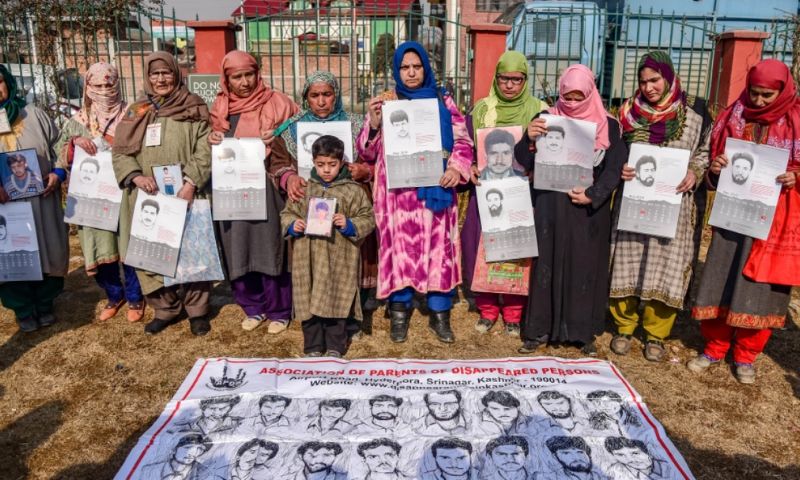
SRINAGAR: A rare court ruling in Indian Illegally Occupied Jammu and Kashmir (IIOJK) has revived painful questions about thousands of people who went missing during decades of conflict in the occupied territory.
Junaid Rashid was only five when his father, Abdul Rashid Wani, vanished from military custody in July 1997. Nearly 29 years later, a judge has declared Wani dead and ordered the issuance of a death certificate.
The ruling cited a police inquiry that indicted an Indian army major of taking Wani into custody, murdering him and disposing of his body. It records the date of death as the day Wani disappeared but gives no information about where his remains are.
Rashid, now 34, said the government had finally acknowledged in court that an atrocity had taken place. His family had spent decades searching for Wani, selling their home and pursuing legal action despite pressure to abandon the case.
Wani’s story reflects the wider tragedy of enforced disappearances in IIOJK. Rights group Association of Parents of Disappeared Persons says as many as 8,000 people may have disappeared in the region.
In 2009, the group mapped 2,700 unmarked graves in remote areas. Kashmir’s State Human Rights Commission later examined 38 locations and said the government had identities for only 464 of 2,730 bodies.
The commission recommended DNA testing, but it has not been carried out. The body was shut down in 2019 after New Delhi revoked IIOJK’s special status and brought the territory under direct control.
Families of missing men, often called “half-widows” and “half-orphans,” say they still want answers about what happened to their loved ones.
Indian security personnel can be tried in civilian courts only with special government approval. Rights advocates say no such permission has been granted despite repeated requests in abuse cases.
For many IIOJK families, Wani’s death certificate offers recognition but not closure.