Key Points
- Housing support benefits one in four families
- Riyadh Metro carries 100 million passengers
- Green financing exceeds $9 billion
ISLAMABAD: Saudi Arabia’s homeownership rate climbed to 66.24 per cent by the end of 2025 from 47 per cent in 2016, bringing the Kingdom closer to its Vision 2030 target of 70 per cent, said Minister of Municipalities and Housing Majed Al-Hogail.
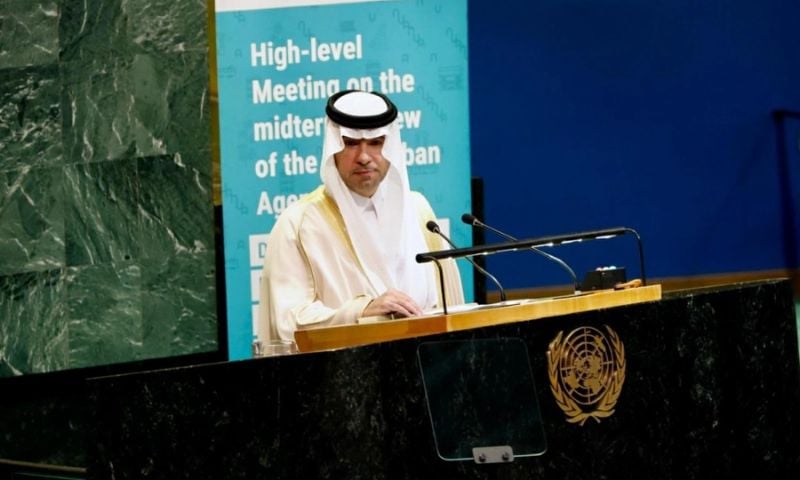
The Saudi minister revealed revolutionary growth figures at a United Nations high-level meeting on urban development in New York.
Addressing the United Nations General Assembly High-Level Meeting on the New Urban Agenda, Al-Hogail said Saudi Arabia had moved beyond planning and policy formulation to achieve measurable results in sustainable urban development.
He said the Kingdom had submitted its updated 2026 national report to the United Nations Human Settlements Programme (UN-Habitat), outlining major urban transformation initiatives and their impact.
The minister said more than 25 per cent of Saudi families benefited from housing support programmes between 2018 and 2025, helping expand access to affordable housing and improve living standards.
The rise in homeownership is regarded as one of the flagship goals of Vision 2030, the Kingdom’s long-term economic and social reform strategy.
Urban development indicators also showed notable improvement.
Public space availability increased from 5.2 square metres per person to 6.9 square metres, which was supported by the Bahja programme. The programme added more than 12 million square metres of community and recreational areas across the country.
Saudi Arabia’s public transport network has expanded rapidly as part of efforts to create more liveable and environmentally sustainable cities.
The Riyadh Metro carried more than 100 million passengers during its first nine months of operation, while urban bus services transported over 96.8 million passengers in 2025, according to the minister.
Saudi women’s participation rises
Al-Hogail said the Kingdom’s urban transformation was accompanied by broader social progress. Women’s participation in the labour force rose from 22.8 per cent to 36 per cent, while the employment rate among people with disabilities doubled during the reform period.
Community engagement has also strengthened, with the number of non-profit organisations surpassing 7,213, representing growth of more than 341 per cent. The minister said the increase reflected rising civic participation and support for social development initiatives.
ALSO READ: Saudi Health Reforms Drive Record Rise in Life Expectancy
Saudi Arabia is further advancing urban governance reforms through greater financial autonomy for municipalities, integration of urban data systems and the inclusion of climate risk assessments in urban planning processes.
These measures are aimed at improving city management and enhancing resilience against environmental challenges.
The Kingdom continues to implement major sustainability initiatives, including the Saudi Green Initiative and the National Renewable Energy Programme, to reduce emissions, expand renewable energy use and improve environmental performance in urban centres.
Private sector participation has played a significant role in the transformation. Saudi Arabia has signed more than 56 public-private partnership agreements covering infrastructure and municipal services, helping mobilise investment and accelerate project delivery.
On the international front, the Kingdom has strengthened cooperation with global development institutions, signing a strategic partnership agreement with UN-Habitat and the United Nations Development Programme covering the 2024-2027 period.
Al-Hogail said Saudi Arabia issued $9.1 billion in green bonds and sustainable sukuk in 2024, while the Public Investment Fund’s green finance framework includes commitments exceeding $10 billion by 2026.
He reaffirmed the Kingdom’s commitment to the goals of the New Urban Agenda and has called for stronger international cooperation and wider access to sustainable financing to support inclusive and resilient urban growth.