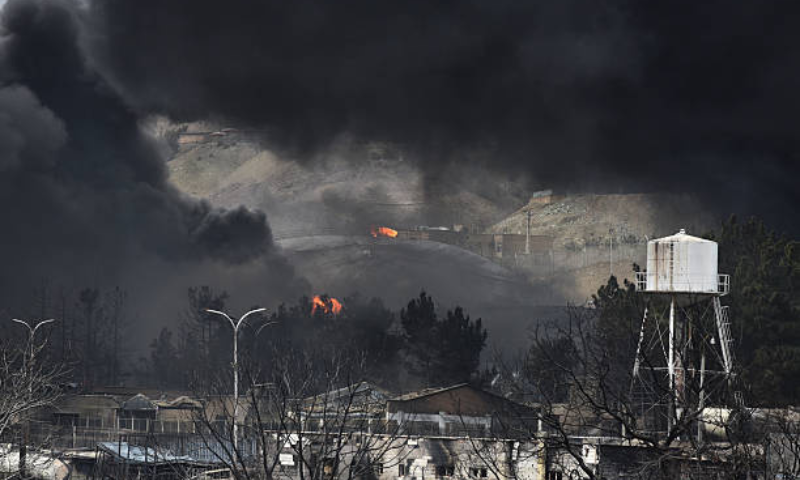
ISLAMABAD: The United States and Iran have sharply expanded their military targets as the war entered its sixth consecutive day, signalling a dangerous escalation in the conflict over the Strait of Hormuz.
Washington launched fresh strikes on military sites and transportation infrastructure across southern Iran, while Tehran ruled out any immediate return to negotiations.
Iranian state media said seven people were killed in US strikes on bridges in the southern port city of Bandar Khamir, citing Hormozgan University of Medical Sciences. Reuters could not immediately independently verify the casualty toll
The latest attacks targeted what the US military described as Iranian military infrastructure linked to surveillance, air defence and maritime operations.
The strikes extended the latest exchange of hostilities, as Washington and Tehran, neck and neck, continued to clash over control of the Strait of Hormuz, a narrow waterway through which a fifth of global energy shipments pass.
Iranian state media reported that US strikes hit three bridges and the train station in the southern port city of Bandar Khamir. IRNA, citing Hormozgan University of Medical Sciences, said seven people were killed in the bridge attacks. Reuters could not immediately independently verify the reported death toll.
In a statement, the United States Central Command (CENTCOM) said the attacks were intended to “further degrade Iranian military capabilities” and reduce Tehran’s ability to threaten international shipping in the region.
According to the command, US fighter aircraft, drones and naval assets struck dozens of military targets, including coastal surveillance facilities, air-defence positions, military logistics infrastructure and maritime capabilities.
Iranian state media reported that missiles struck areas near Qeshm Island, located close to the Strait of Hormuz, as well as targets in Bandar Abbas and Bushehr. The latter city hosts Iran’s only operational nuclear power plant and is considered a critical component of the country’s energy infrastructure.
US targets Iran’s bridges
In a significant escalation, Iranian media also reported that two bridges in Hormozgan province were hit during the attacks.
Independent verification confirmed damage to at least one bridge west of Bandar Abbas, according to the BBC. CENTCOM did not mention bridges among the targets listed in its official statement, referring only to military facilities and capabilities.
Iran also slammed the US over what it described as a “barbaric attack” near a cancer hospital. However, no independent sources verified the hospital strike.
“Shahid Baqaei Hospital, a children’s cancer treatment centre in Ahvaz, was evacuated last night after the US attacked a nearby location. This barbaric attack, reminiscent of Israel’s atrocities against healthcare facilities, caused severe suffering and anxiety among the hospitalised children and forced the emergency evacuation of 211 patients undergoing chemotherapy,” Esmaeil Bagaei wrote on his X handle.
Shahid Baqaei Hospital, a children's cancer treatment centre in Ahvaz, was evacuated last night after the US attacked a nearby location.
This barbaric attack, reminiscent of Israel’s atrocities against healthcare facilities, caused severe suffering and anxiety upon the… pic.twitter.com/xv3W7SY2X9
— Esmaeil Baqaei (@IRIMFA_SPOX) July 16, 2026
“This constitutes a cowardly war crime against the most innocent of human beings — children who are bravely fighting for their lives. Those who ceaselessly preach human rights, yet deliberately turn a blind eye to the targeting of hospitals and health centres, have forfeited every shred of moral credibility.”
The reported attacks on transportation infrastructure came days after US President Donald Trump warned that bridges and power facilities could become targets if Iran refused to return to negotiations.
The remarks drew criticism from legal experts and human rights advocates, who noted that international humanitarian law places strict limits on attacks against civilian infrastructure.
Iran rules out talks
Meanwhile, Iran ruled out the immediate resumption of talks with the US. “Iran is no longer interested in negotiations with the US, which lost trust and violated international law. We are focused on defending the country,” Iran’s foreign ministry spokesperson said.
In an exclusive interview with Press TV, Iran’s foreign ministry spokesman Esmaeil Baqaei says the US aggression against the country is a blatant violation of international law and the MoU signed between the two parties.
The 1949 Geneva Conventions and subsequent international legal frameworks prohibit deliberate attacks on civilian objects and facilities considered essential for civilian populations unless they are being used for military purposes. United Nations High Commissioner for Human Rights Volker Türk previously warned that intentional attacks on civilian infrastructure could constitute war crimes under international law.
Enforcing Iran’s naval blockade
Alongside the air campaign, the United States expanded maritime operations aimed at enforcing what it described as a blockade of Iranian ports and shipping routes. CENTCOM said US Marines boarded an oil tanker in the Gulf of Oman and redirected three commercial vessels attempting to enter areas covered by the blockade.
The military said similar operations conducted earlier this year resulted in the diversion of more than 140 vessels and the disabling of nine ships during a blockade that lasted from April to June. Washington argues that such measures are necessary to prevent Iran from using maritime routes to support military activities and threaten international shipping.
Central flashpoint
The Strait of Hormuz has emerged as the central flashpoint in the confrontation. Located between Iran and Oman, the waterway connects the Arabian Gulf with the Gulf of Oman and the wider Indian Ocean. Energy analysts estimate that roughly one-fifth of the world’s seaborne oil trade passes through the strait, making any disruption a major concern for global markets.
Iran effectively closed access to the strategic waterway following earlier US and Israeli military actions, triggering renewed fears of supply disruptions across international energy markets. The closure has already contributed to heightened volatility in oil prices and increased concerns among shipping companies and importing nations.
Negotiation doors still open
Despite the continuing military campaign, the White House indicated that diplomatic channels remain open. White House Press Secretary Karoline Leavitt told reporters that President Trump remained willing to engage in negotiations if Iran demonstrated a genuine commitment to a diplomatic solution.