
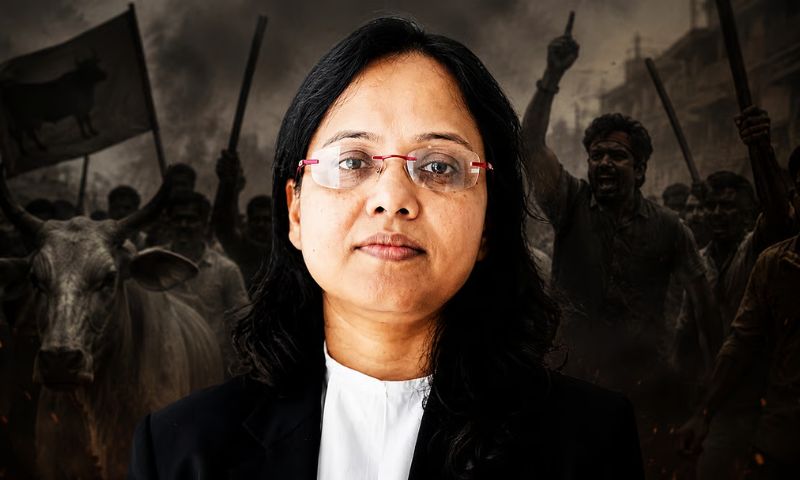
NEW DELHI: A Muslim district court judge in India’s central state of Madhya Pradesh has been placed under police protection after receiving a wave of death threats and online abuse following her conviction of 14 men over the 2022 lynching of a Muslim cattle trader in a case widely described as an instance of cow vigilantism.
Additional District and Sessions Judge Tabassum Khan sentenced the 14 men to life imprisonment on June 12, 2026 after finding them guilty of offences including murder, attempted murder, rioting and wrongful restraint. In her judgment, she concluded that the attack constituted a clear case of mob lynching.
The case stemmed from an incident in 2022 when a Muslim Nazir Ahmad, 50, was transporting cattle at night. According to the prosecution, his vehicle was intercepted by a group of self-styled cow protectors armed with sticks and metal rods. Ahmad and two companions were dragged from the vehicle and brutally assaulted on suspicion of cattle smuggling.
Ahmad later died from his injuries, while the two surviving victims testified during the trial, helping secure the convictions.
The verdict has since triggered a backlash from sections of Hindu nationalist groups and self-proclaimed cow protection organisations. While judicial decisions are frequently debated in India, much of the criticism directed at Judge Khan has centred on her Muslim identity rather than the legal basis of her ruling.
Numerous videos circulating on social media have contained communal slurs, rape threats and death threats against the judge. In some clips, speakers alleged that she had acted against the convicted men because they were Hindus, while others demanded their release and warned of nationwide unrest if the sentences were not overturned.
The online campaign followed protests outside the courtroom by relatives of the convicted men, who attempted to obstruct the police convoy transporting them to prison. Family members claimed the accused had merely been protecting cows, which are regarded as sacred by Hindus and enjoy legal protection against slaughter in many Indian states. The controversy soon spread beyond Madhya Pradesh.
Several Hindu nationalist and cow protection groups organised demonstrations in different parts of the country. During one protest in Punjab, demonstrators burnt an effigy of Judge Khan, while another protest in Uttar Pradesh demanded the immediate release of those convicted.
The case has drawn strong condemnation from India’s legal community. Former Supreme Court judge Markandey Katju criticised attempts to undermine the verdict by focusing on Judge Khan’s religion rather than her legal reasoning. He argued that questioning a judge’s legitimacy on the basis of religious identity posed a serious threat to judicial independence.
Katju later revealed that Judge Khan had contacted him to express gratitude for his public support, saying the sustained abuse had left her traumatised and made her feel as though she had committed an offence simply by performing her judicial duty.
Leading legal bodies, including the Supreme Court Advocates-on-Record Association (SCAORA) and the Supreme Court Bar Association (SCBA), have also condemned the threats and called for firm action against those responsible.
SCBA President Vikas Singh said intimidation of judges undermined the rule of law and the foundations of democracy.
“No judge can deliver justice freely if they fear threats or intimidation,” he said, stressing that judges must be able to perform their duties without fear or favour.
Police have confirmed that criminal proceedings have been initiated over the threats. Officials said two suspects had been arrested and that cyber investigators were tracking individuals responsible for circulating inflammatory content online while continuing to monitor social media platforms.
However, senior advocate Sanjay Hegde argued that stronger institutional safeguards were needed to protect serving judges.
Drawing comparisons with a previous case involving threats against former Bombay High Court judge Gautam Patel, Hegde said judicial protection should not depend on a judge’s rank or religion. Patel had received state protection following a High Court order after facing prolonged threats linked to one of his judgments.
Last week, the Madhya Pradesh High Court directed senior state officials to explain what measures had been taken to safeguard Judge Khan and identify those responsible for the threats. The court also ordered that her police protection remain in place while investigations continue.
The episode has renewed concerns over the safety of Muslim judicial officers in India and highlighted the continuing tensions surrounding cases linked to cow vigilantism, a phenomenon that has repeatedly sparked communal violence and raised questions about the protection of minority communities and the independence of the judiciary.