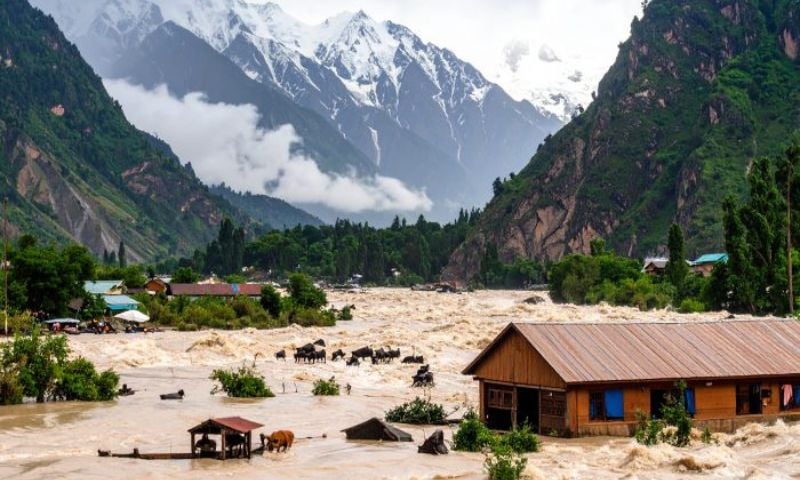
ISLAMABAD: Pakistan Meteorological Department (PMD) has issued a high-priority Glacial Lake Outburst Flood (GLOF) alert for Gilgit-Baltistan and Khyber-Pakhtunkhwa, warning that an approaching westerly weather system could accelerate snow and ice melt, dramatically expanding glacial lakes and posing a serious threat to downstream communities.
⚠️ GLOF ALERT: PMD Issues Advisory for Gilgit-Baltistan & Khyber Pakhtunkhwa#golfalert #RiverFlow #RainAlert #PMD #PakistanWeather #Monsoon2026 #FloodMonitoring #WeatherUpdate #StaySafe @ndmapk @PDMAKP @gbdma pic.twitter.com/Wub89YSF9l
— Pak Met Department محکمہ موسمیات (@pmdgov) July 11, 2026
With daytime temperatures already running above normal across the region’s glaciated valleys, the PMD cautioned that the combination of substantial warming and incoming precipitation could prove dangerous, triggering flash floods, landslides, and debris flows that may cut off remote settlements and endanger lives.
In an advisory shared on social media platform X, the department stated that “a fresh westerly wave is likely to approach northern areas of Pakistan during the following week,” bringing with it “partly cloudy to cloudy weather with moderate to heavy rain/thundershowers” expected in both GB and KP.
PMD Glacier Lake Monitoring Update: Air Temperatures Observed Across Glaciated Valleys on July 11, 2026 at 2000PST.#PMD #GLOFMonitoring #GlacierLakeMonitoring #PakistanWeather #AirTemperatureUpdate #GlaciatedValleys #GilgitBaltistan #KhyberPakhtunkhwa #NorthernPakistan pic.twitter.com/jeSnZZ6zB3
— Pak Met Department محکمہ موسمیات (@pmdgov) July 11, 2026
Perfect storm brewing in the north
The timing of the weather system has alarmed meteorologists, as temperatures are already elevated across the mountainous regions, a scenario that dramatically heightens the risk of sudden meltwater surges.
“The combination of substantial warming and precipitation is likely to substantially accelerate snow and ice melt,” the PMD warned in its advisory.
The department cautioned that river water levels were likely to remain high, existing glacial lakes could rapidly expand, and new glacial lakes could form because of increased volumes of meltwater. This expansion poses a cascading threat, as the rapid growth of these water bodies can destabilise natural ice or moraine dams that hold them in place.
“Rapid expansion of glacial lakes could destabilise natural ice or moraine dams, potentially triggering GLOF incidents,” the advisory read.
Rain-Wind/Thundershower Expected in Kpk, Kashmir, upper punjab and surrounding During the Next 3–6 Hours.#PMD #PakistanWeather #WeatherUpdate #RainAlert #Thunderstorm #KhyberPakhtunkhwa #Kashmir #Monsoon2026 #StayWeatherAware pic.twitter.com/K7IjzUFQrd
— Pak Met Department محکمہ موسمیات (@pmdgov) July 11, 2026
Landslides and debris flows add to danger
Beyond the immediate threat of glacial lake outbursts, the PMD also warned of secondary hazards that could prove equally deadly. Thawing permafrost, combined with excess surface water from rainfall and snowmelt, could trigger heavy mud and debris flows cascading down mountain slopes.
The department also flagged an increased likelihood of landslides in steep terrain, which could block roads, damage infrastructure, and isolate already vulnerable communities.
Vulnerable downstream locations and low-lying areas adjacent to riverbeds face “a high risk of sudden inundation,” according to the advisory, while flash flooding remains a significant concern in other vulnerable locations across both provinces.
⚠️ GLOF ALERT: Advisory for Gilgit-Baltistan & Khyber Pakhtunkhwa#PMD #GLOF #GlacialLakeOutburstFlood #WeatherAlert #GilgitBaltistan #KhyberPakhtunkhwa #FlashFlood #Landslide #DisasterPreparedness #StayAlert #PakistanWeather #PublicSafety pic.twitter.com/tee9VzSdDk
— Pak Met Department محکمہ موسمیات (@pmdgov) July 11, 2026
Public urged to exercise caution
The PMD issued a comprehensive set of safety recommendations for residents and visitors in the affected regions, urging extreme vigilance in the coming days.
Key advisories for the public include:
- Staying away from riverbanks, stream beds, and local nullahs
- Monitoring water levels closely in their vicinity
- Refraining from camping, trekking, or staying near riverbanks, streams, glacial lakes, and narrow mountain valleys
- Avoiding steep slopes and unstable terrain where melting snow could trigger landslides or debris flows
- Continuously monitoring weather forecasts and official advisories issued by the department
Authorities put on high alert
The advisory also called on disaster management authorities and relevant line departments to maintain “24/7 alertness” and take all necessary measures to avoid any untoward situation.
The PMD urged authorities to rapidly disseminate the alert through all available communication channels, including SMS, social media platforms, and local community networks, ensuring that even remote settlements receive timely warnings.
“All concerned are advised to remain alert and take necessary measures to avoid any untoward situation,” the department reiterated in its advisory.
Weekly Weather Outlook (11–17 July 2026)#PMD #pmdweather #WeatherUpdate #WeeklyWeather #PakistanWeather #RainAlert #thunderstorms #hotweather pic.twitter.com/wgvEYAjG5F
— Pak Met Department محکمہ موسمیات (@pmdgov) July 11, 2026
Climate change amplifying risks
The alert comes against the backdrop of Pakistan’s growing vulnerability to climate-induced glacial hazards. The country hosts more than 7,000 glaciers—the largest concentration outside the polar regions—and has experienced a sharp increase in GLOF events in recent years as global temperatures continue to rise.
In 2022, devastating floods across Pakistan killed over 1,700 people and affected millions, with glacial melt contributing significantly to the catastrophic water levels. The northern regions of G-B and K-P have become increasingly susceptible to such events, with communities living in the shadow of unstable glacial lakes facing existential threats.
As the westerly system approaches, the coming week will prove critical for disaster management agencies and local communities alike, as they brace for what could be the first major glacial flood threat of the 2026 season.