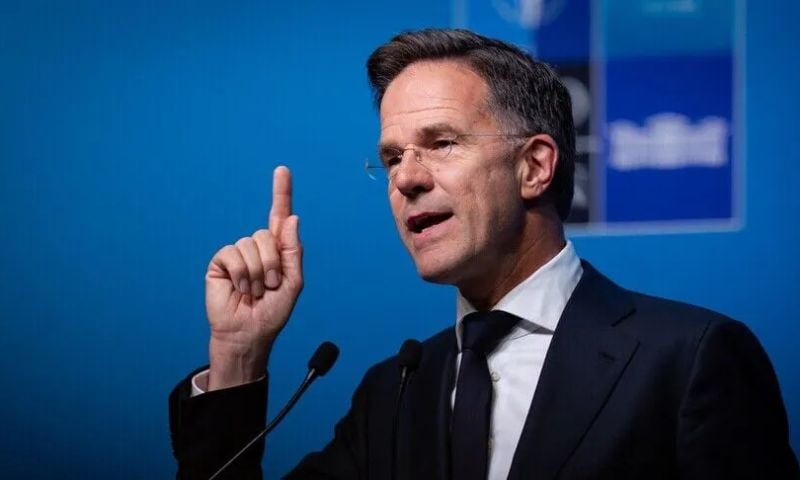



ANKARA, Turkiye: The Secretary-General of North Atlantic Treaty Organisation (NATO) Mark Rutte on Wednesday said the alliance’s leaders’ summit demonstrated a strong sense of unity despite disagreements that emerged during the gathering.
Rutte’s remarks came hours after US President Donald Trump announced that he would cut trade ties with Spain and renewed his claims over Greenland.
“We felt this alliance is more together than ever,” Rutte said during a news conference after the summit.
“The message from this summit is simple: NATO delivers. One year ago, we thanked allies who took historic decisions to strengthen our alliance. Here in Ankara, excellently hosted by President Erdogan, we have demonstrated that those commitments are now being fulfilled,” he said.
The #NATOsummit in Ankara concluded with a clear message: NATO delivers.@SecGenNATO highlighted rising defence investment, new capabilities, expanding defence industrial production, and greater responsibility by European Allies and Canada ↓https://t.co/HLYaQnoQ5b
— NATO (@NATO) July 8, 2026
Rutte said allied nations continue to increase their defence spending, while new military capabilities are being developed and defence industries are ramping up production. He added that European allies and Canada are assuming “greater responsibility” for the alliance’s collective security.
“Allies revealed the significant progress already made toward investing 5 percent of GDP in defence by 2035. Already measuring 4 percent, just one year into a 10-year project. So the momentum is clear. Allies continue to increase both core defence spending and broader investment that strengthens our security,” he added.
NATO’s collective deterrence
“They are generating the capabilities our defence plans require and stepping up their contribution to NATO’s collective deterrence and defence. This is not simply about spending more. It is about ensuring that our armed forces have what they need to keep our 1 billion people safe in a more dangerous world,” he said.
Rutte said the alliance is now focused on achieving its agreed targets, stressing that doing so will require accelerating defence production, reducing bureaucratic hurdles, strengthening resilience, increasing investment in innovation, and enhancing cooperation with partner nations.
“The NATO Summit Defence Industry Forum demonstrated the determination of governments and industry to work together with the greatest determination. And the numbers are staggering, including over $50 billion in new procurement deals in just one day. We also launched a new major initiative, NATO’s Drones, which will see $40 billion invested by allies … over the next five years,” he said.
✧ Ironclad commitment to Article 5
✧ Defence investment rising
✧ New capabilities delivered
✧ Industry production expanding
✧ European Allies and Canada assuming greater responsibility@SecGenNATO | #NATOsummit pic.twitter.com/s1JREUINPq— NATO (@NATO) July 8, 2026
Rutte said major agreements had been reached between US and European defence companies, adding that the new investments and industrial commitments would strengthen the alliance’s collective defence while driving innovation, economic growth, and skilled employment across member states.
Calling for sustained investment and industrial cooperation, he said NATO countries were taking “a historic step” to strengthen the alliance’s fuel supply chain.
“While allies continue to finalise the details, we know that this $30.8 billion investment will modernise our existing fuel storage and distribution infrastructure and support new facilities, including pipelines, toward the eastern part of the alliance,” he said.
Rutte said NATO was also seeking to make greater use of advanced technologies, including by integrating cutting-edge artificial intelligence models and developing an interoperable transatlantic warfighting platform. He added that credible deterrence and collective defence depended on turning commitments into action, stressing that the alliance was already delivering on its objectives.
Support for Ukraine
Rutte said allies had reaffirmed NATO’s unwavering support for Ukraine against war with Russia. He noted that member states had pledged to provide at least $79.8 billion in military equipment, assistance, and training to Ukraine this year and again next year, while continuing efforts to support a peaceful resolution to the conflict.
Rutte also said allies had reaffirmed their commitment to collective defence under Article 5 of the North Atlantic Treaty, under which an attack on one member is regarded as an attack on all.
He added that NATO’s unity, solidarity, and collective strength remained the foundation of peace, security and prosperity. Leaders also agreed on the need to modernise the alliance and prepare for future challenges through a stronger Europe and a stronger NATO.
Rutte said European allies and Canada, in partnership with the United States, were assuming greater responsibility for the alliance’s defence through increased investment and major industrial agreements on both sides of the Atlantic. He described the shift as part of “NATO 3.0” — an alliance that continues to adapt and deliver in order to safeguard one billion people.