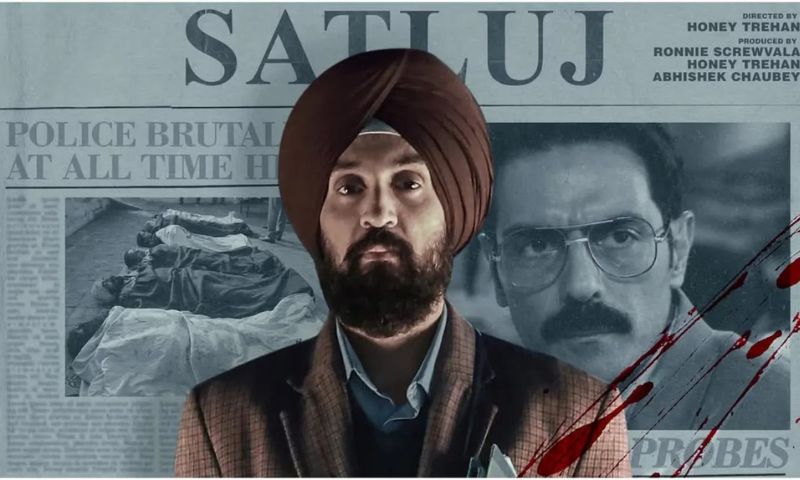
ISLAMABAD:In a move that has sparked outrage across political and religious lines, India, the world’s largest democracy, has banned the film Satluj (formerly Punjab 95), a powerful cinematic chronicle of state atrocities against Sikhs and the courageous fight of human rights activist Jaswant Singh Khalra.
Originally scheduled for release in 2025, the film was finally permitted after a name change and a staggering 127 cuts demanded by the Central Board of Film Certification. Yet, just two days after its release, the platform was directed to remove the film from Indian viewers, citing “security concerns” and obligations under IT Rules 2021. The message was clear: some truths are too uncomfortable to be told.
By silencing Jaswant Singh Khalra’s biopic, the state has once again revealed its unwillingness to confront the voices of those innocents who were brutally tortured and disappeared, write Jagpreet Singh & Nishtha Sood.
Read: https://t.co/8eUleutxTH— The Quint (@TheQuint) July 6, 2026
The story that could not be told
Satluj chronicles the life of Jaswant Singh Khalra, a human rights activist who dedicated his life to documenting the dark chapter of Punjab’s history between 1984 and 1995.
During this period, counter-insurgency operations resulted in mass arbitrary detention, torture, extrajudicial killings, and enforced disappearances of thousands of Sikhs. Khalra’s investigation led him to municipal cremation records in Amritsar, where he uncovered evidence that thousands of unidentified bodies, young Sikh men, had been illegally cremated by the police without their families ever being informed.
“Khalra dedicated his life to bringing that painful period of Punjab’s history to the world. With his efforts, thousands of families had hope of justice for their young sons who had gone missing,” said Shiromani Gurdwara Parbandhak Committee (SGPC) President Harjinder Singh Dhami. “The sad part is that Khalra, who was the hope of the people, was also brutally killed by the police”.
In September 1995, Khalra was abducted outside his home in Amritsar. After a decade-long legal battle, four Punjab Police personnel were convicted for his abduction and murder in 2005, with the Punjab and Haryana High Court enhancing their sentence to life imprisonment in 2007.
Regarding the shameful ban on the film “Satluj”/”Punjab 95” in India
I thankfully got a chance to watch the extremely powerful film “Satluj” on Zee5 over the weekend before the Modi Govt abruptly pulled it down.
The film tells the story of human rights crusader Jaswant Singh… pic.twitter.com/gG8sPFOV5O
— Saket Gokhale (@SaketGokhale) July 6, 2026
A history of broken promises
The film’s silencing evokes painful memories of promises made and broken to the Sikh community. At the time of Partition, Jawaharlal Nehru offered Sikhs semi-autonomous status and offered an autonomous Sikh homeland within India, a parallel parliament, and reservation of key positions, including Deputy Prime Minister.
Nehru also made vague commitments, stating at the 1929 Lahore Congress session that the “brave Sikhs of Punjab are entitled to special consideration” and supporting “semi-autonomous units.”
FREEDOM OF SPEECH IS DEAD IN INDIA#Satluj has been taken down from ZEE5 after being held up by the CBFC for three years
Irrespective of ideology, ART shouldn’t be banned in India
Are we back to the Nehruvian era of censorship? pic.twitter.com/YP6dDI1QhD
— DostcastDaily (@dostcastnews) July 5, 2026
Sikhs chose India, but the promises remained unfulfilled. After independence, states were reorganised on linguistic grounds. Sikhs, a minority in Eastern Punjab, demanded a Punjabi-speaking Suba without Hindu-majority Himachal and Haryana, sparking the Punjabi Suba Movement. In 1955, the State Reorganisation Commission rejected the demand, arguing that “Punjabi was not distant enough from Hindi.”
After years of agitation, Punjab was finally created in 1966, but disputes over the shared capital and river control led to the Anandpur Sahib Resolution of 1973, demanding greater autonomy.
The central government labelled these demands secessionist. To break the Akalis, Indira Gandhi encouraged a more radical alternative: Sant Jarnail Singh Bhindranwale. Punjab descended into a full-fledged separatist movement.
In 1984, the Indian army attacked the Golden Temple in Operation Blue Star, leading to Indira Gandhi’s assassination and the 1984 Sikh pogroms. Khalra documented the subsequent period from 1984 to 1995, marked by brutal counter-insurgency operations.
India can watch propaganda like Bengal Files, Kerala Story but not Satluj.
Battled with censors for years, changed 2 titles, 120 cuts only to get 2 days of viewership.
Zee5 removes it.It’s about Jaswant Singh Khalra who investigated the cremation of 25000 people.#Satluj pic.twitter.com/jos852DkrC
— D (@Deb_livnletliv) July 6, 2026
A nation afraid of its own history
The ban on Satluj has drawn sharp criticism from across the political spectrum. Shiromani Akali Dal president Sukhbir Singh Badal condemned the move, calling it “an assault on our collective memory, truth, and freedom of expression”. “Punjab deserves to confront its past with honesty, not suppression,” he said.
Senior Congress leader Sukhpal Singh Khaira noted that the film’s removal contradicts the Supreme Court’s decision that upheld the conviction of police officers responsible for Khalra’s abduction. “This film is based on true facts that were upheld by the Hon’ble Supreme Court of India while convicting guilty police officers,” he said.
AAP MP Malvinder Singh Kang drew a sharp contrast, stating, “Propaganda-driven films such as The Kashmir Files and The Kerala Story were promoted and screened without obstruction. Yet when a film raises uncomfortable questions about the human rights violations and atrocities in Punjab, it disappears from an OTT platform”.
A legacy of loss and addiction
The heavy-handedness that quelled the insurgency did not end the suffering. Since the early 2000s, Punjab has been flooded with synthetic drugs.
According to a 2017 NCBI NIH report, over 75% of Punjab’s population is addicted, and nearly every third family has one addict. Nearly 66% of school children have tried drugs. One generation was killed being labelled terrorists; another has been lost to drugs.
Human rights activist and US Congressman Edolphus Towns noted, “Under the umbrella of democracy, India has killed more than 2.3 to 3.2 million Sikhs since 1947.” The 25,000 documented cases that Khalra exposed were merely the tip of the iceberg.
Satluj (or Punjab ’95) is a deeply important film that deserves a much wider release so more people can watch it and engage in honest conversations about Punjab’s complex and violent history. Jaswant Singh Khalra’s work documenting extrajudicial killings required immense courage… pic.twitter.com/MEUMSZz2Ye
— Archit Puri (@bantofu) July 6, 2026
A voice silenced, but not forgotten
The director of Satluj, Honey Trehan, had earlier stated, “CBFC tells us to change the name of Jaswant Singh Khalra, the real-life person on whom our film is based. What they are asking is the deletion of the name of a martyr from our history. Jaswant Singh Khalra has been abducted once again; this time by the CBFC”.
Diljit Dosanjh, who portrayed Khalra in the film, had anticipated the suppression. In an Instagram Live session, he said, “Today is Saturday. I feel it could be taken down by Monday”. He later added that Khalra’s voice had been suppressed in 1995 and was being suppressed even today.
Satluj may have disappeared from Indian screens, but Jaswant Singh Khalra’s question remains alive: who has the right to bury truth, and for how long? As the SGPC president declared, “The pages of history cannot be erased, nor can the truth be silenced through any ban”