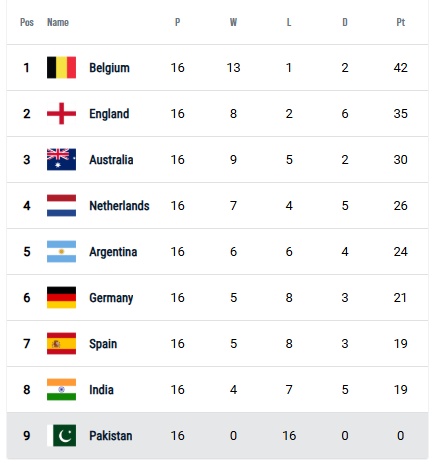
For a nation that once set the standard in world hockey, defeat has become an uncomfortable routine. Pakistan’s 7-0 defeat to England in London this week marked its 16th consecutive defeat in the FIH Pro League, reinforcing a reality that extends far beyond the scoreboard. Years of administrative turmoil, financial uncertainty and structural neglect have left Pakistan no longer competing on equal terms with the world’s elite hockey nations.
The scoreline during their 4-3 loss against India even hinted at resilience. Pakistan led early, fought back late and narrowly lost after conceding four goals. Yet beneath the competitive appearance lay familiar shortcomings and a widening gap in tactical execution against higher-ranked opponents.
Those weaknesses have become recurring features of Pakistan’s modern hockey story. The more difficult question is, why do they continue to exist?
A system under strain
Pakistan entered the 2025-26 FIH Pro League through unusual circumstances. After finishing as runners-up in the Nations Cup, the team gained promotion only when New Zealand declined to participate due to financial constraints.
Yet Pakistan’s return to elite international hockey was accompanied by administrative and logistical difficulties. Upon arriving in Australia earlier this year, players discovered that their hotel reservation had been cancelled because accommodation bills had not been paid. After nearly a full day of travelling, the squad reportedly waited for hours outside the hotel before alternative arrangements were made.
For elite athletes expected to compete against Olympic champions and World Cup contenders, such conditions inevitably affect performance.
The controversy ultimately triggered sweeping changes within the federation’s leadership, adding another chapter to years of instability.
Decline cannot be explained by talent alone
Pakistan’s recent defeats are often attributed to technical deficiencies, but reducing the issue to player quality oversimplifies a much larger problem.
Modern international hockey demands year-round preparation, sports science, specialised coaching, performance analytics and consistent exposure to elite competition. Successful nations invest heavily in professional structures that allow players to develop continuously rather than preparing only before major tournaments.
Pakistan, by contrast, continues to struggle with irregular domestic competitions, inconsistent funding and limited pathways for emerging players.
The consequences become visible during international tournaments.
Against India, Pakistan showed attacking intent but gradually lost control of possession and defensive shape after the opening quarter. Similar patterns emerged throughout the Pro League campaign, where Pakistan frequently competed early before fading physically and tactically.
The problem is not a lack of commitment from players. It is the absence of an ecosystem capable of preparing them for hockey’s highest level.
The financial gap
Pakistan’s hockey crisis is often framed as a talent issue, but the numbers point to a far deeper imbalance. The national team is trying to compete with the world’s best on only a fraction of their financial resources.
Unlike leading hockey nations, the Pakistan Hockey Federation (PHF) has no stable annual budget and relies largely on periodic government grants and emergency support. Even the recently announced Rs150 million grant by the Punjab government was considered a major boost. Overall, Pakistan’s annual hockey budget is estimated at just $0.5-0.7 million. There have also been periods when the federation operated without a formal budget, while players went unpaid.
The contrast is stark.
Australia’s high-performance programme operates on an estimated annual budget of $4-6 million, funded through the Australian Sports Commission, the Australian Institute of Sport and corporate partnerships.
Belgium invests an estimated $4.3-7.5 million annually, supported by regional governments, sponsors and one of Europe’s strongest club systems.
Germany’s federation receives around $3.8-6 million each year through its federal high-performance sports programme, enabling sustained investment in coaching, sports science and youth development.
The gap is not merely financial but structural. While Australia, Belgium and Germany can plan Olympic cycles years in advance, Pakistan’s limited resources are largely consumed by travel, accommodation, daily allowances and administrative expenses, leaving little for grassroots development, sports science or talent identification.
Earlier this year, those financial constraints were exposed when unpaid hotel bills left the national team stranded in Australia ahead of a Pro League fixture.
In practical terms, Pakistan’s hockey programme operates on barely 10 to 15 per cent of the budget available to its elite rivals. More damaging than the funding gap itself, however, is the absence of financial certainty.
Governance remains central challenge
Financial resources matter, but governance determines how effectively those resources are utilised.
Pakistan hockey has spent years grappling with allegations of administrative irregularities, delayed elections, financial disputes and institutional uncertainty.
Frequent leadership changes have prevented continuity in technical planning.
Without stable governance, even talented coaches struggle to implement long-term development programmes. Selection policies change, domestic structures remain inconsistent, and players face uncertainty about contracts, camps and international tours.
The result is a system that reacts to crises instead of preventing them.
Ironically, Pakistan continues to produce naturally gifted players capable of competing individually against the world’s best. What they lack is the institutional support that transforms individual ability into sustained international success.
Looking beyond nostalgia
Pakistan’s hockey history remains unmatched in many respects. Four World Cup titles, three Olympic gold medals and decades of international dominance continue to inspire generations.
But history no longer wins matches. Pakistan’s latest Pro League campaign should be viewed as more than a disappointing series of defeats. It offers a comprehensive diagnosis of structural decline.
The encouraging aspect is that solutions are neither unknown nor impossible. Hockey requires a long-term national strategy insulated from recurring administrative upheaval.
Pakistan hockey’s revival will require far more than periodic government grants. Sustainable funding, greater corporate investment, departmental teams, stronger grassroots structures and new commercial revenue streams—potentially through a franchise-based hockey league modelled on the Pakistan Super League—will all be essential to rebuilding the sport.
The Punjab government’s recent financial support offers an opportunity to begin that process. Whether it marks the start of long-term structural reform or proves to be another short-lived intervention will determine whether Pakistan’s hockey renaissance remains an enduring ambition or finally begins to take shape.