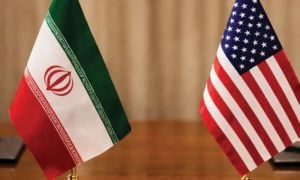
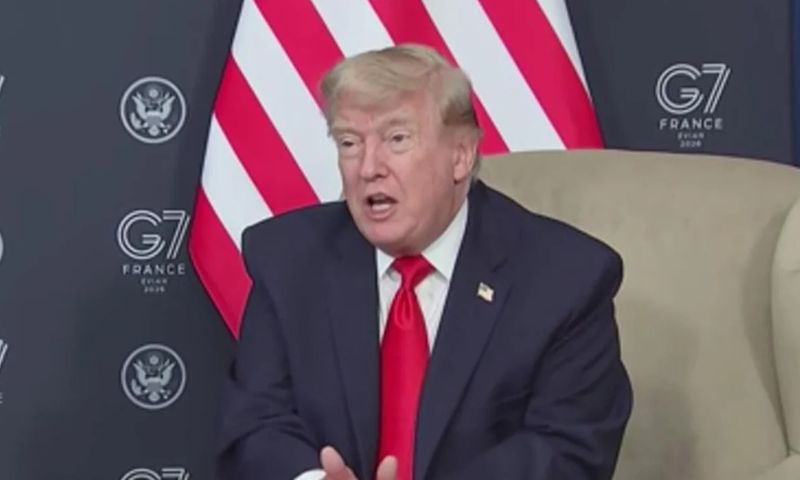



EVIAN, France: US President Donald Trump said on Wednesday that the memorandum of understanding reached between the United States and Iran was “very strong”, expressing confidence that the Strait of Hormuz would fully reopen within days as both countries are ready to sign the Pakistan-mediated landmark peace framework on Friday.
Speaking alongside Egyptian President Abdel Fattah el-Sisi at the Group of Seven (G7) summit in the French resort town of Evian, Trump described the memorandum of understanding reached between Washington and Tehran as a significant step forward.
“Nobody knows what it is, but it’s very strong,” Trump told reporters.
He said the Strait of Hormuz, one of the world’s most important energy transit routes, would be fully open within the next “day or two”.
“What is really happy is the market that has gone wild. It’s gone through the roof. And oil has tumbled down,” Trump said. “That speaks louder than words.”
US-Iran to sign peace deal on Friday
The US President’s comments came as the United States and Iran prepared to sign a landmark memorandum of understanding on Friday in Switzerland to end the months of hostilities.
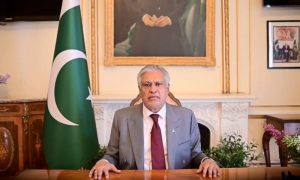
Mediator Pakistan, which played a key role in brokering the deal, will be hosting the peace deal signing ceremony.
Washington and Tehran will launch negotiations on a comprehensive peace settlement, following months of diplomatic efforts to resume the US-Iran talks.
The talks are scheduled to begin immediately after the formal signing of the framework agreement at the Burgenstock resort overlooking Lake Lucerne. Negotiators are expected to work towards a broader accord covering Iran’s nuclear programme, sanctions relief and regional security arrangements.
Iranian Foreign Minister Abbas Araghchi confirmed that a new round of negotiations between Tehran and Washington would begin on Friday.
“Likely on Friday, a new round of negotiations between Iran and the United States to reach a final agreement will begin,” Araghchi said.
“In the final agreement, decisions will be made on the nuclear issues and the lifting of sanctions.”
Iranian Parliament Speaker Mohammad Bagher Ghalibaf is expected to attend the signing ceremony, while US Vice President JD Vance will represent Washington. Trump has also indicated that he may attend.
The diplomatic breakthrough follows weeks of diplomatic efforts to consolidate an April ceasefire and reduce tensions across the Gulf region.
Diplomats and world leaders have credited Pakistan with helping facilitate dialogue between the two sides and encouraging continued engagement during difficult stages of the negotiations.
Officials familiar with the process said Pakistan worked closely with Qatar to maintain momentum that ultimately led to the framework agreement.
Pakistan’s leadership remained actively engaged in diplomatic outreach throughout the crisis, maintaining contacts with regional capitals and international stakeholders in support of de-escalation efforts.
Iran’s nuclear programme
Despite welcoming the agreement, Trump stressed that the memorandum remained preliminary and warned that military action could resume if Iran failed to comply with its commitments.
“It’s a memorandum of understanding. And if I don’t like it, we’ll go back to shooting at them, dropping bombs on their head,” Trump said.
“If I don’t like it, if they don’t behave, we’ll go right back to dropping bombs right smack in the middle of their head.”
Trump also claimed there was a “99.99 percent chance” that Iran would never acquire a nuclear weapon under the new deal.
The US president further dismissed reports suggesting that the agreement included provisions for $300 billion in reconstruction funding for Iran.
“We’re not putting up 10 cents,” Trump said. “We are not investing, and we do not have a fund.”
He added that Washington was not asking Gulf countries to invest in Iran.
“I would say they won’t be doing it for a while until they find out the behaviour of the Iranians,” he said.
End of military operations on all fronts
Meanwhile, Iranian Deputy Foreign Minister Majid Takht-Ravanchi said the memorandum of understanding contains an explicit clause requiring an end to military operations across all fronts, including Lebanon.
According to Drop Site News, Takht-Ravanchi said the agreement also includes a mechanism to address any Israeli violations of the ceasefire arrangement.
The mechanism would be activated if Israel breached the agreement, including through military actions in Lebanon, he said.
Foreign Minister Araghchi separately stated that any future Israeli military operations in Lebanon, or continued occupation of Lebanese territory, would constitute a violation of the memorandum.
He said ending the conflict in Lebanon was inseparable from broader efforts to end regional hostilities.
Hezbollah Secretary-General Naim Qassem and Lebanese Parliament Speaker Nabih Berri have credited Iran for helping secure provisions aimed at ending Israeli military operations against Lebanon.
In a letter released by Hezbollah’s media office and reported by Drop Site News, Qassem thanked Iran for making a halt to the war in Lebanon a “first and fundamental clause” of the US-Iran agreement.
NATO welcomes Hormuz reopening
NATO Secretary General Mark Rutte welcomed the agreement and said the restoration of shipping through the Strait of Hormuz would represent a major breakthrough for global energy markets.
“The restoration of free passage through the Strait of Hormuz will be a massive step forward,” Rutte told a press conference in Brussels.
He said many NATO allies were prepared to support the initiative through efforts led by France and the United Kingdom.
The planned reopening of the waterway comes after months of disruption that affected global energy supplies and pushed oil prices sharply higher.
The Strait of Hormuz handles a substantial share of global oil and liquefied natural gas exports, making its stability critical to international markets.
Oil markets
Even as the agreement raised hopes of improved regional stability, international energy agencies warned that significant challenges remain.
The International Energy Agency (IEA) said oil flows through the Strait of Hormuz had already begun increasing in early June, aided by a rise in ship-to-ship transfers in the Gulf of Oman.
According to the agency, total Middle East oil flows rose to around 12 million barrels per day in early June from a May low of 9.6 million barrels per day.
However, the IEA cautioned that political and operational constraints, including demining efforts and unresolved transit arrangements, continue to pose risks to the recovery.
The agency forecasts global oil supply will decline by 3.9 million barrels per day in 2026 as production losses in the Middle East outweigh increasing output from the Americas.
Russian crude oil and refined fuel exports remained broadly stable at approximately 7.4 million barrels per day in May despite continued Ukrainian drone attacks on refineries, the IEA said.
The IEA also reported that global oil demand is expected to fall by 1.1 million barrels per day this year following a sharp decline of five million barrels per day between April and June.
Demand weakness, initially concentrated in regions directly affected by the Iran conflict, has spread more broadly, with deliveries of major fuels showing signs of strain across most regions.
The agency expects demand to recover next year as lower oil prices and an improving economic outlook support consumption growth.
The Organization of the Petroleum Exporting Countries (OPEC), in its own monthly report, lowered its forecast for global oil demand growth in 2026 to 970,000 barrels per day.
The IEA forecasts that global supply will remain approximately 920,000 barrels per day below demand in 2026, narrowing from previous estimates.