
ISLAMABAD: As the 2026 ICC Wo For nearly a decade, women’s cricket suffered a predictable affliction: Australia won, and everyone else fought for second place. But the 10th edition of the ICC Women’s T20 World Cup 2026 (June 12 – July 5) arrives at a perfect moment of upheaval, the old order has crumbled, yet no new order has been written.
Women’s T20 World Cup prepares to bowl off, a remarkable shift has occurred. The gap that once separated Australia from the chasing pack has narrowed to a sliver, and for the first time in a generation, the tournament is genuinely wide open.
The stage is set for the Women’s #T20WorldCup 2026 🤩
Here’s what every captain had to say before the action begins ⬇️
https://t.co/2xnX8WFBGM— ICC (@ICC) June 7, 2026
Five teams can credibly claim they have a shot at the trophy. Three of them are crammed into a single “group of death.” And Australia, the perennial champions, enter the tournament holding neither the 50-over nor T20 world crown, an unfamiliar position they haven’t faced since 2018.
“This is the most unpredictable Women’s World Cup we’ve ever had,” said one ICC analyst. “The aura of invincibility around Australia has faded. The rest have caught up. And that makes for must-watch cricket.”
Australia’s cracks: A power vacuum and selection muddles
The story begins with Australia, not because they are favourites, but because their vulnerabilities are the single biggest reason the tournament is open.
Alyssa Healy’s retirement at the start of 2026 left a leadership vacuum that has yet to be filled. Sophie Molineux was named successor, but injuries have limited her to just two of Australia’s six T20Is since taking over. In her first series as captain, Australia suffered their first bilateral defeat on home soil since 2017, falling 2-1 to India.
The captaincy has also created a selection bind. Australia are spoilt for choice in the spin department, Ash Gardner and Georgia Wareham are bankers, while Alana King starred on her return to the format in the West Indies. Molineux’s place, when fit, is never guaranteed.
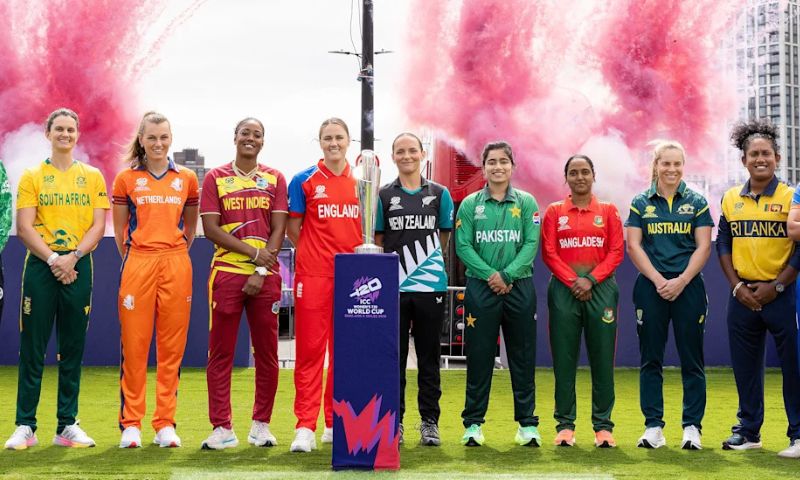
ICC Chairman Jay Shah and CEO Sanoj Gupta join captains of all 12 teams ( Including Pakistan 🇵🇰 ) participating in women’s ICC T20 World Cup at captain’s carnival oraginsed at London’s historic waterloo bridge. #Cricket pic.twitter.com/tgYnyG2jbl
— Nibraz Ramzan (@nibraz88cricket) June 8, 2026
Worse, the sheer number of world-class all-rounders means the side can look oddly balanced. Annabel Sutherland, a player who would open the batting for most nations, regularly comes in at No. 7. Too much depth, paradoxically, has led to an unclear game plan.
Australia remain No. 1 in the ICC rankings, and their talent pool remains the deepest. But the winning machine is no longer clinically ruthless. The cracks are real, and every other team can see them.
A riveting day of action on day three of the ICC Women’s T20 World Cup warm-ups 2026 👌
The #T20WorldCup warm-up matches are being streamed LIVE and FREE on https://t.co/CPDKNxpgZ3 and the official ICC channel on YouTube 📺 pic.twitter.com/DszkegoSor
— ICC (@ICC) June 9, 2026
The contenders: Five teams, One trophy
South Africa – The final specialists
No side has featured in all three of the last ICC tournament finals. That alone makes South Africa dangerous. Laura Wolvaardt is arguably the most in-form T20 batter in the world, while Marizanne Kapp gears up for what could be her last big show.
The un-retirements of Dane van Niekerk and Shabnim Ismail have addressed South Africa’s biggest gap, a premium fast bowler. With a golden generation peaking despite limited domestic investment, the Proteas have every reason to believe.
India – The mercurial powerhouse
Fresh off their 50-over World Cup triumph, India remain the most unpredictable of the top bunch. They boast one of the most powerful batting lineups in the competition, but their bowling lacks bite. Losses to South Africa and England have cast doubt on their consistency.
Yet having finally broken their ICC trophy drought last year, they now have the chance to become reigning champions in both white-ball formats. If their batting fires, no total is safe.
England – The home favourites
England haven’t reached a T20 World Cup final since 2018, but under coach Charlotte Edwards, things are clicking. They are fitter, smarter, and showing signs of explosive batting, Alice Capsey and Heather Knight’s chase against India at Taunton proved they can go pound-for-pound with anyone.
The big question: captain Nat Sciver-Brunt will be fit for the tournament opener but unable to bowl, disrupting team balance. Still, England have never lost a World Cup on home soil. With home crowds, familiar conditions, and the most complete tournament run-in, they won’t get a better chance.
New Zealand – The defending champions in transition
The White Ferns are in the final act of their goodbye tour for Suzie Bates and Sophie Devine. Their emotional 2024 victory was catharsis, about those two legends more than anything else.
Now, the baton passes to Melie Kerr, whose volume of runs since taking the captaincy shows she can win matches alone. But a lack of contributions from the rest of the XI in their series loss to England makes it hard to rank them as genuine title contenders, even if Group B makes them likely semi-finalists.
Australia – Still dangerous, but beatable
Make no mistake: writing off Australia would be foolish. They remain the No. 1 ranked side with unparalleled depth. But the aura is gone. Teams no longer fear them. And in a short format where momentum matters more than reputation, that changes everything.
The Group of death: Three giants, one early exit
Group A is where the tournament could be decided before the knockouts even begin. Australia, South Africa, and India, arguably the three main contenders, are all crammed into the same group. At least one of them will miss the semi-finals.
The opening match between Australia and South Africa could be season-defining. The loser faces an immediate uphill battle. Every match in this group will feel like a final.
Group B, by contrast, appears more open – featuring New Zealand, England, and other qualifiers. England’s path to the knockouts looks relatively straightforward, which could give them valuable momentum heading into the business end.
Why this tournament is different: The lottery factor
T20 World Cups should have an element of lottery. Fast-paced matches played in quick succession, where one extraordinary over or one dropped catch can change everything. But women’s T20 World Cups have often lacked that feeling, with the sense that only two sides could realistically lift the trophy.
This time is different.
The fabled gap between Australia and the rest no longer exists. Five teams enter with genuine belief. The captaincy pictures are unsettled. The bowling attacks have holes. The batting lineups are explosive but inconsistent. And for the first time in years, no one knows what will happen next.
What to Watch For
Laura Wolvaardt vs. Australia’s spin trio – South Africa’s opener is in career-best form. Can Australia’s spinners silence her?
Nat Sciver-Brunt’s fitness – England’s best player won’t bowl. How does that change their XI?
India’s bowling attack – Can they defend totals without a world-class pace unit?
Australia’s captaincy – Sophie Molineux leads from the sidelines as often as the field. Is that sustainable?
The 2026 Women’s T20 World Cup arrives at a perfect moment, when the old order has crumbled but no new order has yet been written. Australia are vulnerable. South Africa are hungry. India are unpredictable. England are at home. New Zealand are sentimental favourites.
For the first time in a decade, the trophy is genuinely up for grabs. The gap has closed. The lottery is real. And whoever handles the pressure best will become world champions.
Play begins June 12. Expect the unexpected.