PYONGYANG: Chinese President Xi Jinping concluded his landmark visit to North Korea on Tuesday, declaring that the two neighbouring nations had achieved a deeper and more comprehensive understanding of one another and established a clearer roadmap for the future of bilateral relations.
The visit, Xi’s first to North Korea in seven years, culminated in a summit with North Korean leader Kim Jong Un in Pyongyang, where both leaders agreed to broaden cooperation across a range of sectors, including politics, the economy and culture. State media in both countries portrayed the talks as a significant step forward in strengthening ties between Beijing and Pyongyang.
According to China’s official Xinhua News Agency, Xi told a farewell luncheon hosted by North Korean officials that mutual trust and understanding between the two countries had grown considerably during the visit.
“The mutual understanding between China and North Korea has become deeper and more comprehensive, and the direction of future development has become clearer and more defined,” Xi said before departing the North Korean capital.
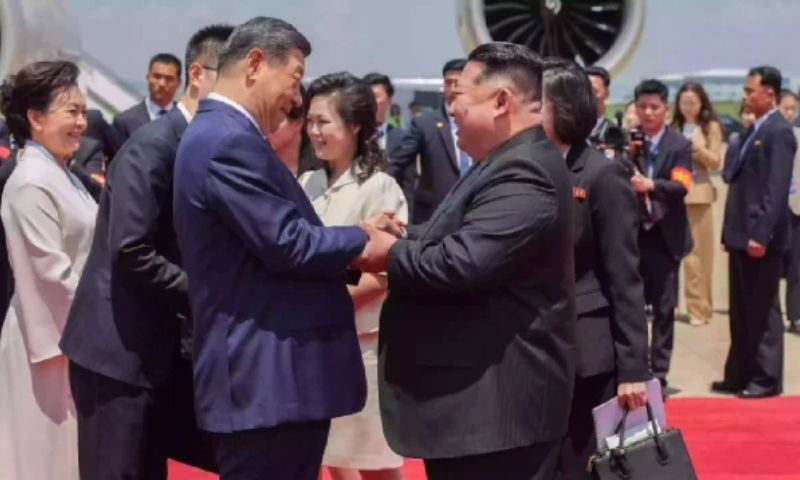
Xi received a highly ceremonial send-off as he left Pyongyang. Footage broadcast by China’s state television network showed Kim Jong Un standing on the tarmac and waving as the Chinese leader’s aircraft taxied for departure. Large crowds gathered along roads leading to the airport, waving national flags and chanting slogans celebrating friendship between the two countries.
As part of the visit’s final engagements, Xi and Kim jointly planted a fir tree at a prominent political training institution for party officials. Chinese media described the gesture as a symbol of the enduring and continually renewing friendship between the two nations.
Xi also paid tribute to historical ties by visiting Pyongyang’s Sino-Korean Friendship Tower, a monument honouring Chinese soldiers who lost their lives during the Korean War. The visit underscored Beijing’s emphasis on the shared history that has long underpinned relations between the two communist states.
North Korea’s official Korean Central News Agency (KCNA) reported that the leaders agreed to strengthen strategic communication through regular exchanges and visits by senior officials. The agency said both sides were committed to enhancing cooperation and maintaining close coordination on issues of mutual concern.
Kim also reaffirmed his support for Beijing’s “One China” principle, according to KCNA. The policy holds that Taiwan is part of China, a position strongly defended by Beijing. China continues to regard the island as its territory.
Chinese state media focused heavily on practical cooperation, highlighting proposals involving trade, agriculture, transport links and official exchanges.
Lim Eul-chul, a professor at South Korea’s Kyungnam University, observed that Pyongyang’s portrayal of the summit centred on preserving national dignity while reinforcing what it called the countries’ “special relationship”. Beijing, meanwhile, appeared more interested in promoting concrete state-to-state cooperation and broader international initiatives.
China remains North Korea’s largest trading partner and its most important economic ally. Observers had widely anticipated that Xi’s visit would focus significantly on trade, economic cooperation and the potential expansion of tourism links.
The diplomatic programme also included cultural events aimed at showcasing the close relationship between the two countries. Xi and Chinese First Lady Peng Liyuan attended a performance featuring Chinese and North Korean songs alongside Kim Jong Un and his wife, Ri Sol Ju.
KCNA reported that the event celebrated the “value and closeness” of friendship between the Democratic People’s Republic of Korea (DPRK), North Korea’s official name, and China.
At a state banquet marking the 65th anniversary of the friendship treaty between the two countries, Xi reportedly described bilateral relations as entering a “new historical starting point”. Chinese media further quoted him as pledging that Beijing would remain committed to safeguarding shared interests and maintaining strong ties with Pyongyang.
Notably absent from North Korean accounts of the summit, however, was any reference to the country’s nuclear weapons programme or its relationship with the United States. Analysts suggested this omission reflected a desire by both governments to frame the visit primarily around friendship and cooperation rather than contentious security issues.
Ja Ian Chong, a political science professor at the National University of Singapore, said the lack of public discussion on nuclear matters indicated that Beijing preferred to present the visit as a demonstration of stable neighbourly relations. The summit also comes amid renewed speculation about the future of diplomacy between Washington and Pyongyang.
During his first term in office, US President Donald Trump held three unprecedented meetings with Kim Jong Un. Those efforts eventually collapsed amid disagreements over North Korea’s nuclear programme and US demands for denuclearisation. Trump has since indicated a willingness to resume dialogue with the North Korean leader.
While questions remain over the broader geopolitical implications of the visit, the summit has reaffirmed the strategic importance of the China–North Korea relationship at a time of heightened tensions and shifting alliances in East Asia.
Both governments have portrayed the meeting as a milestone that will guide future cooperation and strengthen one of the region’s most enduring political partnerships.