
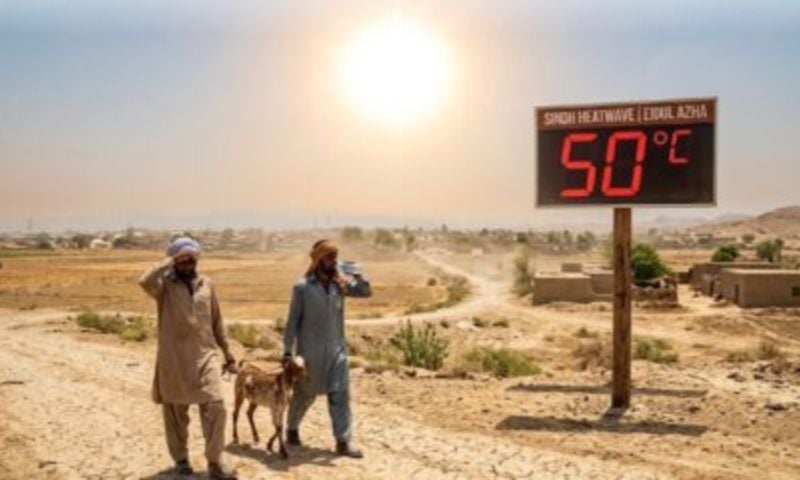



ISLAMABAD: With the mercury poised to breach the 51°C mark in several cities, the Pakistan Meteorological Department (PMD) on Saturday issued an urgent heatwave warning spanning six days, from June 7 to June 12, cautioning that large swathes of the country, particularly southern Punjab and upper Sindh, will experience temperatures four to six degrees Celsius above normal, posing serious health and infrastructure risks.
PMD Heatwave Alert: Heatwave Conditions Likely Across Pakistan from 07–12 June, with Temperatures Reaching Up to 51°C in Parts of Sindh and Balochistan#Heatwave #PMD #WeatherAlert #PakistanWeather #ExtremeHeat #StaySafe #HeatwaveAlert #گرمی #ہیٹ_ویو #موسم pic.twitter.com/MwANTN8NEd
— Pak Met Department محکمہ موسمیات (@pmdgov) June 6, 2026
The advisory, which comes on the heels of the PMD’s seasonal forecast predicting above-average heat throughout the summer, paints a grim picture of relentless thermal stress across nearly every province.
In Sindh, the most extreme conditions will unfold between June 7 and 12, with districts including Sukkur, Shikarpur, Qambar Shahdadkot, Jacobabad, Larkana, Mohenjo Daro, Dadu, Shaheed Benazirabad, Ghotki, Khairpur, Naushahro Feroze, Sibi, Turbat and Panjgur expected to swelter under 48°C to 51°C, temperatures that push the limits of human endurance.
Even Pakistan’s usually temperate northern regions will not escape. In Khyber Pakhtunkhwa, cities like Peshawar, Mardan, Bannu, Karak, Lakki Marwat and Dera Ismail Khan will see daytime highs of 41°C to 46°C from June 8 to 11, while Chitral, Dir and Swat, along with Gilgit-Baltistan, will record unseasonably warm 37°C to 40°C between June 8 and 10.
The twin capitals of Islamabad and Rawalpindi, alongside Attock, Chakwal, Jhelum, Gujrat, Mirpur, Bhimber, Kotli, Bagh and Muzaffarabad, are forecast to bake under 41°C to 44°C from June 8 to 10.
Punjab’s heartland, including Lahore, Okara, Kasur, Faisalabad, Sargodha, Multan, Bahawalpur and Bahawalnagar, will face even harsher conditions, with temperatures ranging from 44°C to 48°C between June 8 and 11.
Coastal Karachi, often spared the worst of inland heat, will see temperatures climb to 40°C to 43°C from June 8 to 12, a significant departure from its usual sea-moderated climate.
“Night temperatures are also likely to rise during the forecast period,” the PMD advisory warned, a critical detail that deprives residents of the usual nocturnal relief and increases the risk of heatstroke, dehydration and cardiovascular stress.
🏔️ Tourist Weather Update (06 June 2026): Rain-thunderstorm activity possible in Swat, Gilgit, Hunza, Skardu, Kalam & Neelum Valley on Sunday. #TouristWeather #PakistanTourism #Swat #Hunza #Skardu #Gilgit #WeatherUpdate pic.twitter.com/oJiYtcuk1H
— Pak Met Department محکمہ موسمیات (@pmdgov) June 6, 2026
The department also cautioned that intense surface heating could trigger dust storms in south Punjab and Sindh, further reducing visibility and air quality. Electricity demand is expected to spike sharply, raising the spectre of load-shedding amid already strained power infrastructure.
The PMD issued explicit safety directives: avoid unnecessary exposure to direct sunlight between 10am and 4pm, the peak heating window. Children, women, senior citizens, and those with chronic illnesses were urged to take extra precautions.
Farmers were advised to adjust crop activities and ensure livestock are sheltered and hydrated, a rare but vital warning acknowledging the agricultural sector’s vulnerability.
The heatwave warning follows the Met Office’s seasonal outlook earlier this week, which predicted “normal to below-normal” rainfall across most of Pakistan during the June–July–August (JJA) period.
🌤️ Weather Update (06 June 2026): Hot & dry conditions continue in southern Sindh and Balochistan. Partly cloudy weather expected in Upper KP, Kashmir & Gilgit Baltistan. #PakistanWeather#PakistanWeather #WeatherUpdate #Heatwave #IslamabadWeather #GilgitBaltistan #PMD pic.twitter.com/zKKPFVI7uU
— Pak Met Department محکمہ موسمیات (@pmdgov) June 6, 2026
The agency noted that the Indian Ocean Dipole (IOD) is expected to shift to a positive phase by July 2026, while El Niño conditions have already emerged and will strengthen further, a meteorological cocktail that historically amplifies heat and suppresses monsoon rains.
The largest negative rainfall departures are expected over northeastern Punjab, while above-normal temperatures will dominate nationwide, particularly in eastern Gilgit-Baltistan, Kashmir and adjoining northern Punjab.
A Success Story in Disaster Risk Reduction: PMD’s Early Warning Leads to Safe Evacuations Ahead of Hisper GLOF
PMD Early Warning Triggers Rapid Response as Glacier Burst Causes Flood Surge in Hisper–Hoper pic.twitter.com/aTWtnXsSU9
— Pak Met Department محکمہ موسمیات (@pmdgov) June 6, 2026
With the first heat spike just hours away, the PMD’s message is unambiguous: prepare, hydrate, and stay indoors, because this June is shaping up to be unforgettable for all the wrong reasons.