
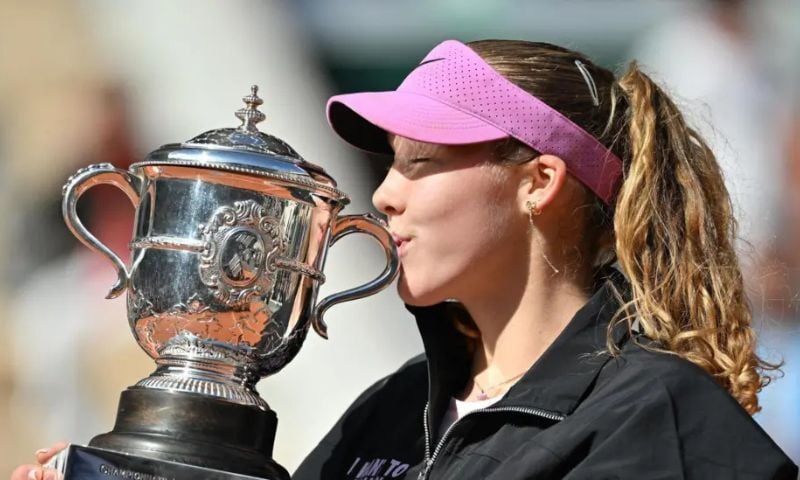
PARIS, France: In a final that pitted youth against fairy tale, it was the raw, relentless brilliance of Mirra Andreeva that prevailed. The 19-year-old Russian swept past Polish qualifier Maja Chwalinska 6-3, 6-2 on Saturday at Court Philippe Chatrier to secure her first Grand Slam title, and in doing so, etched her name alongside tennis royalty as the youngest French Open women’s singles champion since Monica Seles lifted the trophy three decades ago.
MIRRA THE CHAMPION 🏆#RolandGarros pic.twitter.com/mbInya59hj
— Roland-Garros (@rolandgarros) June 6, 2026
The occasion was supposed to be a coronation for the improbable. Chwalinska, ranked 114th in the world, had arrived in Paris as an unknown qualifier and somehow defied logic match after match, becoming only the second female player since tennis turned professional in 1968 to reach a Grand Slam final after Britain’s Emma Raducanu’s stunning 2021 US Open run. But on the sport’s grandest stage, the moment proved too immense.
Nervous start, decisive shift
Both players looked visibly tense in the opening exchanges. Chwalinska survived a marathon first service game, saving three break points with a daring mix of delicate drop shots and fearless forehand winners. For six games, neither woman could seize control. Then, at 3-3, the match tilted permanently.
Andreeva found her rhythm precisely when it mattered most. She began dictating rallies, forcing Chwalinska onto the defensive and extracting unforced errors from the Pole’s racket. A sliced backhand into the net from Chwalinska handed Andreeva the decisive break for 4-3. The Russian consolidated for 5-3 and then broke again to wrap up the first set with clinical efficiency.
Second set domination
The second set was a masterclass in composure. Andreeva broke immediately to go 2-0 up as Chwalinska sprayed yet another forehand error. The Polish qualifier, who had won nine consecutive matches from qualifying to the final, suddenly looked unrecognizable, tentative, rushed, and overwhelmed. She wasted three break points and dropped serve again to fall 4-0 behind.
Mirra reaches the crown 👑#RolandGarros pic.twitter.com/OgBcKiOHH4
— Roland-Garros (@rolandgarros) June 6, 2026
To her credit, Chwalinska did not completely crumble. She pulled one break back and made the score 5-2, briefly reviving hopes of an unlikely comeback among the hundreds of Polish fans scattered across the stands. But Andreeva, showing maturity far beyond her 19 years, closed out the match on her opponent’s serve with a stunning crosscourt backhand winner, a shot worthy of a champion.
History for Andreeva, heartbreak for Chwalinska
For Andreeva, victory means more than just a trophy. At 19 years and 42 days, she becomes the youngest woman to hoist the Suzanne Lenglen Cup since Iga Swiatek in 2020 and the youngest French Open winner overall since Monica Seles won her third straight title in 1992, aged 18. It is her maiden Grand Slam title, but on this evidence, likely not her last.
“The feeling in real life is so much better than in your dreams.”
Andreeva’s post-match interview following her final win against Chwalinska ✨#RolandGarros pic.twitter.com/4IBpeK14sa
— Roland-Garros (@rolandgarros) June 6, 2026
For Chwalinska, the defeat will sting deeply. She entered Roland Garros as a qualifier ranked outside the top 100, won nine matches in a row, and captured the hearts of tennis fans worldwide with her tactical intelligence and fearless play. But on the biggest stage of her life, the script refused to write a fairy tale ending. She walked off Court Philippe Chatrier with her head held high, a runner-up, but also a revelation.
As the Russian flag was raised and Andreeva lifted the gleaming silver trophy, the tennis world witnessed the arrival of a new superstar. Roland Garros has a new queen. And she is only 19.