UNITED NATIONS: Pakistan has said that peaceful settlement of disputes is a cornerstone of its foreign policy, and a solemn obligation under the UN Charter, emphasising that mediation must become the guiding principle of prevention, not an instrument of crisis management.
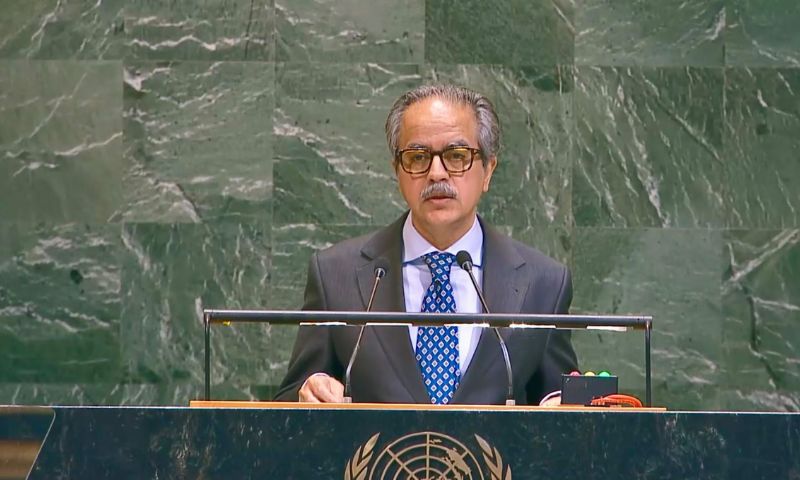
Speaking during the UN General Debate on Agenda Item 31(b): Strengthening the Role of Mediation in the Peaceful Settlement of Disputes, Conflict Prevention and Resolution, Pakistan’s Permanent Representative to the UN, Ambassador Asim Iftikhar Ahmad, said “the true test of our commitment to peace is not how we condemn conflicts after they breakout, but how proactively we prevent them in the first place”.
“Mediation is the bridge between confrontation and peace. It enables diplomacy to further its noble purpose to replace force with reason, silence with dialogue, and human suffering with justice,” Ambassador Asim Iftikhar added.
The true test of our commitment to peace is not how we condemn conflicts after they breakout, but how proactively we prevent them in the first place. Mediation is the bridge between confrontation and peace. It enables diplomacy to further its noble purpose to replace force with… pic.twitter.com/fl6TAAg1qh
— Permanent Mission of Pakistan to the UN (@PakistanUN_NY) June 1, 2026
He said that conflicts happen only when diplomacy is delayed, the path of dialogue shunned and disputes left to fester, further stating that the UN’s first responsibility is not merely to respond to conflicts after they erupt, but also to prevent them before they destroy lives, regions and generations.
Ambassador Asim referred to the Security Council resolution 2788, presented by Pakistan and adopted unanimously in July 2025.
The resolution, he said, reaffirmed the centrality of Chapter VI, encouraged the effective use of mediation and good offices, and underscored the role of the United Nations, regional and sub-regional organisations in the peaceful settlement of disputes.
Ambassador Asim said that this belief has all along guided Pakistan’s diplomatic conduct, adding that in the recent crisis in the Middle East, Pakistan stood for restraint, de-escalation and a return to diplomacy.
“As a friendly neighbour of Iran, a brotherly partner of the Gulf countries, and a country with longstanding ties of amity with the United States, Pakistan continues to make sincere efforts to facilitate a durable solution for regional and global peace and stability,” he stated.
Remarks by Ambassador Asim Iftikhar Ahmad,
Permanent Representative of Pakistan to the UN,
During the General Debate on Agenda Item 31(b): Strengthening the Role of Mediation in the Peaceful Settlement of Disputes, Conflict Prevention and Resolution
(1st June 2026)
**********… pic.twitter.com/cdNXJo6jSL— Permanent Mission of Pakistan to the UN (@PakistanUN_NY) June 1, 2026
In order to make mediation effective, the Permanent Representative shared Pakistan’s suggestions.
Ambassador Asim suggested early mediation through enhanced early warning systems, preventive diplomacy, the Secretary-General’s good offices, and proactive use of Chapter VI mechanisms.
“Anchor mediation in international law and the UN Charter, ensuring respect for rights, including self-determination, and rejecting occupation, aggression, and treaty violations,” Pakistan’s Permanent Representative suggested.
“Address root causes of conflicts, not just immediate symptoms, by resolving protracted disputes in line with relevant UN Security Council resolutions,” he added.
Ambassador Asim stressed the need to strengthen the UN mediation architecture through predictable funding for the Mediation Support Unit and deeper partnerships with regional and subregional organisations.
“Promote trust and political courage among parties, encouraging them to view mediation as a responsibility to their people and to international peace rather than a concession to the other side,” he suggested.
Ambassador Asim said that “Pakistan will continue to uphold mediation, at the heart of our collective efforts for peaceful settlement, conflict prevention and resolution.”