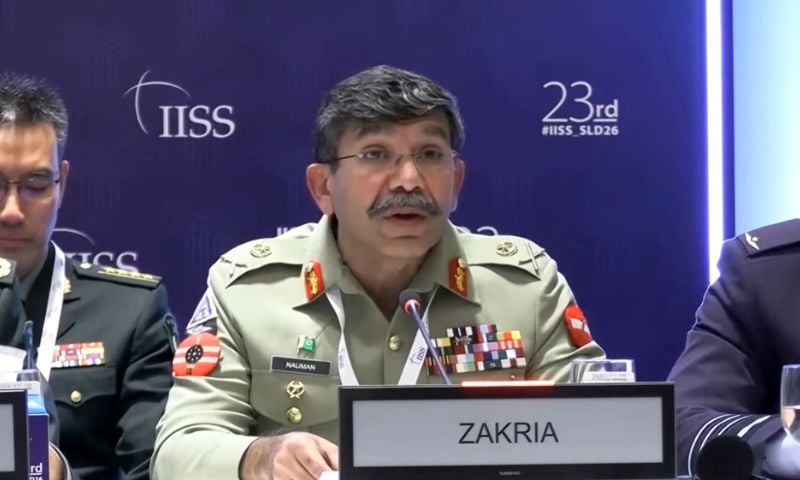
SINGAPORE: Lieutenant General Nauman Zakria has emphasised that rapid technological advancements and military modernisation must be guided by ethics, responsibility and international cooperation, warning that emerging technologies are reshaping the global security landscape and creating new risks to strategic stability.
Addressing delegates at the Shangri-La Dialogue 2026 in Singapore, Gen Zakria said the growing integration of artificial intelligence, autonomous systems, cyber capabilities, quantum technologies and multi-domain operations was transforming military decision-making and strategic competition while introducing new vulnerabilities and risks of miscalculation.
Speaking before an audience of diplomats, policymakers and military officials from around the world, he noted that increasing reliance on interconnected technological systems had compressed decision-making timelines and altered the nature of interstate conflict and deterrence.
“The information environment is becoming increasingly fragmented as digital platforms, AI-generated content and disinformation campaigns erode trust, distort narratives and compress decision-making timelines,” he said.
South Asia’s Strategic Environment
Referring to South Asia, Gen Zakria said the region’s strategic stability continued to be shaped by nuclear deterrence, conventional asymmetry, enduring political tensions and unresolved disputes between Pakistan and India.
He described China as a constructive and stabilising factor that contributes to strategic balance, regional connectivity and economic cooperation.
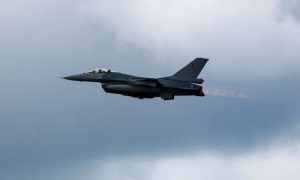
Commenting on the May 2025 conflict between Pakistan and India, Gen Zakria said Pakistan’s response demonstrated effective multi-domain operations supported by tri-service coordination and the integrated use of cyber, electronic warfare, intelligence, surveillance and space-based capabilities.
According to him, the conflict reinforced the importance of escalation control and crisis communication mechanisms in maintaining regional stability.
He warned that continued militarisation and adversarial rhetoric in South Asia, combined with the absence of robust crisis management frameworks, could undermine long-term peace and security.
Call for Global Cooperation
Gen Zakria stressed that technological innovation should not be separated from ethical responsibility and strategic accountability.
He called for internationally accepted norms governing the military use of artificial intelligence, autonomous systems, cyber operations and space technologies, arguing that human oversight must remain central in decisions involving the use of force.
The senior military official also advocated confidence-building measures, transparency mechanisms and technical dialogue among states to reduce misunderstandings and prevent destabilising arms races.
He further urged countries to strengthen direct communication channels, saying dialogue must continue even during periods of geopolitical rivalry.
“Strategic stability is preserved not only through deterrence, but through communication as well,” he said.
Concluding his remarks, Gen Zakria underscored the need for stronger international cooperation on cyber governance, responsible AI development, space security and digital ethics.
He said peace and stability have never been automatic outcomes of technological progress, but rather depend on political responsibility, strategic restraint and sustained international engagement.