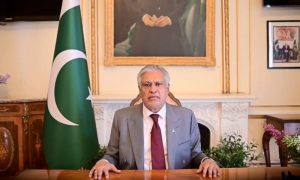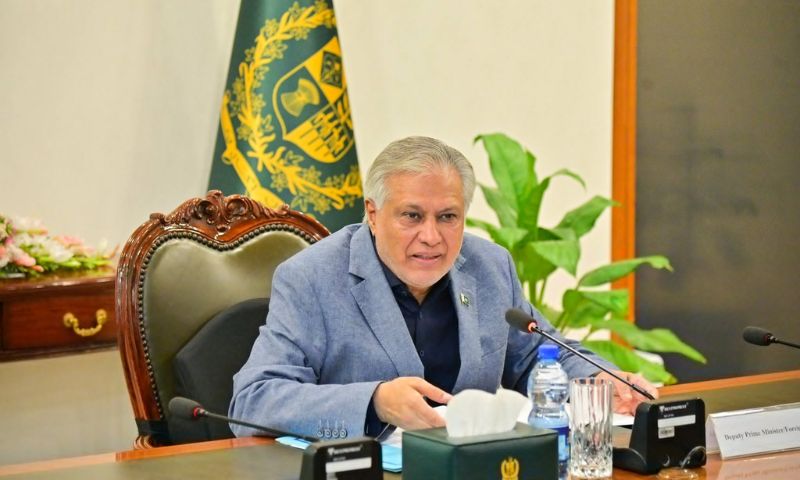



HANGZHOU, China: Pakistan and China have signed more than 300 memorandums of understanding (MoUs) and nearly three dozen joint ventures worth over $13 billion under their expanding economic partnership, Pakistan’s Deputy Prime Minister and Foreign Minister Mohammad Ishaq Dar said at a high-level B2B investment conference in Hangzhou.
Dar said around 30 per cent of the agreements had already progressed into formal contracts, reflecting growing momentum, trust and confidence between businesses from both countries.
Pakistan and China reaffirmed their expanding economic partnership as senior government officials, investors and business leaders gathered in the eastern Chinese city of Hangzhou for a major business-to-business (B2B) investment conference focused on information technology, telecom, battery energy storage systems (BESS) and agriculture.
Addressing the conference, Dar described the event as a significant step toward deepening bilateral commercial cooperation and accelerating Pakistan’s economic transformation, according to a statement issued by Pakistan’s Foreign Office on Sunday.
The conference was attended by Prime Minister Shehbaz Sharif, Zhejiang Governor Liu Jie, senior Pakistani ministers, diplomats and leading corporate representatives from both countries.
Speaking before representatives of more than 500 companies, Dar said Pakistan was pursuing an ambitious agenda of economic revival, industrial expansion and sustainable growth under the leadership of Prime Minister Shehbaz Sharif.
“Pakistan is open for business. Pakistan is reforming. Pakistan is rising,” Dar told the gathering, highlighting Islamabad’s efforts to place economic diplomacy at the centre of its foreign policy.
The deputy prime minister said the Hangzhou conference was the fifth sector-focused B2B investment forum organised between Pakistan and China in recent years. He added that more than 300 MoUs and nearly three dozen joint ventures worth over $13 billion had been signed during this period.
He said nearly 30 per cent of those agreements had already moved into formal contracts, describing the progress as evidence of “trust, confidence and shared ambition” between the two countries. Dar also highlighted several emerging success stories in bilateral business cooperation.
Referring to the recent inauguration of the IBI Pakistan Digital Economy Headquarters in Islamabad, he said the Chinese company had established operations in Pakistan within eight months of meetings held in Beijing with the Pakistani leadership. He added that IBI’s recent visit to Pakistan resulted in the signing of MoUs worth more than $1 billion.
The deputy prime minister also praised the joint venture between Pakistan’s Servis Group and China’s Long March Tyres, saying the partnership was on track to become a billion-dollar company listed on the Pakistan Stock Exchange within five years.
During his remarks, Dar commended Pakistan’s diplomatic missions in China for promoting economic diplomacy and facilitating business partnerships in priority sectors. He particularly praised Pakistan’s Ambassador to China, Khalil Hashmi, for strengthening commercial engagement between the two countries.
Dar noted that the conference coincided with the 75th anniversary of diplomatic relations between Pakistan and China, describing the bilateral relationship as an “iron brotherhood” that had endured changing global realities and regional challenges.
He said the traditionally strong government-to-government relationship was now being reinforced by a vibrant and rapidly expanding private-sector partnership. Referring to China’s development experience, Dar said Pakistan could learn valuable lessons from the Chinese economic model, particularly in industrial development and practical innovation.
“I am glad that we took that first step in Shenzhen two years ago under Prime Minister Shehbaz Sharif,” he said. “Since then, this journey has gathered momentum, confidence and purpose. And now, there is no looking back — only forward and upward.”
The conference concluded with renewed commitments from Pakistani and Chinese stakeholders to expand cooperation in technology, agriculture, industrial manufacturing and sustainable energy, reinforcing the strategic economic dimension of the long-standing bilateral partnership.