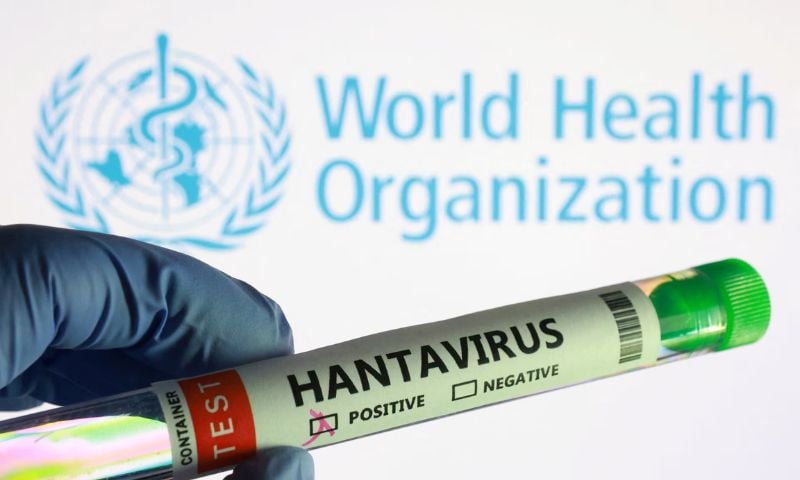



GENEVA: The World Health Organization warned on Monday that the hantavirus linked to a deadly outbreak aboard a cruise ship is most infectious at the very start of illness, stressing the need for strict quarantine measures for passengers and crew exposed to the virus.
The outbreak aboard the Dutch-flagged cruise vessel MV Hondius has killed three people and triggered global concern over the possible international spread of the virus as evacuees return to their home countries.
“The first few moments of illness is when the infectiousness is highest,” Olivier Le Polain told a WHO social media briefing.
The WHO has recommended that all nearly 150 passengers and crew members who were onboard the ship when it arrived near Tenerife in Spain’s Canary Islands on Sunday be quarantined for six weeks.
Six-week quarantine
According to the WHO, the recommended 42-day isolation period corresponds to the maximum incubation period of the Andes virus, the only known strain of hantavirus capable of human-to-human transmission.
WHO epidemic and pandemic preparedness director Maria Van Kerkhove said all individuals onboard the vessel had been classified as “high-risk” contacts.
“For people returning home, our recommendations are active monitoring and follow up and daily checks for symptoms at home or in a specialised facility for the full incubation period of 42 days, after last potential exposure,” the WHO told AFP.
The organisation said the isolation period began on May 10.
Polain said infected individuals typically begin showing symptoms after around three weeks, but stressed that authorities should not wait for symptoms to emerge before placing contacts in quarantine.
“If WHO recommends quarantine it is because actually people are infectious at the very start of illness,” he said.
He added that early symptoms could initially appear mild, including fatigue and fever, before deteriorating rapidly.
Concerns over further cases
Polain warned that additional infections could still emerge in coming days or weeks because of the virus’s lengthy incubation period.
“That’s why we need to remain vigilant, make sure that at the first signs and symptoms are being recognised, isolated and taken care of,” he said.
The WHO said the environment onboard the ship likely contributed to the spread of the virus.
“It’s an environment where people live together in a fairly enclosed space,” Polain said.
“That’s why also we likely see more spread than we would see otherwise.”
Different measures
While the WHO issues recommendations, individual governments remain responsible for implementing health protocols.
Most countries involved in the evacuation have adopted the WHO’s quarantine guidance.
Germany, Britain, Switzerland and Greece have opted for 45-day quarantine periods.
Australia and France announced shorter initial observation periods of three and two weeks respectively, with possible extensions.
The United States has taken a different approach.
According to acting director of the Centers for Disease Control and Prevention, Jay Bhattacharya, the 17 returning American passengers would not necessarily be quarantined.
Depending on individual risk assessments, passengers could return home “without exposing other people on the way”, he said on Sunday.
WHO Director-General Tedros Adhanom Ghebreyesus warned that the US approach “may have risks”. Tedros was in Tenerife to help supervise evacuation efforts.
No vaccine or approved treatment
The WHO said there is currently no licensed vaccine or treatment for hantavirus infections, which can carry fatality rates of up to 50 percent.
The organisation said early supportive treatment and rapid transfer to intensive care facilities could improve survival chances.
The WHO also urged healthcare systems worldwide to strengthen surveillance, contact tracing and infection prevention measures.
The agency said high-risk contacts could include cabin mates, intimate partners, healthcare workers exposed without protective equipment, and individuals handling contaminated materials or bodily fluids.
It also called on governments to ensure “clear and transparent communication” with affected individuals and the wider public regarding the outbreak and response measures.