ISLAMABAD: Pakistan’s President Asif Ali Zardari on Sunday said that India is using water resources as a weapon, adding that New Delhi’s unilateral decision to suspend the Indus Waters Treaty following the Pahalgam incident amounted to “hydro-terrorism”.
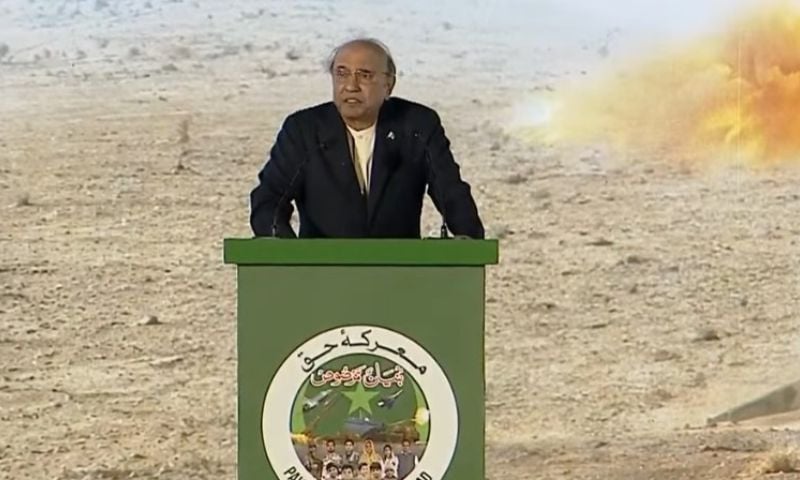
Speaking at a ceremony at the Pakistan Monument in Islamabad to commemorate one year of Pakistan’s historic military victory against India during the May 2025 conflict, President Zardari said May 10 “is a golden chapter in Pakistan’s history”, referring to the ceasefire that ended the conflict between the two nuclear-armed neighbours.
President Zardari praised Pakistan’s armed forces for their historic response during the conflict with India.
The ceremony was also attended by Prime Minister Shehbaz Sharif, Chief of Defence Forces and Chief of Army Staff Field Marshal Syed Asim Munir.
Chief of Naval Staff Admiral Naveed Ashraf and Chief of Air Staff Air Chief Marshal Zaheer Ahmad Baber Sidhu were also present on the occasion.
President Zardari said Pakistan’s response to India’s “unprovoked aggression” in May 2025 would be “written in golden letters”. He said that Indian forces had targeted Pakistan’s civilian areas and places of worship during the 2025 unprovoked aggression.
Pakistan forces down 8 Indian fighter jets
President Zardari said that during the four-day conflict, Pakistan’s armed forces had shot down eight Indian fighter jets. “Our forces shot down eight Indian fighter jets,” he said.
The President maintained that India is using water resources as a weapon. He said that New Delhi’s suspension of the Indus Waters Treaty following the Pahalgam incident amounted to “hydro-terrorism”.
The Indus Waters Treaty, brokered by the World Bank in 1960, governs water sharing between the two neighbouring countries.
Zardari praised Pakistan’s military response during the conflict, saying the Pakistan Air Force had demonstrated superior capability.
“Our pilots faced a larger adversary, but with extraordinary skill and confidence, they defended our skies,” he said.
He also commended the Pakistan Navy for defending maritime borders and said the armed forces had acted with restraint despite military capability.
“Pakistan chose to exercise restraint. Our response was mature and measured,” he added.
The 2025 conflict began after a “false flag” operation in Pahalgam.
Reiterating Pakistan’s long-standing position on Kashmir, Zardari said Islamabad would continue political, moral and diplomatic support for Kashmiris and called for a resolution in line with United Nations resolutions.
He also claimed that “India is sponsoring terrorism in Pakistan via Afghanistan”, urging an end to the use of Afghan territory for cross-border terrorism.
Pakistan’s diplomatic efforts to end Iran war
President Zardari said Pakistan’s diplomatic efforts, including its role in mediating between the US and Iran to end the Middle East conflict, had strengthened its image as a “regional stabiliser”.
He credited Field Marshal Munir and Prime Minister Shehbaz Sharif with contributing to Pakistan’s international diplomatic profile.
Zardari said Pakistan’s armed forces remained fully capable of defending national sovereignty “in the face of any challenge”.
Prime Minister Shehbaz Sharif also mentioned Pakistan’s efforts for de-escalation between the US and Iran.
’آج مجھے فیلڈ مارشل بتارہے تھے کہ ایران کا جواب موصول ہو گیا‘وزیراعظم شہباز شریف#USIranTalks #Islamabad #PMShehbazSharif #FieldMarshal #BreakingNews #SamaaTV pic.twitter.com/sjq6rqimjZ
— SAMAA TV (@SAMAATV) May 10, 2026
“Our sincere efforts continue, and Field Marshal was telling me a while ago that we have received Iran’s response,” PM Sharif said, revealing that Iran has responded to the US proposal to end the conflict.
“I cannot go into more detail. I commend the efforts of Deputy Prime Minister Ishaq Dar and congratulate Field Marshal Asim Munir, who has dedicated himself [to this cause],” PM Sharif added.