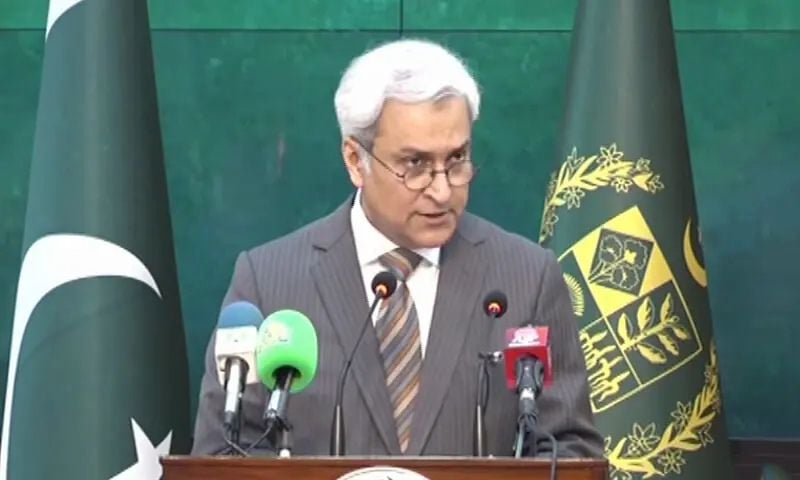



ISLAMABAD: Pakistan’s Foreign Office spokesperson Tahir Andrabi said on Thursday that Islamabad remained hopeful a US-Iran agreement would be reached “sooner rather than later”, amid Pakistan-led diplomatic efforts to end the Middle East conflict through diplomacy and negotiations.
Speaking during the press briefing, spokesperson Andrabi said Pakistan would welcome any settlement reached between Washington and Tehran, regardless of where the agreement was finalised.
“If an agreement is reached in Pakistan, it would be an honour for us,” Andrabi remarked, while reiterating Islamabad’s support for dialogue and diplomacy to ensure lasting peace and stability in the region.
The Foreign Office spokesperson also said he could not say whether the draft of the agreement would be one page or longer.
On Wednesday, Axios, while citing official sources, reported that the US expects it is moving closer to a preliminary agreement with Iran to end the war.
Foreign Office Spokesperson Tahir Andrabi is addressing weekly news briefing in #Islamabad https://t.co/Rd5K0g2CFc
— Radio Pakistan (@RadioPakistan) May 7, 2026
Pakistan’s commitment to peace
The spokesperson said that on May 4, Pakistan’s Deputy PM Ishaq Dar held a telephonic conversation with Iran’s Foreign Minister Abbas Araghchi and discussed the regional situation and Pakistan’s diplomatic efforts for peace.
“The Iranian side appreciated Pakistan’s constructive and mediation role, while the Deputy PM reaffirmed that dialogue and diplomacy remain the only path to lasting peace and stability,” the spokesperson added.
The spokesperson said that after Pakistan’s active diplomatic engagements, 22 crew members held aboard the seized Iranian container ship, ‘MV Touska’, were evacuated to Pakistan and later to Iran.
“This was a major confidence-building measure by the United States of America. These returns were coordinated in tandem with the support of both the Iranian and US sides,” Andrabi said.
There were reports that Tehran was reviewing a fresh proposal from Washington for a peace following the suspension of ‘Project Freedom’ launched by the US to open the Strait of Hormuz.
The Foreign Office spokesperson recalled that Prime Minister Shehbaz Sharif had welcomed the “timely announcement” regarding the pause in ‘Project Freedom’ and noted that Pakistan remained firmly committed to supporting all efforts that promoted restraint and the peaceful resolution of conflict between the US and Iran through dialogue and diplomacy.
The spokesperson added that PM Sharif had also expressed the hope that the “current momentum” would lead to a lasting agreement that would secure durable peace and stability for the region and beyond.
The Foreign Office spokesperson further stated that “working with the same spirit of optimism and positive engagement”, Pakistan’s Deputy Prime Minister and Foreign Minister Ishaq Dar had remained in contact with his counterparts throughout the last week in an effort to pursue peace, diplomacy and a peaceful settlement between Washington and Tehran.
The latest hostilities between Washington and Tehran began more than two months ago when the US and Israel launched strikes in Iran on February 28.
On April 11, Pakistan hosted the high-stakes first round of direct talks between the US and Iran in Islamabad.
Washington and Tehran failed to agree on a final agreement during the Islamabad Talks; however, the talks paved the way for further negotiations to end the conflict.
As Pakistan continued diplomatic efforts, the hostilities between Washington and Iran have largely ceased since the two sides agreed on a Pakistan-brokered ceasefire on April 8.
Pakistan’s mediation role
There were some positive signals on Wednesday, with Trump saying he had had “very good talks” with Iran over the past 24 hours.
Meanwhile, Tehran appeared receptive to the fresh US proposal to end the war, saying that it was reviewing the agreement and a response would be relayed to Washington via Islamabad.
US news outlet Axios also claimed that Washington and Tehran were close to agreeing on a one-page memorandum of understanding to end the war and “set a framework for more detailed nuclear negotiations”.
Among the main issues that remain a sticking point between the two sides are unrestricted navigation through the Strait of Hormuz and Washington’s demand for long-term commitments on Iran’s nuclear programme, including constraints on enrichment and safeguards against weaponisation.
Pakistan prefer diplomacy with India
On the first anniversary of Marka-e-Haq, reiterating Pakistan’s desire for dialogue and diplomacy, he made it clear that Pakistan would respond with full strength and all available means if aggression was imposed on it, as it was exactly one year ago.
The spokesperson said that Pakistan has always underscored the importance of diplomacy and dialogue in settling all bilateral issues with India.
“Pakistan’s position on these bilateral issues is anchored in international law, in the UN Charter, in the relevant UN Security Council resolutions. In no issue between Pakistan and India, Pakistan’s position is in contravention to any tenant of international law or the UN charter or the UN Security Council resolutions,” the spokesperson maintained.
The spokesperson said that Pakistan did not talk of war and clashes, rather prefer dialogue and diplomacy. However, he added that if an aggression, which took place exactly a year ago, is imposed on Pakistan, the country’s armed forces would respond with full strength and all means available.
On India’s violation of the Indus Water Treaty, the Foreign Office spokesperson said that Pakistan reserves the right to explore all legal and political mechanisms enshrined in the treaty and under international law, to claim the country’s right on the waters of the Indus Basin system.
“All options remain on the table. Some are already underway through the Indus Waters Commissioners. We are closely monitoring the implementation of the Treaty and documenting all variations in river flows. All efforts are being made to ensure that not a single drop of water that is Pakistan’s right is taken away.”
Operation Bunyan-um-Marsoos and Marka-e-Haq
The spokesperson called the Operation Bunyan-um-Marsoos a “defining moment” in Pakistan’s journey, which was not just about remembering the past but about shaping the future.
“Because the spirit of Marka-e-Haq lives not just in our history, but in each of us,” he remarked.
Spokesperson Andrabi said that Pakistan had always understood the importance of diplomacy, dialogue, and the peaceful settlement of all bilateral issues with India.
“Pakistan has never shied away from dialogue with India on any issue. The fact that dialogue has not taken place cannot be blamed on Pakistan. We have repeatedly expressed our readiness for dialogue. However, it takes two to dialogue, and for it to be meaningful, it must be a dialogue and not a monologue. It is for everyone to judge who is responsible for the absence of dialogue.”
He said that Pakistan’s response under Operation Bunyan-um-Marsoos was measured, lawful, and in line with the UN Charter.
He said that Deputy PM Dar also briefed the Diplomatic Corps on the first anniversary of Marka-e-Haq, wherein he highlighted that the Jammu and Kashmir dispute remained central to regional stability and called for its resolution under the UN auspices through an impartially held plebiscite, besides cautioning against any unilateral action on the Indus Waters Treaty.
He said that peace and security in South Asia remained a concern for international partners, as the belligerent statements emanating from New Delhi were a cause of concern.
Spokesperson said that the first anniversary of Marka-e-Haq was an occasion to reinforce the national resolve that the sovereignty, territorial integrity, and political independence of the country would be defended with all means possible and with full resolve.
Commenting on the Indian arms build-up and force modernisation, the spokesperson said that Pakistan was mindful of the impact of India’s force modernisation on strategic stability in South Asia.
“Our military preparedness and our own acquisitions of technologies would be sufficient to maintain our robust defence, robust military preparations and maintain our credible minimum deterrence vis-a-vis India.”
Terrorism emanating from Afghan soil
On Pakistan-Afghanistan relations, the spokesperson reiterated that the single issue of terrorism emanating from Afghan soil was holding back the bilateral relations.
Andrabi said if the Taliban regime provides credible assurances that Afghan soil would not be used against Pakistan, all other issues between the two nations could be resolved easily.