


LONDON: Oil prices fell on Thursday while global stock markets traded mixed as investors awaited further developments on a possible US-Iran agreement to end the Middle East conflict and reopen the Strait of Hormuz, amid Pakistan-led diplomatic efforts aimed at securing a negotiated settlement.
Brent crude futures fell 1.8 percent to $99.43 a barrel by around 1045 GMT, while US West Texas Intermediate crude dropped 2.1 percent to $93.04 a barrel after both benchmarks had plunged more than 10 percent at one stage on Wednesday on hopes of a peace breakthrough.
European stock markets retreated following strong gains in the previous session, while major Asian indexes closed higher.
Tokyo’s Nikkei 225 surged 5.6 percent as trading resumed after public holidays in Japan.
“The wild streak of enthusiasm which hit markets amid hopes for a major de-escalation in the Iran conflict is tempering,” Susannah Streeter, chief investment strategist at Wealth Club, said.
“There’s a realisation that there are more hurdles to climb for a longer-term resolution to be agreed, even though Iran is reported to be reviewing a US peace proposal aimed at formally ending the conflict,” she added.
On Wednesday, US President Donald Trump said an agreement could be near following “very good talks” with Iran over the previous 24 hours.
Tehran, meanwhile, said it was reviewing a fresh proposal from Washington and would convey its response through mediator Pakistan.
The conflict, which began after the United States and Israel launched strikes on Iran on February 28, triggered Iranian attacks across the Middle East and led Tehran to impose restrictions in the Strait of Hormuz — a vital route for global oil and gas shipments.
Pakistan optimistic about agreement
Meanwhile, Pakistan’s Foreign Office spokesperson Tahir Andrabi said on Thursday that Islamabad remained hopeful that a US-Iran agreement would be reached “sooner rather than later”.
Speaking during the Foreign Office’s weekly press briefing in Islamabad, Andrabi said Pakistan would welcome any settlement reached between Washington and Tehran, regardless of where the agreement was finalised.
“If an agreement is reached in Pakistan, it would be an honour for us,” Andrabi said. He reiterated Islamabad’s support for dialogue and diplomacy to ensure lasting regional peace and stability.
He declined to comment on reports regarding the format or length of any draft agreement.
US news outlet Axios reported on Wednesday, citing official sources, that Washington and Tehran were moving closer to a preliminary understanding to end the conflict and establish a framework for future nuclear negotiations.
According to the report, the proposed understanding could take the form of a one-page memorandum of understanding.
Pakistan-led diplomatic efforts
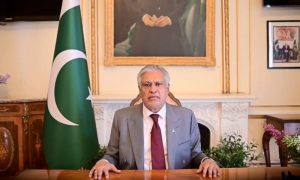
Andrabi said Pakistan’s Deputy Prime Minister and Foreign Minister Ishaq Dar had remained engaged with regional counterparts over the past week to advance diplomatic efforts.
He said Deputy PM Dar held a telephone conversation with Iranian Foreign Minister Abbas Araghchi on May 4 to discuss the regional situation and Pakistan’s mediation efforts.
“The Iranian side appreciated Pakistan’s constructive and mediation role, while the Deputy PM reaffirmed that dialogue and diplomacy remain the only path to lasting peace and stability,” Andrabi said.
The spokesperson also said Pakistan had facilitated the evacuation of 22 crew members held aboard the seized Iranian container vessel MV Touska.
“This was a major confidence-building measure by the United States of America. These returns were coordinated in tandem with the support of both the Iranian and US sides,” he said.
Andrabi recalled that Prime Minister Shehbaz Sharif had welcomed the suspension of the US military operation dubbed ‘Project Freedom’, which had been launched to reopen the Strait of Hormuz.
He said the prime minister had described the pause as a “timely announcement” and reaffirmed Pakistan’s commitment to supporting efforts aimed at peaceful conflict resolution through diplomacy.
The spokesperson added that PM Sharif hoped the “current momentum” would lead to a durable agreement ensuring long-term peace and regional stability.
Islamabad Talks and ceasefire
The latest round of hostilities between Washington and Tehran began more than two months ago following US and Israeli strikes on Iran on February 28.
Soon, Pakistan emerged as a key diplomatic intermediary between the two sides.
On April 8, Washington and Tehran agreed to a Pakistan-brokered ceasefire, significantly reducing hostilities.
Islamabad subsequently hosted the first direct talks between US and Iranian officials on April 11 and 12.
Although the negotiations ended without a final agreement, both sides agreed to continue diplomatic engagement.
Pakistan has since continued facilitating contacts between the two countries.
Markets react
In currency markets, the US dollar lost some of its safe-haven appeal as tensions eased.
Investors were also closely monitoring the Japanese yen amid speculation that Tokyo could intervene to support the weakened currency.
Elsewhere, Norway’s central bank raised its benchmark interest rate by a quarter percentage point to 4.25 percent, warning that the Middle East conflict risked fuelling already elevated inflation.
“Inflation is too high and has run above target for several years,” Norges Bank Governor Ida Wolden Bache said in a statement.
Technology shares also remained supported by continued investor optimism surrounding artificial intelligence, following strong quarterly earnings from major firms including Apple, Alphabet, Microsoft and Samsung.