


Key Points
- Pakistan has the world’s most battle hardened armed forces
- DG ISPR said Marka-i-Haq exposed India’s narrative against Pakistan and highlighted Pakistan’s regional security role.
- He outlined 10 strategic outcomes, including deterrence, geopolitical recognition, and civil-military unity.
- Pakistan’s armed forces remained fully prepared across all domains and were ready to defend the country if required.
- DG ISPR said Pakistan-Saudi Arabia share deep, multidimensional ties.
- Navy said it protected sea routes during the conflict and was ready to target the INS Vikrant if needed.
- Air Force claimed full readiness during the conflict and an “8–0” operational outcome against the Indian Air Force.
ISLAMABAD: Pakistan’s military spokesperson on Thursday warned that the country could immediately restore the status quo if India attempted to deny Pakistan its water rights.
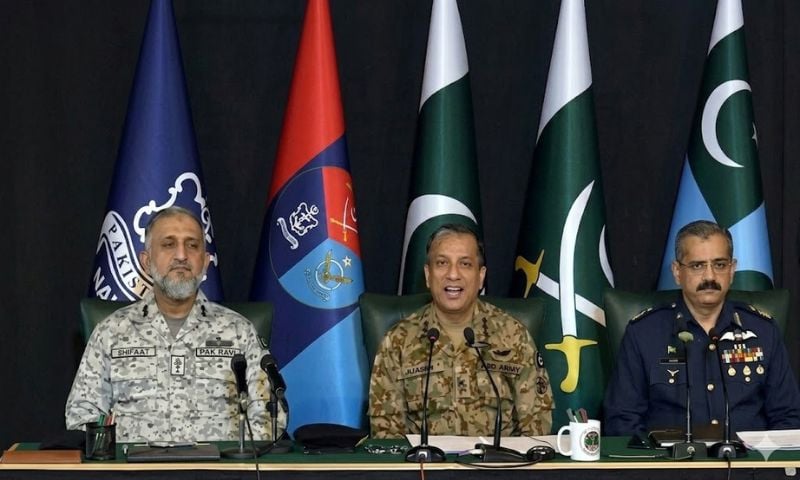
The Director General Inter-Services Public Relations (ISPR) Lieutenant General Ahmed Sharif Chaudhry made the remarks during a press conference in Islamabad as the nation marked the first anniversary of Marka-i-Haq.
He was joined by Rear Admiral Shifaat Ali, Deputy Chief of Naval Staff (Operations), and Air Vice Marshal Tariq Ghazi, Deputy Chief of Air Staff (Projects).
Pakistan has described last year’s military confrontation with India, starting from the April 22 Pahalgam attack to the conclusion of Pakistan’s Operation Bunyanum Marsoos, with a ceasefire on May 10 that ended the escalation between the two countries as Marka-i-Haq, or the “Battle of Truth.”
DG ISPR said that the country’s armed forces had risen to the nation’s expectations and defeated a much larger enemy with multi-domain operations.
Pakistan army defeated five times larger enemy
He noted that Pakistan’s military had defeated an enemy “five times larger than itself”. He said Marka-i-Haq had led to 10 strategic consequences, the foremost being the collapse of India’s narrative portraying Pakistan as a hub of terrorism.
He maintained that India had attempted to accuse Pakistan of involvement in terrorism without presenting any evidence. Referring to the Pahalgam incident, he said that even after a year, the questions raised by Pakistan had yet to receive any answers.
“Where is the evidence?” he asked. “Nobody buys this … you are the biggest terrorist. Nobody listens to them, nobody believes them,” he said.
Discussing the second consequence, he said the conflict reinforced Pakistan’s position as a net security stabiliser in the region. He further described Pakistan and its leadership as the region’s “biggest ambassadors of security.”
Turning to the third strategic consequence of Marka-i-Haq, he said it reflected the “politicisation of Indian military leadership and the militarisation of Indian political leadership.”
“This is what’s happening over there”, he said, adding that India’s military had “unfortunately been politicised”.
Discussing the fourth strategic consequence of Marka-i-Haq, he said the conflict had led to growing international recognition of India’s attempts to externalise its internal challenges while internalising external issues, alongside the use of terrorism as a state policy tool.
Hubristic attitude
He said that India’s domestic challenges included the repression of minorities and Kashmiris, attributing these issues to “a false sense of entitlement” and a “hubristic attitude.”
The DG ISPR said India was unwilling to address its internal problems politically and domestically, and instead sought to shift attention outward by accusing Pakistan of involvement in terrorism within India. He stressed that such matters should be resolved “politically and internally.”
“Kashmir is an internationally recognised dispute,” he said. “It’s not your internal problem for you to make demographic changes there … you cannot do that.”
True face of the Indian media
He said the fifth consequence of Marka-i-Haq was the “exposure of the true face of the Indian media and its discredited information operations.” He also noted that Indian authorities had begun blocking Pakistani media outlets during the conflict, a practice he said was continuing.
According to the DG ISPR, restricting media access had failed to address the issue, adding that his message to India was to “speak the truth.” He argued that truth was the only thing capable of enduring in today’s information environment, while disinformation and false narratives could no longer succeed.
Modern warfare
Discussing the sixth consequence, he said Marka-i-Haq highlighted the transformed nature of modern warfare, which now involved multi-domain operations, non-contact warfare, coordination across platforms, proxies and information warfare.
He explained that warfare was no longer confined to territorial borders, but now extended across land, sea, air, cyberspace and the cognitive domain. According to him, Pakistan’s armed forces were fully prepared to confront India across all these arenas during Marka-i-Haq and remained prepared today.
He said the seventh consequence was Pakistan’s demonstrated capability and resilience in dealing with multifaceted challenges, while the eighth was the clear establishment of deterrence.
“Anyone who thinks there is space for war between two nuclear neighbours is crazy. That is madness. Only a madman can think about. You want to do it, then there should be no doubt about our resolve,” he said.
He said the ninth consequence of Marka-i-Haq was Pakistan’s recognition as a geopolitically important and responsible middle power.
According to him, the tenth — and most significant — consequence was the strong unity between the public, the government and the armed forces.
“We saw a surge in terrorist incidents post-Marka-i-Haq,” he said. “We are not seeking conflict, we are not seeking war. But we know how to defend ourselves with honour and dignity,” he said.
Pakistan-Saudi Arabia ties
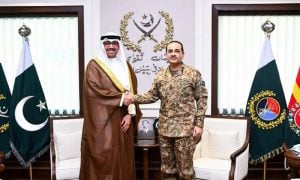
Speaking about Pakistan–Saudi Arabia relations, Lt Gen Chaudhry said that Islamabad and Riyadh share deep, multidimensional ties, and reaffirmed Pakistan’s commitment to the Kingdom’s security.
Responding to a question, the DG ISPR added that Pakistan highly values its longstanding relationship with Saudi Arabia. “Any threat to Saudi Arabia is also a threat to us,” he added.
He said that the mutual defence pact between Pakistan and Saudi Arabia was of great importance, as Pakistan had been “chosen” to guard the two holiest sites in Islam.
“We were chosen to protect Harmain Shareefain (Masjid al-Haram in Makkah and Masjid-i-Nabawi in Madinah), and protecting Harmain Shareefain is intrinsically linked to Saudi Arabia’s national security,” he explained.
In September last year, Pakistan and Saudi Arabia signed a “Strategic Mutual Defence Agreement” in Riyadh, under which both countries agreed that an attack on one would be treated as an act of aggression against both.
Last month, Pakistan sent fighter jets and other military forces to Saudi Arabia to strengthen security under a defence pact between the two countries, the Saudi defence ministry said in a statement.
Historic conflict
Speaking at the press conference, Rear Admiral Shifaat Ali described Marka-i-Haq as a “historic and memorable” conflict, noting that India had long portrayed itself as a major naval power backed by a large defence budget and ambitions of becoming a blue-water navy.
He questioned why the Indian Navy did not directly engage Pakistan during the conflict. According to him, India had attempted to deploy naval assets in the northern Arabian Sea with the aim of targeting Pakistan’s naval capabilities and disrupting maritime trade.
Rear Admiral Ali, however, said the Pakistan Navy’s strategy ensured that ports, installations and sea lanes remained fully functional throughout the confrontation. He also recalled that the Pakistan Navy and the PAF had been prepared to target the INS Vikrant during the conflict.
8–0 outcome
Speaking at the press conference, Deputy Chief of Air Staff Air Vice Marshal Tariq Ghazi gave a brief overview of Marka-i-Haq. He said PAF Chief Zaheer Ahmad Sidhu had led both the planning and execution of the Pakistan Air Force’s operational response during the conflict.
Describing the operation, Ghazi said the PAF immediately adopted a strong defensive posture while maintaining the highest level of alert and conducting full-spectrum monitoring, including surveillance of enemy communications.
According to him, the air force implemented an extensive air defence strategy through combat air patrols, rapid scrambles and continuous aerial surveillance to counter any potential hostile action. He added that, for the first time in warfare, the PAF had integrated and operationalised its multi-domain assets.
Ghazi further said the PAF observed aggressive deployments by the Indian Air Force, including the positioning of key assets and offensive weapons systems across India, while also attempting to conceal critical assets. He maintained, however, that the PAF closely monitored all such movements.
He also added that the PAF achieved an “8–0” outcome in its engagement with the Indian Air Force, adding that multiple Indian aircraft were shot down during the confrontation.