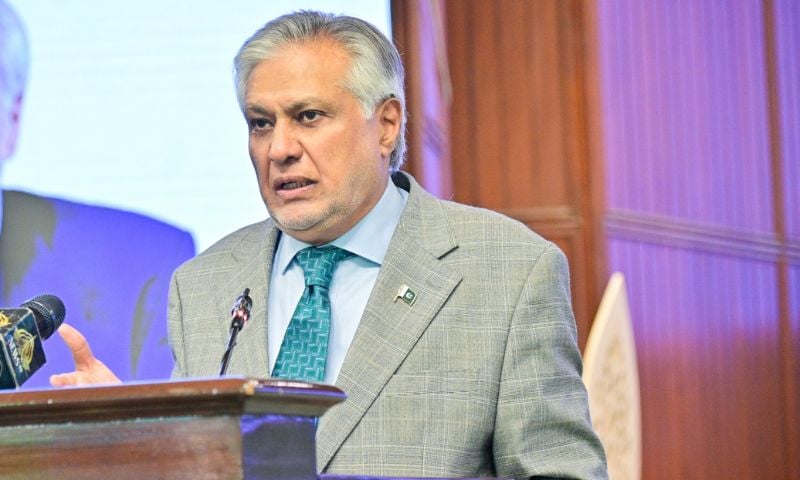



ISLAMABAD: Pakistan is now focused on turning the indefinitely extended ceasefire between the United States and Iran into a permanent peace, Deputy Prime Minister and Foreign Minister Ishaq Dar said on Wednesday.
US President Donald Trump has indefinitely extended the Pakistan-brokered initial two-week ceasefire between Washington and Tehran, but the conflict remains unresolved.
Speaking at the second session of the Ulema Council Conference in Islamabad, Deputy PM Dar said the ceasefire had helped halt the escalation.
Dar said that Pakistan’s diplomatic efforts were now aimed at securing direct negotiations and a “permanent end to the war.”
“At least the deaths of several hundred people a day — with the toll going into the thousands — have stopped,” Dar added.
The Deputy Prime Minister called on the Ulema to pray for Pakistan’s diplomatic efforts, saying that they were now geared towards turning the ceasefire into a “permanent end to the war”.
Dar also called on Muslim countries to unite in case they had developed any rifts between them. He stressed his belief that Muslim states would be stronger in their efforts if they worked together.
The Deputy Prime Minister highlighted Pakistan’s role in bringing the US and Iran to direct negotiations for the first time in 47 years.
Deputy Prime Minister / Foreign Minister Senator Mohammad Ishaq Dar @MIshaqDar50 today addressed the second session of the Ulema Council Conference in Islamabad. He welcomed and lauded the participation of distinguished international and national Ulema and scholars, noting the… pic.twitter.com/6HOvQHaU3I
— Office of the Deputy Prime Minister (@DPM_PK) May 6, 2026
Pakistan’s diplomatic efforts for peace
Dar said that Pakistan “played its full part” from February 28, when the US and Israeli launched military campaign against Iran, until today in its response to the war.
“After 47 years, we brought the US and Iran to sit down at the same table,” Dar added.
He highlighted that Pakistan had engaged with Iran on the issue of their strikes on US bases in other Middle Eastern countries that had heightened tensions in the region, stressing its part in the Muslim Ummah in an effort to halt the regional hostilities.
On February 28, the US and Israeli forces launched the war against Iran, after which Tehran closed the Strait of Hormuz while American forces later launched a blockade of Iranian ports.
The Islamabad Talks, which marked the highest level engagement between Washington and Tehran since 1979, ended without a final agreement, but paved the way for further negotiations.
As the Pakistan-brokered two-week ceasefire agreed on April 8 neared its original deadline, Trump posted on social media that he had decided to extend it indefinitely “upon the request of [Pakistan’s Chief of Defence Forces] Field Marshal Asim Munir, and Prime Minister Shehbaz Sharif”.
US and Iran close to deal
The US believes it is getting close to reaching an agreement with Iran on a one-page memorandum of understanding to end the conflict and set a framework for more detailed nuclear negotiations.
Trump announced on Tuesday that the US has suspended “Project Freedom” – a naval initiative facilitating the movement of commercial shipping through the strategically vital Strait of Hormuz – following requests from Pakistan and several other countries.
Iran said earlier on Wednesday it would accept a peace deal only if it was “fair”, after Trump paused the naval mission tasked with reopening the Strait of Hormuz.
The US decision came amid Pakistan-led diplomatic efforts between the US and Iran, with talks ongoing but no final agreement yet reached.
Washington is expecting Tehran’s response on several key points of the proposal within the next 48 hours, according to Axios.
The report noted that while no final agreement has been reached, this marks the closest both sides have come to a deal since the conflict began, according to officials quoted by Axios.
Among other provisions, the deal would involve Iran committing to a moratorium on nuclear enrichment, the US agreeing to lift its sanctions and release billions in frozen Iranian funds, and both sides lifting restrictions around transit through the Strait of Hormuz, Axios said.
The one-page, 14-point memorandum of understanding is being negotiated between US envoys Steve Witkoff and Jared Kushner and several Iranian officials, both directly and through mediators, the Axios report added.
In its current form, the memorandum would declare an end to the war in the region and the start of a 30-day period of negotiations on a detailed agreement to open the strait, limit Iran’s nuclear programme and lift US sanctions, Axios reported.
Iran said earlier on Wednesday it would accept a peace deal only if it was “fair”.
Pakistan-led diplomatic efforts
Iranian President Masoud Pezeshkian indicated that Tehran remains open to dialogue but rejected Washington’s “maximum pressure” approach as unrealistic.
Meanwhile, Pakistan’s Prime Minister Shehbaz Sharif expressed appreciation to President Trump for “courageous leadership” and a timely decision to pause the maritime operation in Hormuz.
In a statement shared on X, the premier said the move came at a critical juncture and reflected a constructive response to the request made by Pakistan alongside several allied nations.
He particularly acknowledged the role of Saudi Arabia and its leadership, including Saudi Crown Prince and Prime Minister Prince Mohammed bin Salman, for their diplomatic engagement during the evolving situation.
The prime minister noted that Washington’s decision to halt the operation could contribute significantly to easing regional strain.
He emphasised that such steps help create space for dialogue and reduce the risk of escalation in one of the world’s most sensitive maritime corridors.
Highlighting Pakistan’s diplomatic stance, the prime minister reiterated that Islamabad remains firmly committed to supporting initiatives that prioritise restraint and peaceful conflict resolution.
The statement further conveyed optimism that the current momentum generated by coordinated diplomatic efforts would lead to a broader and more sustainable agreement.
According to the prime minister, such an outcome would not only stabilise the immediate region but also contribute to wider international peace and security.