Key Points
- Iran may have deployed 20+ naval mines, some with GPS or remote control capability.
- The IRGC declared a 1,400 sq km “danger zone” in the Strait of Hormuz.
- A UK- and France-led multinational coalition is being discussed for securing the strait.
- Shipping firms warn of delays and higher risk costs due to uncertainty.
- Iran disputes US claims of mine-clearing operations in the waterway.
WASHINGTON: A Pentagon assessment has warned that it could take up to six months to fully clear the Strait of Hormuz of suspected Iranian-laid naval mines, a delay that could keep global energy prices elevated and prolong disruption to international shipping, according to a report published by the Washington Post.
The strategic waterway, through which roughly one-fifth of the world’s oil and gas passes during normal conditions, has been largely inaccessible since the outbreak of conflict involving the United States, Israel and Iran. The situation has significantly disrupted global energy flows and contributed to volatility in international markets.
According to the report, Iran has effectively restricted access to the Strait of Hormuz since the beginning of hostilities, while the United States has also maintained a blockade.
Even in the event of a ceasefire or a de-escalation of tensions, the Pentagon assessment suggests that the clearance of naval mines could take several months before normal maritime traffic is restored.
Officials cited in the Washington Post report stated that the six-month estimate was presented to members of the US House Armed Services Committee during a classified briefing.
Lawmakers were reportedly informed that Iran may have deployed around 20 or more mines in and around the strait, including some that can be remotely controlled or positioned using GPS technology, making detection and removal more complex.
The Pentagon has not officially confirmed the details of the assessment. Department of Defense officials were contacted for comment, while Pentagon spokesman Sean Parnell told the Washington Post that aspects of the report were “inaccurate”.
Iran’s Islamic Revolutionary Guard Corps has separately issued warnings declaring a wide “danger zone” covering approximately 1,400 square kilometres in the region, where mines are believed to be present.
Iranian authorities have also stated that the Strait of Hormuz will not be reopened while what they describe as a US naval blockade remains in place. Concerns over maritime safety have already begun to affect global shipping operations.
Representatives from international logistics companies, including Germany’s Hapag-Lloyd, have warned that uncertainty over safe passage routes is causing delays and increasing risk assessments for vessels operating in the region.
Reports indicate that even during a brief and limited reopening of the strait at the start of a recent ceasefire period, only a small number of ships attempted passage, with many operators remaining cautious due to fears of mines or renewed attacks.
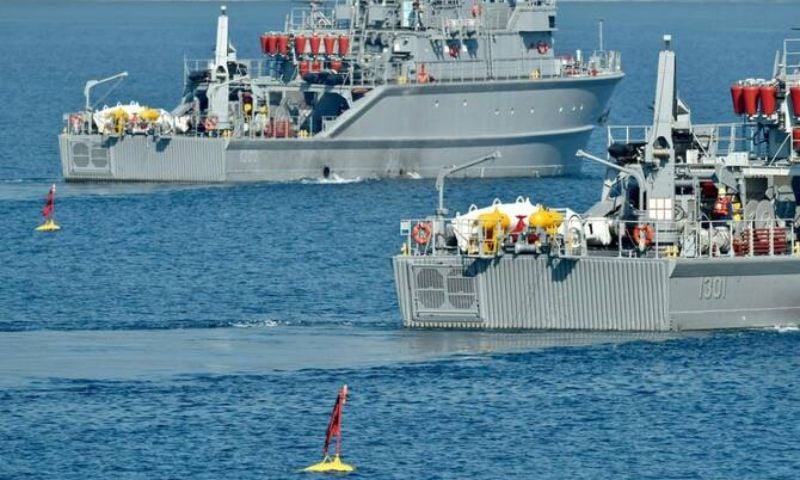
Earlier in April, the US Navy stated that its vessels had entered the waterway as part of preliminary mine-clearing efforts.
However, this claim was disputed by Iran’s Revolutionary Guard, which denied any such operation and warned that foreign military vessels attempting to transit the channel would be considered hostile.
Meanwhile, diplomatic and military coordination efforts are underway. Talks in London involving military planners from more than 30 countries began on Wednesday, focusing on the formation of a UK- and France-led multinational initiative aimed at safeguarding navigation in the Strait of Hormuz once hostilities ease.
The proposed coalition is expected to discuss long-term security arrangements for reopening the strait, alongside coordinated mine clearance operations designed to restore safe maritime passage through one of the world’s most critical energy corridors.