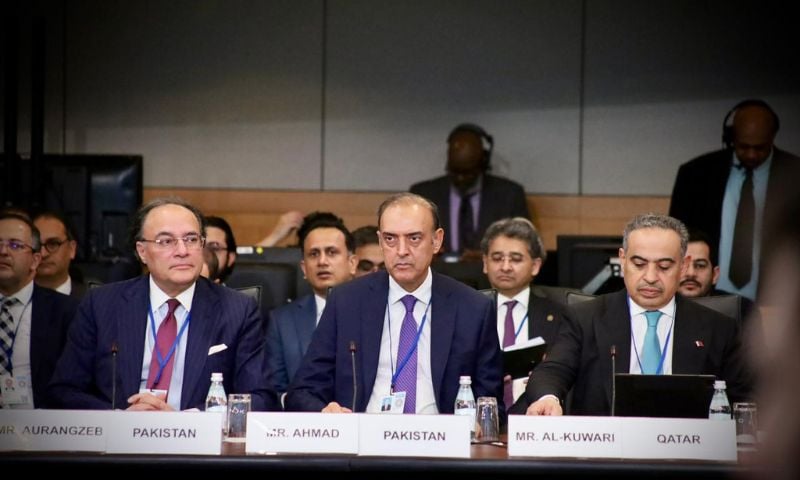
NEW YORK: Pakistan’s Finance Minister Muhammad Aurangzeb outlined the government measures to manage the immediate impact of the Middle East crisis on the country, including pricing mechanisms and logistics chains to maintain stability in essential supplies.
He was speaking on the sidelines of the World Bank–IMF Spring Meetings 2026, according to the finance ministry.
He described the Middle East crisis as “one of the most significant supply shocks in recent history,” and detailed measures being taken to address its immediate impact, including adjustments to procurement strategies, pricing mechanisms, and logistics chains to ensure stability in essential supplies.
Aurangzeb also reaffirmed the government’s commitment to phasing out broad-based subsidies, shifting instead toward targeted support programmes designed to protect the most vulnerable segments of society while maintaining fiscal discipline, the ministry said.
Finance Minister Highlights Policy Response to Global Shocks at IMF MENAP Meeting
Federal Minister for Finance and Revenue, Senator Muhammad Aurangzeb, participated in a meeting convened by the Managing Director of the International Monetary Fund (IMF) with Finance Ministers,… pic.twitter.com/NHFzBhvut1
— Ministry of Finance, Government of Pakistan (@Financegovpk) April 15, 2026
“He noted that the government, in close coordination with the State Bank of Pakistan, is conducting a comprehensive assessment of the second and third-order effects of the crisis across key macroeconomic indicators, including inflation, economic growth, exports, remittances, and the current account,” the finance ministry says.
“The finance minister has highlighted that Pakistan has entered the current period of global uncertainty with strengthened policy buffers and has drawn important lessons from past external shocks, including the devastating floods in recent years.”
Reaffirming the government’s commitment to its structural reform agenda, Muhammad Aurangzeb said any necessary policy adjustments would be carried out in a responsible manner, without undermining the hard-earned gains in macroeconomic stability.
He concluded by expressing appreciation for the continued engagement and support of the International Monetary Fund leadership.