Key Points
- Finance minister highlights reform execution as core challenge for Pakistan’s economy
- Government shifts from blanket subsidies to targeted support amid energy pressures
- Strong debt management cited, with Eurobond repayment termed a “non-event”
- Surge in Karachi transit flows, and record Roshan Digital inflows signal confidence
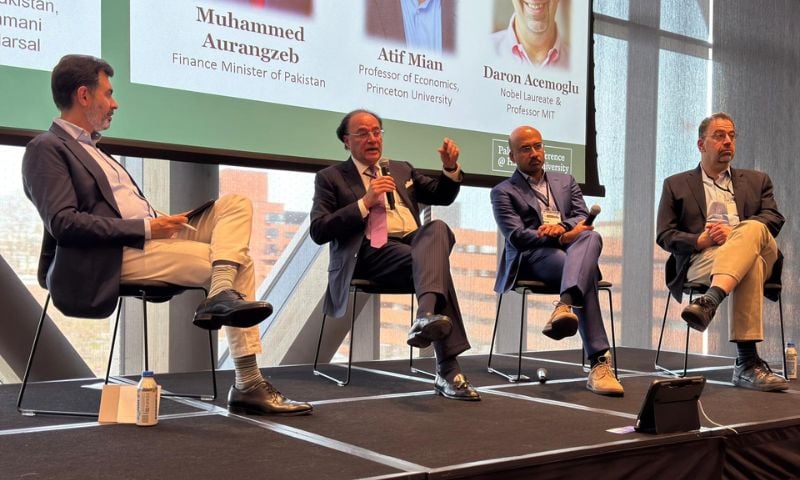
ISLAMABAD: Pakistan’s Finance Minister Muhammad Aurangzeb has outlined the country’s economic reform priorities, stressing execution and timely decision-making as the country’s biggest challenges, during a policy discussion at Harvard University.
Speaking at the Pakistan Conference 2026 in Boston, Aurangzeb described the ongoing Middle East conflict as a major global supply shock, saying Pakistan’s immediate response focused on maintaining uninterrupted energy supplies despite limited reserves.
He said the government initially introduced a blanket subsidy to absorb rising energy costs, later transitioning to targeted support aligned with fiscal space and full price transmission, helping avoid major supply disruptions and security concerns.
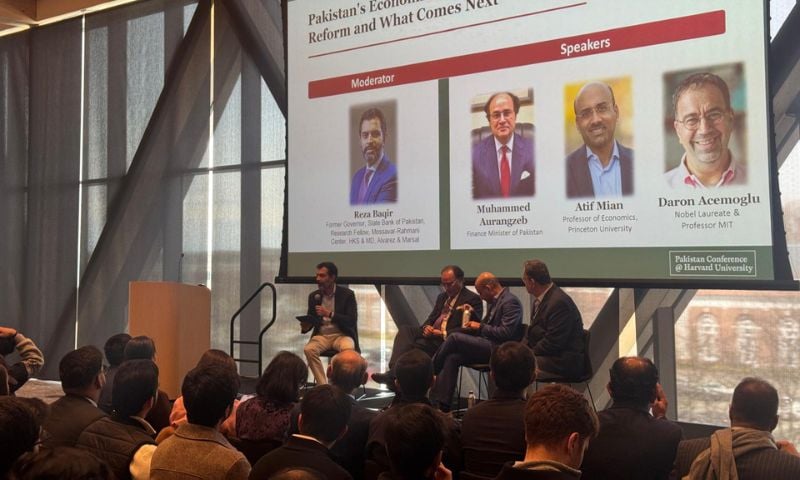
The session, moderated by former State Bank governor Reza Baqir, includes leading economists such as Atif Mian and Nobel laureate Daron Acemoglu, focusing on Pakistan’s economic outlook and long-term growth trajectory.
On external accounts, the minister pointed to strong debt management, noting that a recent Eurobond repayment passed without market stress and expressing confidence in meeting upcoming obligations.
He highlighted emerging opportunities during the crisis, including a sharp rise in transit trade and transhipment through Karachi Port.
The opening surpassed volumes recorded in 2025 within weeks, alongside progress toward operationalising Gwadar Port.
Finance Minister Senator Muhammad Aurangzeb at Harvard on Pakistan’s Economic Agenda:
• Middle East tensions = major global supply shock
• Energy policy: blanket subsidies → targeted support
• Eurobond repayment a “non-event”; external outlook stable
• Karachi transit… pic.twitter.com/CIbgY6RRcZ— Ministry of Finance, Government of Pakistan (@Financegovpk) April 12, 2026
Aurangzeb also cited a record monthly inflow under the Roshan Digital Account initiative in March, reflecting renewed confidence among overseas Pakistanis. However, the remittances cannot substitute for sustainable growth, he added.
He emphasised a strategic shift toward export-led growth and expansion in services trade, identifying these as more durable drivers of economic resilience compared to reliance on inflows.
The minister acknowledged that Pakistan has long understood the direction of reforms but has struggled with implementation.
The delays in difficult decisions have historically contributed to repeated cycles of instability and reliance on IMF programmes.
He reaffirmed the structural reforms, including broadening the tax base, improving tax administration and raising the tax-to-GDP ratio, supported by ongoing digital transformation within the Federal Board of Revenue.
Aurangzeb also called for reducing dependence on industrial subsidies, advocating competitiveness and trade liberalisation, including tariff rationalisation, to integrate Pakistan more effectively into global markets.
On energy, he said solar capacity has reached around 8,000 MW, helping cushion recent shocks. He unveiled plans for enhanced renewable energy generation over the coming decade.
The minister highlighted key reform milestones, including agriculture income tax legislation across all four provinces and progress on privatisation, with 28 state-owned enterprises referred to the Privatisation Commission.
He identified population growth and climate change as critical long-term challenges, warning that sustained economic progress will depend on addressing both pressures alongside continued regulatory reforms and improvements in ease of doing business.