BEIJING: Pakistan and the Afghan Taliban have agreed to avoid escalation in their ongoing tensions following talks hosted by China in recent days, Beijing said on Wednesday, as Islamabad continues to press Kabul for verifiable action against terrorist groups operating from Afghan territory.
In February, Pakistan launched a large-scale counter-terrorism operation against terrorist groups based in Afghanistan and involved in cross-border terrorist attacks.
Pakistan launched the counter-terrorism operation after the Afghan Taliban’s unprovoked aggression along the border and terrorist attacks in Pakistan.
Islamabad has long claimed that the Afghan Taliban regime is harbouring terrorists responsible for cross-border attacks.
Pakistan has repeatedly asked the Taliban regime to take action against terrorist groups and prevent Afghan soil from being used for terrorism.
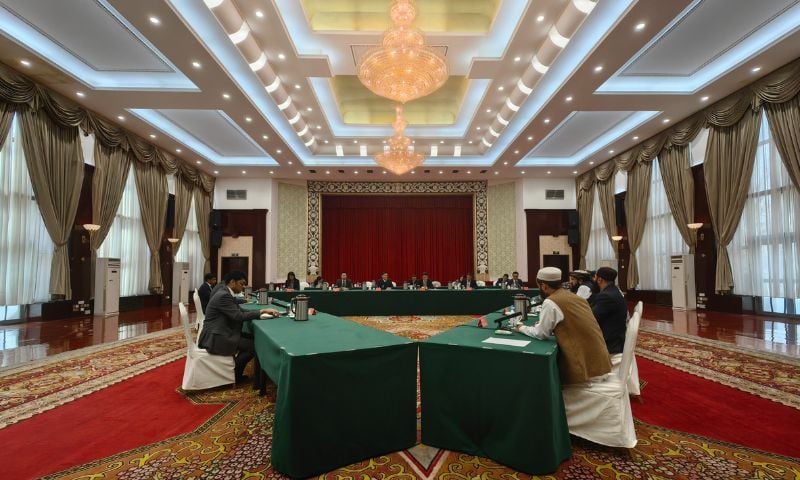
“Representatives of China, Pakistan and Afghanistan held week-long informal talks in Urumqi, Xinjiang from April 1 to 7. The delegations of the three sides include representatives from authorities in charge of foreign affairs, defence and security,” Chinese foreign minister spokesperson Lin Jian said in a statement.
The Chinese foreign ministry spokesperson said that the Pakistani and the Afghan Taliban sides reiterated that they follow the purposes and spirit of the UN Charter and the Five Principles of Peaceful Coexistence.
Representatives of #China, #Pakistan and #Afghanistan held week-long informal talks in Urumqi, Xinjiang from April 1 to 7. The delegations of the three sides include representatives from authorities in charge of foreign affairs, defense and security.
The Afghan and Pakistani… pic.twitter.com/oLM8pRdzEh
— Lin Jian 林剑 (@SpoxCHN_LinJian) April 8, 2026
Both sides reaffirmed to stay committed to resolving differences as soon as possible, work for the turnaround of Afghanistan-Pakistan relations, and agree to refrain from actions that may escalate or complicate the situation, the Chinese foreign ministry spokesperson said.
“The three sides agreed to discuss a comprehensive plan to resolve issues in the relations between Afghanistan and Pakistan, and identified the core and priority issues. All sides believed that the Urumqi process is substantive, and agreed to maintain communication and dialogue,” Lin Jian added.
Senior representatives from all three countries attended the meeting, while China hosted and facilitated the dialogue.
The Pakistan delegation during the talks is led by Additional Secretary of the Ministry of Foreign Affairs, Asad Gilani.
Similarly, the Taliban regime’s five-member delegation included representatives from the interim regime’s Foreign Ministry, Mohibullah Wasiq and Abdul Hai Qanit.
Other members represented the Taliban regime’s interior and defence ministries, as well as the Taliban’s Intelligence Directorate.
During the talks, Pakistan firmly reiterated its demand for the dismantling of terrorist safe havens inside Afghanistan, particularly those of the banned Tehreek-e-Taliban Pakistan (TTP) terrorist group.
Islamabad also called for a clear, verifiable, and written mechanism to ensure concrete and sustained action against terrorist groups based in Afghanistan that are involved in terrorist attacks in Pakistan.
A truce implemented during the Eid al-Fitr holiday, which marks the end of the Muslim fasting month of Ramadan, concluded on March 24.
The Urumqi talks come amid strained bilateral relations following Pakistan’s launch of a large-scale counter-terrorism operation Ghazab lil-Haq on February 26, targeting terrorists’ hideouts inside Afghan territory.
Terrorist activity in Pakistan has seen a resurgence since the Afghan Taliban regained control of Kabul in 2021.
Pakistan has consistently maintained that terrorist groups, including the TTP, operate from Afghan soil, while the Taliban regime has been widely criticised for failing to take decisive action against terrorist groups based in Afghanistan.
The counter-terrorism operation Ghazab lil-Haq was initiated after unprovoked cross-border firing by the Taliban.
A temporary pause in the operation was observed from March 18 to 23 during Eid al-Fitr.
Earlier, the chief of staff of the Collective Security Treaty Organisation (CSTO) had warned that numerous international extremist and terrorist groups are operating in Afghanistan, posing a risk of instability across the region.
He said that the presence and activities of terrorist groups in Afghanistan threaten regional security and could lead to the spread of terrorism to neighbouring countries.