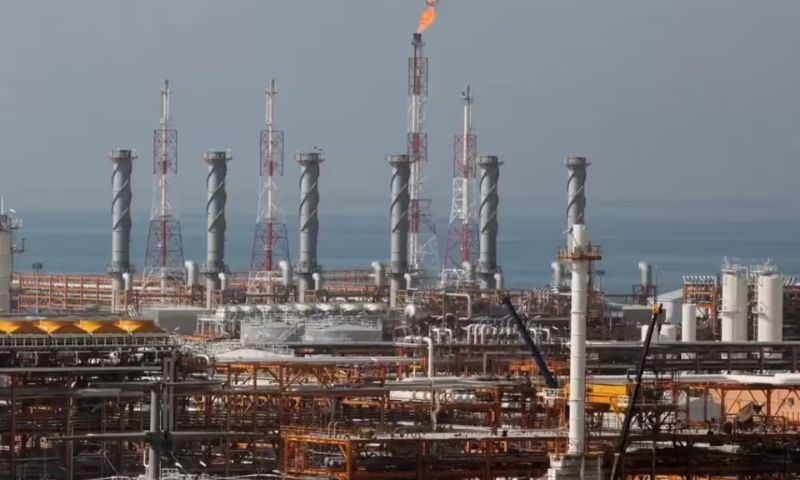



DUBAI: Israel struck the South Pars petrochemical plant in Asaluyeh district of Iran’s Bushehr province, Israel’s Defence Minister said on Monday after Tehran said the facility was attacked.
Israeli Defence Minister Israel Katz said Israel had carried out a “powerful strike” on Iran’s largest petrochemical facility.
He claimed the site accounted for around half of the country’s petrochemical production.
Iranian authorities earlier said that the facility had come under attack.
Iran’s semi-official Fars news agency reported that strikes also hit the South Pars gas field — the world’s largest natural gas field shared between Iran and Qatar. The reports blamed both Israel and the United States.
Meanwhile, explosions were reported across Tehran. Thick smoke was seen rising near Azadi Square after an airstrike struck near the campus of Sharif University of Technology.
Iranian state media said the head of intelligence for the Islamic Revolutionary Guard Corps Majid Khademi was killed in Monday’s strikes on Tehran.
Iran responded with missile strikes targeting Israel and Gulf Arab states. In the northern Israeli city of Haifa, at least four people were killed when a residential building was hit.
Strait of Hormuz disruptions
The escalation has heightened concerns over the Strait of Hormuz, through which roughly a fifth of global oil supply passes during peacetime.
Iran’s actions in the waterway and attacks on regional energy infrastructure have driven volatility in global energy markets.
US President Donald Trump warned Tehran to reopen the strait, setting a deadline that expires late Monday Washington time. He threatened severe retaliation if no agreement is reached.
“Tuesday will be Power Plant Day, and Bridge Day,” he said in a social media post, warning Iran it would face devastating consequences if it failed to comply.
Diplomatic push: ‘Islamabad Accord’
Amid the escalation, diplomatic efforts have intensified to secure a ceasefire.
Officials said the United States and Iran had received a proposed peace plan, titled the “Islamabad Accord”, aimed at halting hostilities and reopening the Strait of Hormuz.
According to multiple media reports citing sources familiar with the discussions, the plan envisages a two-phase approach.
The first phase calls for an immediate 45-day ceasefire and reopening of the strait.
This would be followed by negotiations over 15 to 20 days to reach a comprehensive settlement.
The final agreement could include Iranian commitments to limit its nuclear programme, particularly refraining from developing weapons, in exchange for sanctions relief and the release of frozen assets.
Earlier, Axios reported that a broader framework under discussion included a possible 45-day ceasefire to enable negotiations towards a permanent deal.
Pakistan’s mediation efforts
Pakistan is playing a key role in mediation efforts, maintaining contacts with US and Iranian officials as well as regional countries to de-escalate the conflict.
Officials said Islamabad has been in communication with US Vice President JD Vance, special envoy Steve Witkoff and Iranian Foreign Minister Abbas Araqchi.
The proposal includes holding final in-person negotiations in Islamabad and establishing a regional framework to ensure security of the Strait of Hormuz.
Pakistan has also coordinated with Turkiye, Egypt, Saudi Arabia, and Gulf states, while working alongside China.
A joint Pakistan-China initiative has called for an immediate ceasefire, protection of civilians and the security of key maritime routes.