Key Points
- The Orion spacecraft performed a 14-second engine correction burn, the first of its kind since leaving Earth’s orbit, to fine-tune its lunar trajectory.
- The astronauts will use newly designed emergency spacesuits capable of supporting life for up to six days in case of cabin depressurization.
- During the lunar flyby, the crew will experience a rare solar eclipse from space, allowing them to observe the Sun’s corona and potentially detect flashes from meteorite impacts on the Moon.
CAPE CANAVERAL, FLORIDA, USA: In a landmark moment for modern space exploration, astronauts aboard NASA’s Orion spacecraft have entered the Moon’s gravitational domain, a region known as the lunar sphere of influence, signaling a major step forward in the Artemis II mission.
The transition occurred early Monday when the spacecraft crossed into a zone where the Moon’s gravitational pull surpasses that of Earth. While not a visible boundary, this mathematically defined region marks the crew’s official arrival into the Moon’s cosmic neighborhood—an achievement not witnessed since the era of Apollo 17.
NASA officials described the moment as a critical milestone, underscoring both the precision of the spacecraft’s trajectory and the broader significance of returning humans to deep lunar space after more than half a century.
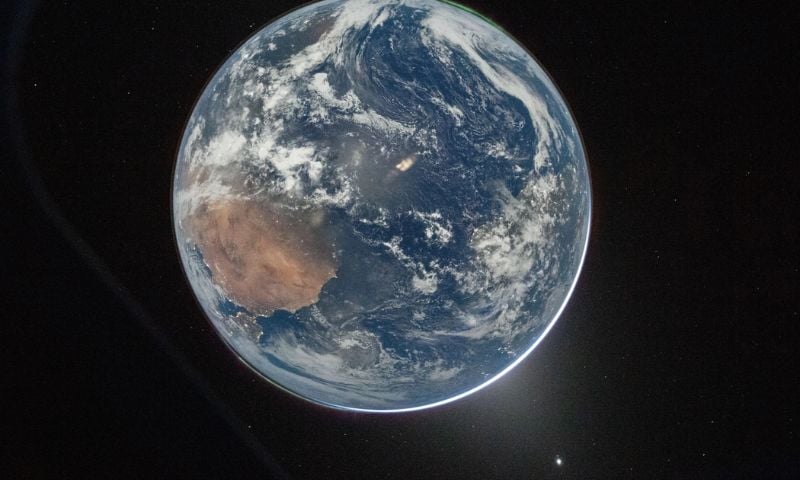
One last look at Earth before we reach the Moon.
This view of the Earth was captured on April 5, the fourth day of the Artemis II mission, from inside the Orion spacecraft. The four astronauts will reach their closest approach of the Moon tomorrow, April 6. pic.twitter.com/z2NJUGWkKc
— NASA (@NASA) April 5, 2026
The four-member crew—Reid Wiseman, Christina Koch, Victor Glover, and Canadian astronaut Jeremy Hansen—are now preparing for a close lunar flyby expected later Monday. At their farthest point, they will travel approximately 252,760 miles from Earth, surpassing the distance record set during Apollo 13 and venturing farther than any humans in history.

As the spacecraft approached the Moon, astronauts captured striking imagery, including a distant crescent view of Earth framed through Orion’s window—offering a poignant reminder of humanity’s home planet from deep space.
The crew’s schedule remains intensive. Alongside testing newly designed spacesuits capable of sustaining life in emergencies for several days, the astronauts executed a brief engine burn to refine their trajectory—remarkably the first correction maneuver required since departing Earth’s orbit.
During the lunar flyby, the astronauts will conduct around seven hours of scientific observations, focusing on key geological formations. Among them is the ancient Orientale basin, a vast impact crater formed roughly 3.8 billion years ago, as well as the heavily eroded Hertzsprung basin on the Moon’s far side. Scientists hope these observations will provide new insights into how lunar surfaces evolve over time.
Equipped with high-resolution cameras, the crew will also document regions of the Moon never before seen directly by human eyes, reinforcing the mission’s exploratory significance.
Adding to the rare experience, the astronauts are expected to witness a solar eclipse from space, during which the Moon will obscure the Sun. This unique vantage point will allow them to study the Sun’s outer atmosphere and potentially observe flashes caused by meteorite impacts on the lunar surface. Planets including Mercury, Venus, Mars, and Saturn may also become visible during this period.
NASA scientists emphasize that while robotic missions have gathered extensive data, human presence enables real-time interpretation and spontaneous discovery—elements crucial to advancing lunar science.
The Artemis II mission represents a pivotal step in NASA’s broader goal of establishing a sustained human presence on and around the Moon, paving the way for future crewed landings and deeper space exploration.