ISLAMABAD: Iran and the United States have received a proposed plan to halt hostilities — a move that could take effect as early as Monday and lead to the reopening of the Strait of Hormuz, several international media outlets reported, citing sources familiar with the discussions. Pakistan’s Foreign Office Confirms that the peace process is ongoing.
Proposed Islamabad Accord
The proposed Islamabad Accord is structured in two phases. The immediate phase calls for a ceasefire to begin straight away and the reopening of the Strait of Hormuz without delay. This would be followed by a final, comprehensive peace deal to be negotiated over 15–20 days.
Tentatively named the “Islamabad Accord,” the final agreement may include Iran agreeing to limits on its nuclear programme, specifically refraining from developing weapons.
In return, Tehran would receive sanctions relief, the release of frozen assets, and a broader regional framework to ensure the security of the Strait of Hormuz.
🚨BREAKING:
🇺🇸🇮🇷 Iran and the U.S have received a plan to end the war, drawn up by mediators in Pakistan.
Under the proposal, dubbed the “Islamabad Accord,” a ceasefire would take effect immediately, reopening the Strait of Hormuz, with 15–20 days to finalise a broader… https://t.co/Fahz3MiqIt pic.twitter.com/L9YOocv9MR
— Mario Nawfal (@MarioNawfal) April 6, 2026
Earlier, Axios reported that the U.S., Iran, and regional mediators were considering a 45-day ceasefire as part of a deal that could ultimately bring a permanent end to the conflict, citing U.S., Israeli, and regional sources.
Pakistan has been in continuous contact with U.S. Vice President JD Vance, special envoy Steve Witkoff, and Iranian Foreign Minister Abbas Araqchi. Under the proposal, the ceasefire would take immediate effect, reopening the Strait of Hormuz, with 15–20 days allocated to finalise a broader settlement, reports Reuters, a news agency.
The deal, tentatively named the “Islamabad Accord,” would include a regional framework for the strait, with final in-person negotiations in Islamabad.
Earlier on Sunday, US President Donald Trump hoped that there was a “good chance” of making a deal with Iran on Monday.
“I think there is a good chance tomorrow, they are negotiating now,” the president told a Fox News journalist.
“If they don’t make a deal and fast, I’m considering blowing everything up and taking over the oil,” he added.
🚨 BREAKING: @TreyYingst details his phone call with President Trump this morning about the ongoing negotiations with Iran.
“The president tells me, ‘If they don’t make a deal, and fast, I’m considering blowing everything up and taking over the oil.'” | @foxandfriends pic.twitter.com/Si0GDQUOnH
— Fox News (@FoxNews) April 5, 2026
Iranian officials have indicated that Tehran seeks a permanent ceasefire with guarantees against future attacks by the U.S. and Israel, while messages have also come from mediators including Pakistan, Turkey, and Egypt.
The final deal is expected to involve Iranian commitments to halt nuclear weapons development in exchange for sanctions relief and the release of frozen assets.
The renewed diplomatic push comes amid rising tensions threatening the security of shipping lanes through the Strait of Hormuz, a key conduit for global oil supplies. U.S. President Donald Trump has called for a swift end to hostilities, warning of consequences if a ceasefire is not achieved promptly.
The conflict has also heightened volatility in energy markets, with traders monitoring developments closely.
Pakistan is playing a prominent role in the discussions, leveraging its long-standing diplomatic ties with both Washington and Tehran. Islamabad has engaged in back-channel communications with US and Iranian officials, alongside coordination with other regional partners such as Egypt and Türkiye.
Analysts suggest Pakistan’s mediation reflects a strategic effort to stabilise the region and reduce spill-over effects from the conflict, which has already disrupted global energy markets.
The ceasefire period could be extended if additional time is required to negotiate security guarantees, trade routes, and other critical issues.
Tensions remain high, however. US President Donald Trump has set a deadline for Iran to reopen the strategically vital Strait of Hormuz, warning of retaliatory strikes on critical infrastructure if demands are not met.
The proposed temporary truce, if agreed, could provide negotiators the breathing space needed to convert short-term cessation into lasting peace.
Pakistan’s diplomatic outreach
Pakistan has intensified its diplomatic efforts to bring an end to the US-Israel war involving Iran.
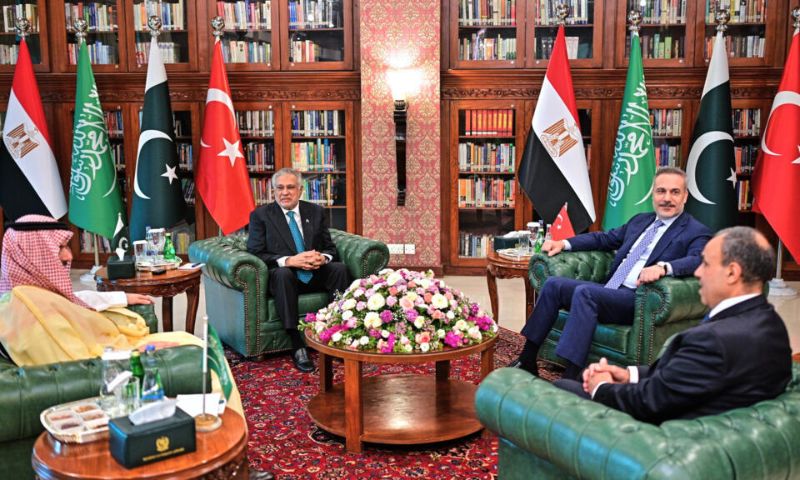
Islamabad hosted key regional ministers from Saudi Arabia, Turkiye, and Egypt, while also facilitating the exchange of messages between Washington and Tehran.
Pakistan and China jointly called on the United States, Israel, and Iran to halt ongoing strikes and begin “peace talks as soon as possible.”
The appeal followed a high-level meeting in Beijing between Deputy Prime Minister and Foreign Minister Ishaq Dar and Chinese Foreign Minister Wang Yi.
Bahrain has lauded Pakistan’s diplomatic efforts to promote dialogue and stability in the region, with Foreign Minister Dr. Abdullatif bin Rashid Al Zayani praising the Pakistan–China five-point initiative during a call with Minister Ishaq Dar.
The framework, calling for an immediate ceasefire, dialogue, civilian protection, and the security of key maritime routes including the Strait of Hormuz, has received broad regional and international support, including from the US.