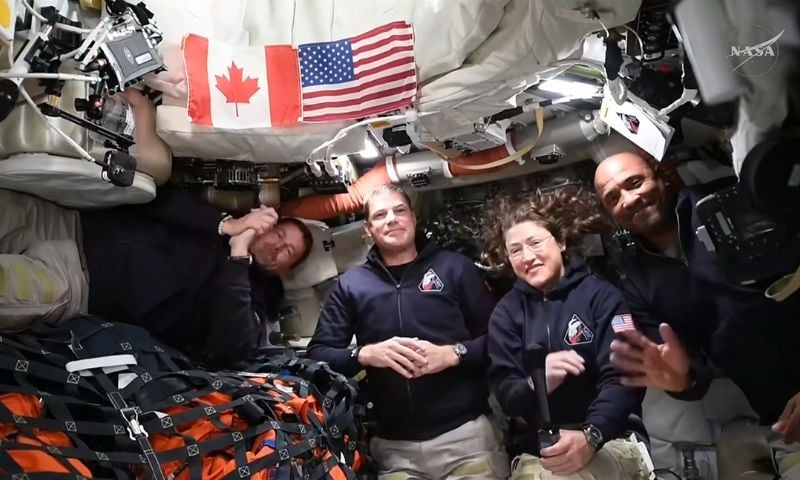
HOUSTON, United States: Astronauts aboard NASA’s Artemis II mission on Sunday reported witnessing unprecedented views of the Moon, including the vast Orientale basin—often dubbed the lunar “Grand Canyon”—as their spacecraft advances towards a historic flyby.
The crew, currently travelling aboard the Orion spacecraft, has crossed the two-thirds mark of its 10-day mission, venturing nearly 200,000 miles (over 321,000 kilometres) from Earth. At the same time, they are closing in on the Moon, now roughly 82,000 miles away, according to mission data.
In a remarkable first, astronauts confirmed they had directly observed the Orientale basin in its entirety—an enormous, multi-ringed impact crater previously captured only through robotic imaging.
Speaking during a live interaction organised by the Canadian Space Agency, mission specialist Christina Koch described the sight as “distinctive” and emphasised that no human had seen it with their own eyes before.
The mission is approaching a crucial phase, with the spacecraft expected to enter the Moon’s “sphere of influence” late Sunday into Monday, according to AFP.
At this point, lunar gravity will surpass Earth’s pull, effectively guiding the spacecraft’s trajectory. If successful, the crew—comprising Reid Wiseman, Victor Glover, Christina Koch, and Jeremy Hansen—could set a new record for the farthest distance travelled by humans from Earth.
Mission officials confirmed that astronauts have already completed key preparatory tasks, including a manual piloting exercise and a detailed review of the planned lunar flyby. Their work also involves documenting geological features such as ancient lava plains and impact craters, aided by prior training in lunar geology.
Commander Wiseman described morale aboard the spacecraft as high, highlighting a deeply personal moment when he spoke to his daughters from space. “For a moment, I felt reunited with my family,” he said during a live press briefing, calling the experience one of the most meaningful of his life.
Unlike the Apollo missions of the 20th century, which orbited roughly 70 miles above the lunar surface, Artemis II will maintain a much higher altitude—over 4,000 miles at its closest approach. This trajectory allows astronauts to observe a broader, more complete view of the Moon, including polar regions that were previously less visible.
The crew has already captured striking images, including views of the Moon’s far side—regions never directly seen by human eyes until now. According to mission officials, these areas had only been documented by automated instruments in the past.
The Artemis II mission forms a key part of NASA’s long-term strategy to re-establish a sustained human presence on the Moon. Future missions aim to lay the groundwork for a permanent lunar base, which could serve as a launchpad for deeper space exploration, including journeys to Mars.
Despite the technical demands of the mission, astronauts have also embraced the wonder of spaceflight. Canadian astronaut Hansen described the experience of weightlessness as “like being a child again,” capturing the sense of awe that continues to define humanity’s return to deep space.