Key Points
- Two Foreign Ministers agree to maintain close and continuous contact
- Islamabad pushes dialogue as primary route to de-escalation
- Rising fears of broader regional and global fallout
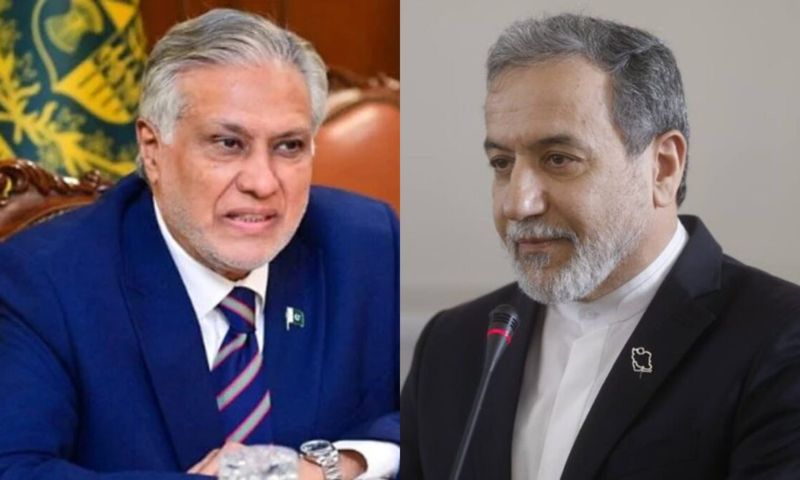
ISLAMABAD: Pakistan has intensified its mediation efforts to become a bridge between Iran and the US, with escalating war in the Middle East. A telephone call between Pakistan’s foreign minister and his Iranian counterpart resulted in agreement on close and continuous contact.
Islamabad geared up its diplomatic endeavour to contain the rising regional conflict.
Pakistan’s Deputy Prime Minister and Foreign Minister Ishaq Dar held a telephonic conversation with Iran’s Foreign Minister Abbas Araghchi on Sunday.
The two sides reviewed the fast-evolving situation and committed to remaining in close coordination in the wake of ongoing developments as the war between Iran and the US-Israel alliance is escalating fast.
Deputy Prime Minister / Foreign Minister Senator Mohammad Ishaq Dar @MIshaqDar50 spoke tonight with Foreign Minister Abbas Araghchi @Araghchi.
They exchanged views on the evolving regional situation.
DPM/FM reiterated Pakistan’s support for all efforts aimed at de-escalation… pic.twitter.com/PvLp2tpDM0
— Ministry of Foreign Affairs – Pakistan (@ForeignOfficePk) April 4, 2026
According to a statement issued by the Ministry of Foreign Affairs, the two leaders exchanged views on the current regional environment, with Islamabad reiterating its support for all efforts aimed at de-escalation and peaceful resolution of the conflict.
“Dialogue and diplomacy remain the only viable path forward,” the statement quoted him as saying during the telephonic counterpart.
Continued escalation could destabilise an already volatile region and carry far-reaching consequences beyond the immediate area of conflict, it added.
The latest engagement reflects Islamabad’s growing diplomatic efforts to position itself as a mediator between Iran and the US, while the war has intensified.
The war is still escalating in its fifth month now, and has already raised concerns of a broader regional confrontation.
Pakistan has maintained active contact with multiple regional capitals in recent days, advocating restraint and encouraging negotiated solutions and has also offered to host a dialogue between the warring parties in addition to mediation.
Officials familiar with the exchange said both sides acknowledged the gravity of the situation and the risks of further escalation, particularly as the conflict continues to expand in scope.
The agreement to maintain close contact is being viewed as a critical step for sustained communication between Islamabad and Tehran.
A close contact becomes vital between two countries when one is at war, and the other is trying to mediate.
Analysts say Pakistan’s ability to engage across different sides of the conflict places it in a position to facilitate dialogue, even as the situation remains fluid and unpredictable.
Islamabad’s outreach is consistent with its broader foreign policy approach, which emphasises balanced engagement and peaceful conflict resolution.
With tensions showing no immediate signs of easing, diplomatic coordination is expected to intensify further, with Pakistan likely to continue its mediation efforts in coordination with regional and international stakeholders.
The evolving crisis has heightened global concern, with fears that any further escalation could trigger wider instability across the Middle East and beyond, making diplomatic interventions increasingly urgent.