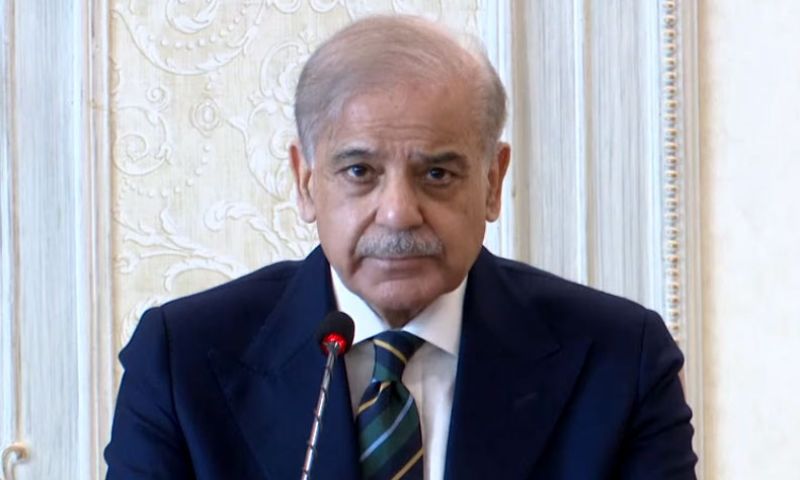
ISLAMABAD: Pakistan’s Prime Minister Shehbaz Sharif said on Thursday that Islamabad was making sustained diplomatic efforts at various levels to ease the Middle East conflict.
Addressing a high-level meeting in Islamabad on the regional situation, PM Sharif said Pakistan was engaging all sides to promote de-escalation.
“The flames of war in the region have not yet been extinguished; however, as a friend to all parties, Pakistan has been working tirelessly to ease tensions, engaging in talks and diplomatic efforts at various levels,” he said.
The meeting was attended by Pakistan’s Chief of Defence Forces and Chief of Army Staff Field Marshal Syed Asim Munir, Deputy Prime Minister and Foreign Minister Ishaq Dar, members of the federal cabinet, and Chairman Pakistan Peoples’ Party Bilawal Bhutto Zardari.
Chief ministers of all four provinces and Gilgit-Baltistan and Prime Minister of Azad Jammu and Kashmir, also attended the meeting.
Prime Minister Sharif expressed deep sorrow over the human cost of the conflict, noting that it had entered its second month and caused significant casualties.
“We mourn the loss of lives due to this ongoing conflict, and on many occasions, we have issued condolences over the deaths,” he said.
“جیسا کہ آپ جانتے ہیں کہ خطے میں جنگ اب دوسرے مہینے میں داخل ہو چکی ہے اور جو شہادتیں ہوئی ہیں، ہمیں اس پر بے حد افسوس ہے۔ اس حوالے سے ہم نے مختلف اوقات میں تعزیتی پیغامات بھی جاری کیے۔ خطے میں جنگ کے شعلے ٹھنڈے کرنے کے لیے ہم نے ایک مخلص دوست اور برادر ملک کے طور پر بھرپور کوشش… pic.twitter.com/fMm2JTi8N8
— Government of Pakistan (@GovtofPakistan) April 2, 2026
Pakistan’s diplomatic outreach
Prime Minister Sharif acknowledged the diplomatic efforts led by Deputy PM Ishaq Dar, who recently returned from China following talks with Chinese Foreign Minister aimed at de-escalating regional tensions.
He also commended Field Marshal Munir for his role in promoting regional peace.
“Due to their great efforts, two of our ships that were stuck in the Strait of Hormuz were able to pass through. Recently, another 20 ships have successfully crossed,” PM Sharif said, referring to developments in the Strait of Hormuz.
Pakistan has stepped up diplomatic engagement in recent weeks, positioning itself as a potential intermediary in efforts to reduce tensions and promote dialogue in the region.
Pakistan-China joint peace place
Earlier, Pakistan’s Foreign Office spokesperson Tahir Andrabi said that a joint five-point peace initiative by Pakistan and China has received broad appreciation from across the region and beyond, with even US leadership acknowledging ongoing diplomatic efforts.
The plan is being seen as part of a wider, coordinated push for de-escalation, with officials noting strong alignment between proposals discussed in Beijing and outcomes of recent consultations held in Islamabad involving Pakistan, Saudi Arabia, Turkey, and Egypt.
“The five points have received appreciation from across the region and beyond, —- there were statements from the U.S. leadership about appreciation of diplomatic efforts.” Foreign Office spokesperson Tahir Andrabi said in a weekly press briefing in Islamabad.
The initiative reflects a broader effort to end the war, secure a cessation of hostilities, and create a sustainable pathway towards a lasting resolution of the conflict.
Andrabi said the five-point plan provides a structured framework for reducing tensions and advancing diplomatic solutions.
He said there are strong similarities across the different frameworks, adding that the initiatives — whether in Urumqi, Beijing, or Islamabad — have all been widely welcomed.
🔴LIVE: Spokesperson’s Weekly Press Briefing 02-04-2026 at Ministry of Foreign Affairs, Islamabad https://t.co/2CIL4Nphhm
— Ministry of Foreign Affairs – Pakistan (@ForeignOfficePk) April 2, 2026
He said the plan centres on an immediate ceasefire, measures to contain the conflict, and ensuring humanitarian aid reaches those affected.
He said the plan calls for an immediate ceasefire, efforts to prevent the conflict from spreading, and unhindered humanitarian assistance for affected populations.
The initiative also stresses the protection of civilians and non-military infrastructure, alongside adherence to international humanitarian law.
Andrabi said the plan emphasises safeguarding civilian and non-military targets, strict adherence to international humanitarian law, and reaffirming the primacy of the UN Charter.
Maritime security, particularly in the Strait of Hormuz, forms a key component of the proposal, given its importance to global energy supplies.
Economic impact and relief measures
Prime Minister Sharif warned that the conflict was having serious implications for Pakistan’s economy, despite recent signs of stabilisation.
“Like other countries, Pakistan is also facing severe challenges, but the government remains committed to addressing these issues,” he said.
He added that the government had introduced financial support measures to cushion the impact.
“Through collective efforts, we’ve provided a blanket cover of Rs139 billion to support our economy, ensuring the most essential sectors remain functional.”
The prime minister said the government had passed on limited petroleum price adjustments to the public, amounting to Rs55, while providing relief worth Rs129 billion by diverting development funds of Rs100 billion.
He also pointed to the austerity measures adopted to protect the public from further economic strain.
“پاکستان باقی ممالک کی طرح اس جنگ سے بہت متاثر ہو رہا ہے۔ ہماری معیشت کے لیے پچھلے دو سال میں آپ سب نے مل کر بے پناہ کاوشیں کی اور پاکستان کی معیشت کو میکرو لیول پر مستحکم کیا۔ اب اس وقت ترقی اور خوشحالی کا وقت آ چکا ہے، لیکن بدقسمتی سے جنگ کے نتیجے میں ہمیں معاشی طور پر بے پناہ… pic.twitter.com/eFPzly0IrF
— Government of Pakistan (@GovtofPakistan) April 2, 2026
Focus on vulnerable sectors
PM Sharif stressed the need to protect vulnerable segments of society, particularly those linked to agriculture and public transport.
“Today, it is our responsibility to ensure the safety of the poor and to protect agriculture and public transport,” he said, adding that additional funding would be required.
He called on all sectors, including the elite, to demonstrate self-sacrifice and support national efforts during the crisis.
Call for joint strategy
The prime minister emphasised the importance of a coordinated national response, urging stakeholders to adopt a joint strategy to mitigate the war’s impact.
He said the federal government had remained in close contact with provincial administrations, keeping them informed and engaged in decision-making.
PM Sharif also commended Bilawal Bhutto Zardari for his contributions during the crisis, describing his role as demonstrating clear leadership.
He thanked provincial chief ministers and other stakeholders for their cooperation in implementing austerity and relief measures.
“Joint efforts are essential to protect the weaker segments of society,” Sharif said, adding that austerity and conservation measures must be implemented “in letter and spirit”.